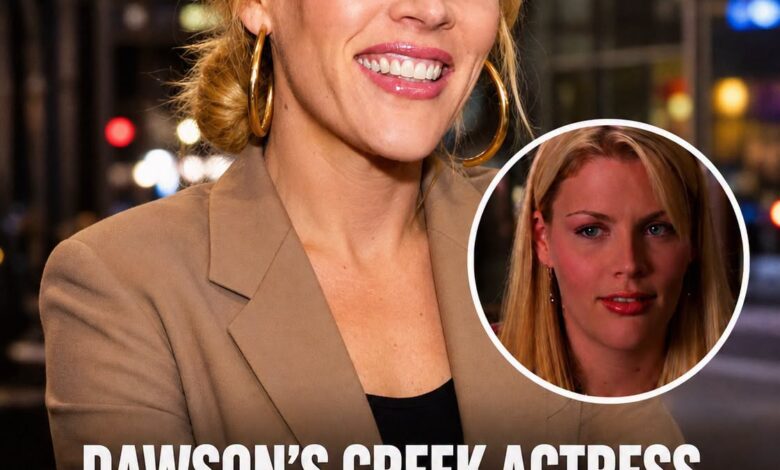
Busy Philipps wasn’t sick.
She wasn’t suffering from crushing headaches. She hadn’t experienced seizures, unexplained weakness, or some dramatic neurological episode that sent her racing to an emergency room.
As far as she knew, there was no reason to believe anything dangerous was growing inside her brain.
Then she saw an Instagram post.
It was the kind of ordinary moment most people would scroll past and forget within minutes. Someone mentioned a Prenuvo full-body scan, and Philipps became curious.
That curiosity would divide her life into two parts:
Before the scan.
And after it.
Philipps booked the imaging despite feeling well. She expected, at most, reassurance or perhaps some minor health issue to discuss with a doctor.
Instead, the scan detected something in her brain.
Suddenly, an elective appointment that had begun almost casually became terrifyingly serious.
More testing followed.
Then came the words nobody expects to hear while going about an otherwise normal life.
There was a tumor.
A grade 2 oligodendroglioma.
Philipps would later recall the frightening clarity with which a doctor explained the situation.
“It’s a real tumor, and it’s got to come out.”
There are sentences that don’t simply deliver information.
They change the architecture of your life.
One moment, Philipps was thinking about work, parenting, schedules, messages and all the ordinary responsibilities that make up a busy day.
The next, she was thinking about survival.
About brain surgery.
About her children.
And perhaps most painfully, about everything she might not be there to see.
Her daughter Birdie became the thought she grabbed onto when fear threatened to overwhelm everything else.
Philipps could imagine missing future milestones, and that possibility was unbearable.
Graduation.
Adulthood.
The countless ordinary days between them.
She did not want Birdie’s story to become the story of a child whose mother died before she had the chance to watch her grow up.
So Philipps made herself a promise.
She was going to be there.
Of course, promises don’t control tumors.
Determination cannot replace surgery.
And positive thinking does not guarantee survival.
But when so much suddenly becomes uncontrollable, sometimes a promise gives fear somewhere to go.
For Philipps, the next step was clear.
The tumor had to be removed.
What followed was a five-hour operation on the organ that contains nearly everything we understand as ourselves—memory, speech, personality, movement, thought.
Brain surgery is frightening even as an abstract concept.
It becomes something else entirely when you’re the person being wheeled toward the operating room.
The woman known publicly for being funny, candid and energetic was suddenly forced into a role no performance could prepare her for: patient.
There was nothing glamorous about it.
No clever line could remove the risk.
She had to surrender control to a surgical team and trust that when she opened her eyes again, she would still recognize the life waiting for her.
The surgery was completed.
But recovery did not unfold as a clean Hollywood sequence in which the frightening operation ends and triumphant music begins.
There were complications.
The possibility of infection became another source of fear.
Her body had endured enormous trauma, and healing demanded more patience than Philipps was naturally inclined to give it.
Like many people accustomed to working constantly, she wanted normality back immediately.
Work offered one version of it.
Schedules.
Sets.
Responsibilities.
Places where people expected Busy Philipps to be Busy Philipps rather than a woman recovering from brain surgery.
So she returned.
Too quickly, she would later recognize.
There is a peculiar pressure surrounding recovery, particularly for people whose identities are tied to productivity.
Surviving the crisis can create an urge to prove that the crisis didn’t change you.
Look, I’m fine.
I’m working.
I’m moving.
I’m still myself.
But the body does not care about performance.
It knows what happened.
Philipps eventually had to acknowledge that recovery wasn’t an obstacle standing between her and normal life.
Recovery was her life for that moment.
And gradually, something unexpected began replacing the initial terror.
Gratitude.
Not simplistic gratitude.
Not the kind that pretends a brain tumor is somehow a gift.
She was grateful because information had arrived before symptoms forced it to.
She was grateful that the scan had revealed something she hadn’t known was there.
Grateful for medical professionals who recognized what required attention.
Grateful for the dermatologist whose observations became part of the larger chain of care.
Grateful for surgeons who could do something about a problem that would once have been far more difficult to detect and treat.
Most of all, she was grateful to still be present.
That gratitude fundamentally changed how she described what happened.
It would be understandable for someone in her position to feel cursed by the discovery.
Why me?
Why this?
Why now?
Philipps found herself moving toward another word.
Lucky.
It sounds almost absurd at first.
How could somebody diagnosed with a brain tumor call herself lucky?
Because the tumor was already there.
The scan didn’t create it.
Knowing about it didn’t make her sick.
Information simply revealed the reality that had been developing silently inside her.
That distinction became crucial.
Before the scan, Philipps felt healthy.
But feeling healthy and having no underlying disease are not always the same thing.
Her experience became a dramatic reminder of that uncertainty.
At the same time, her story is not a prescription that everyone should immediately seek expensive full-body imaging.
Broad screening in people without symptoms can uncover incidental findings that are harmless, ambiguous, or lead to additional tests and procedures. Whether any particular screening test makes sense depends on individual circumstances and medical guidance.
Philipps’ experience is her experience.
What it changed most profoundly was her relationship with information.
Fear can make people avoid doctors.
A strange lump gets ignored.
An appointment is postponed.
A screening gets pushed into next year.
A symptom is rationalized because discovering the explanation feels more frightening than continuing not to know.
Philipps now understands the other side of that equation intimately.
Sometimes knowing is frightening.
But sometimes knowing creates options.
Her diagnosis did exactly that.
The tumor had been quietly present without asking permission and without announcing itself dramatically.
Finding it allowed doctors to act.
That action gave Philipps something she desperately wanted after hearing the diagnosis.
A chance.
A chance to heal.
A chance to return to work when her body was actually ready.
A chance to watch Birdie grow.
A chance to experience all the ordinary moments that suddenly looked extraordinary when she imagined losing them.
That may be one of the strangest effects of serious illness.
Beforeward, the future feels almost automatic.
Graduations will happen.
Birthdays will arrive.
There will be another summer.
Another Christmas.
Another morning complaining about traffic or unfinished laundry.
We behave as though time has signed a contract with us.
Then a doctor says a few words, and suddenly the future stops feeling guaranteed.
Ordinary life becomes precious precisely because it is ordinary.
Philipps emerged from surgery carrying that knowledge.
She was still herself.
Still a mother.
Still an actor.
Still funny.
Still impatient.
Still ambitious.
But something fundamental had shifted.
Her body was no longer background scenery.
She had learned what could exist silently inside it.
And instead of allowing that realization to turn every future sensation into terror, she tried to transform it into attentiveness.
There is a difference between fear and awareness.
Fear says catastrophe is everywhere.
Awareness says pay attention.
Fear can paralyze.
Information can sometimes provide choices.
That is the message Philipps appears most determined to carry forward.
Not that everyone has a hidden tumor.
Not that every unusual sensation means cancer.
Not that one particular scan is the answer for every person.
But that avoiding medical information simply because the possibilities are frightening does not make those possibilities disappear.
She knows that because hers didn’t disappear.
It was there while she worked.
There while she parented.
There while she laughed.
There while she felt perfectly normal.
Then an Instagram post triggered a moment of curiosity.
Curiosity became an appointment.
The appointment became an image.
The image became a diagnosis.
The diagnosis became five hours of surgery.
And surgery became a second chance to reconsider what being “lucky” actually means.
Lucky does not always mean nothing bad happened.
Sometimes something terrifying happens and luck is finding it when there is still something you can do.
For Busy Philipps, that difference now carries the weight of everything she hopes comes next.
More work.
More laughter.
More mistakes.
More birthdays.
More ordinary mornings.
And Birdie’s graduation.
Especially that.
When Philipps made herself that promise, she couldn’t know exactly what the future would hold.
None of us can.
But she knew what she wanted.
To be there.
After everything—the unexpected scan, the terrifying diagnosis, the operation and the difficult recovery—being there no longer sounds ordinary.
It sounds enormous.
Philipps didn’t choose the tumor.
She didn’t choose the fear that followed its discovery.
What she can choose is what she does with the knowledge that came afterward.
For now, she chooses gratitude over dread.
She chooses attention over avoidance.
And when she looks at the strange chain of events that began with something as forgettable as scrolling through Instagram, she sees not only the moment her life was interrupted.
She sees the moment it may have been saved.