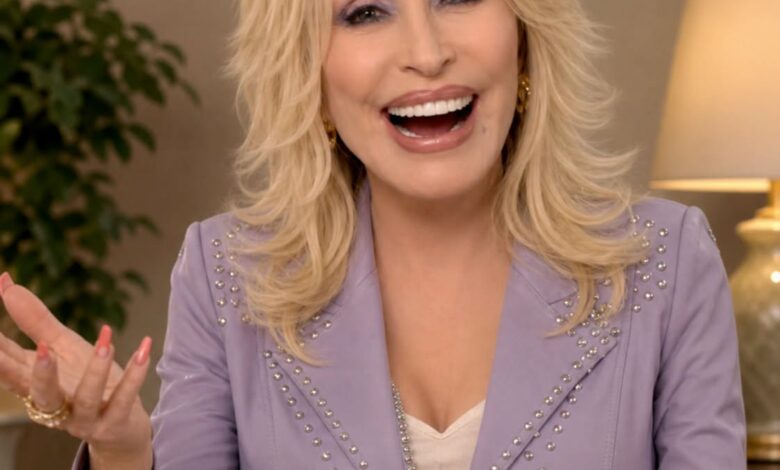
Two weeks before the end, Dolly Parton appeared in gold.
There was no hospital bed in sight. No visible fear. No solemn announcement warning fans that time was running out.
There was simply Dolly.
Blonde hair perfectly arranged. Makeup immaculate. Gold shimmering beneath the lights. That unmistakable voice carrying the same warmth people had heard for decades.
She was promoting something called “My Life of Many Colors,” a museum experience devoted to the extraordinary road she had traveled.
At the time, it looked like another project.
Now, it feels like a goodbye.
Dolly spoke about her journey in the language she had always understood best: transformation.
“From rags to rhinestones.”
Few phrases could summarize her life more perfectly.
She had begun as a little girl in the mountains of East Tennessee, one of twelve children in a family where money was scarce but stories, music, faith, and imagination were abundant.
She had spent a lifetime turning those beginnings into art.
Poverty became “Coat of Many Colors.”
Heartbreak became “Jolene.”
A painful professional farewell became “I Will Always Love You.”
Frustration with working life became “9 to 5.”
Again and again, Dolly took something difficult and dressed it in melody until millions of people could carry it with them.
Now she was inviting fans into a museum built around that transformation.
Her costumes.
Her memories.
Her struggles.
Her victories.
The artifacts of a life that seemed too energetic to become history.
Nobody watching could know how quickly everything would change.
Within weeks, Dolly would be hospitalized in Nashville.
According to the account shared after her death, she was admitted on a Friday while privately battling cancer.
By Tuesday, she was gone.
The speed of that final decline made the news almost impossible for admirers to process.
Dolly Parton had always seemed unusually permanent.
Not young, exactly.
Permanent.
She belonged to that rare category of entertainers who appeared to have existed forever and somehow seemed destined to continue doing so.
Generations knew her differently.
Some remembered the young songwriter working alongside Porter Wagoner.
Others remembered the movie star of “9 to 5.”
Some knew the Dollywood entrepreneur.
Some knew the woman whose song Whitney Houston transformed into one of the most famous recordings in history.
And millions of children knew her for something completely different.
Books.
To them, Dolly wasn’t necessarily the country legend in rhinestones.
She was the Book Lady.
That made the idea of her suddenly disappearing difficult to absorb.
There had always been another project.
Another song.
Another collaboration.
Another business idea.
Another joke.
Another announcement.
Even as she grew older, Dolly spoke in the future tense.
She was still creating.
Still planning.
Still imagining.
That is why the Instagram reel feels so different now.
Watch something shortly before a person dies and every gesture changes meaning.
A smile becomes poignant.
An ordinary sentence sounds prophetic.
A promotional message begins resembling a farewell even if it was never intended as one.
Dolly’s invitation to explore the story of her life now carries precisely that emotional weight.
She was telling people where she had been.
Showing them what she had built.
Inviting them to walk through the evidence.
Rags to rhinestones.
A phrase that once sounded playful suddenly feels almost like an epitaph.
But if Dolly understood the seriousness of her condition, she did not make that burden public.
That, too, was characteristic.
People sometimes confused Dolly’s openness with complete accessibility.
She was remarkably candid.
She joked about her appearance.
Discussed poverty.
Talked about heartbreak.
Shared stories about her marriage.
Turned embarrassing experiences into punch lines before anyone else could use them against her.
Yet beneath that openness was a surprisingly firm boundary.
Dolly decided what belonged to the public.
Everything else remained hers.
Her marriage to Carl Dean demonstrated that for nearly six decades.
Dolly became one of the most recognizable women alive.
Carl largely declined to participate in the spectacle.
He rarely appeared beside her publicly and seemed perfectly content allowing the world to wonder about him.
Dolly protected that privacy.
She understood something celebrity culture often refuses to accept:
Being loved by millions does not mean millions are entitled to everything.
Illness apparently remained within that protected territory.
Rather than turn her declining health into a public countdown, she continued communicating through the language she knew.
Work.
Memories.
Music.
Images.
Celebration.
Then came the final posts.
One looked backward toward Kenny Rogers, her longtime friend and collaborator.
Their voices had become permanently intertwined through “Islands in the Stream,” but the affection between them extended beyond a recording.
Seeing Dolly remember Kenny so close to her own final days now carries an unintended tenderness.
She had spent years watching people from her generation disappear.
Friends.
Collaborators.
Contemporaries.
Then Carl.
The loss of her husband changed the landscape of her private life in a way few outsiders could fully understand.
For decades, Carl had been the quiet home behind the public whirlwind.
She traveled.
He stayed close to Tennessee.
She walked red carpets.
He avoided them.
She belonged to crowds.
He represented the place where she did not have to perform for one.
When he was gone, Dolly faced a kind of silence that professional success could never fill.
Yet she kept moving.
That was what she had always done.
Work was not simply employment to Dolly Parton.
It was how she metabolized life.
Pain entered.
Something came out.
A lyric.
A joke.
A project.
A charitable idea.
A melody.
A museum.
She transformed emotion into motion.
Even near the end, she was still doing it.
Perhaps that explains why “My Life of Many Colors” feels so fitting as one of her final public projects.
Dolly had always rejected the idea that a person had to be only one thing.
She could be glamorous and deeply serious.
Religious and mischievous.
A brilliant businesswoman who made endless jokes about looking foolish.
A country singer who crossed effortlessly into pop culture.
A wealthy celebrity who never stopped talking about the poverty that formed her.
A woman without biological children who became associated with childhood literacy around the world.
Her life really did contain many colors.
Some dazzling.
Some dark.
Some known only to her.
The absence of children of her own had followed Dolly throughout her career, largely because people kept asking about it.
She sometimes wondered what motherhood might have looked like.
But over time, she came to understand her life differently.
Perhaps, she suggested, she had been meant to belong to many children rather than raise her own.
Her Imagination Library gave that idea physical form.
Books began arriving in children’s homes.
Then more books.
And more.
What began in Tennessee expanded until countless families associated Dolly’s name not merely with music, but with the experience of a child receiving a book addressed personally to them.
It was motherhood transformed into something that resisted ordinary definitions.
And Dolly had family all around her.
Brothers and sisters.
Nieces.
Nephews.
Godchildren.
Friends who became relatives through years of shared life.
Employees and collaborators who remained with her across decades.
Then there were the millions who had never met her but somehow felt they knew her.
That intimacy was one of Dolly’s strangest gifts.
She could perform before enormous crowds without seeming distant.
She spoke as though she had pulled up a chair beside you.
Her humor removed the pedestal before anybody could place her on it.
Her songs completed the illusion.
She wrote about wanting someone.
Losing someone.
Being jealous.
Being poor.
Working too hard.
Leaving when leaving hurt.
Loving somebody enough to let them go.
Those emotions require no backstage pass.
Everybody understands them.
That is how a woman from a tiny Tennessee community became something resembling extended family to strangers across the world.
So when hearts began flooding her final posts, people weren’t merely reacting to a celebrity death.
They were grieving memories attached to her.
A mother singing Dolly songs while cooking.
A grandmother watching her on television.
A road trip with “Jolene” playing too loudly.
A first viewing of “9 to 5.”
A wedding.
A breakup.
A funeral.
A childhood book arriving in the mail.
Dolly existed inside other people’s lives in ways she could never have known.
Perhaps that is why her final reel feels so haunting.
She was inviting everyone to come see her story.
To walk through the colors.
To look at where she started and where she ended up.
And then, almost impossibly soon afterward, the woman herself was no longer there to tell it.
But Dolly had spent decades preparing for that inevitability without necessarily calling it preparation.
She built things designed to outlive her.
Songs survive their singers.
Books survive their benefactors.
Institutions survive their founders.
Stories survive their storytellers.
Dollywood would still open.
Children would still receive books.
Young singers would still discover “Jolene.”
Couples would still slow-dance to songs Dolly wrote before they were born.
Some heartbroken person somewhere would still hear “I Will Always Love You” and realize that leaving somebody and loving them are not always opposites.
And visitors would walk into a museum called “My Life of Many Colors” and encounter a woman who had already understood that memory can be curated without being embalmed.
That may be the most Dolly thing about the ending.
She did not leave behind a monument painted gray.
She left color.
Gold.
Pink.
Sequins.
Butterflies.
Handwritten lyrics.
Mountain stories.
Photographs.
Music.
Laughter.
Her death might have happened quietly behind hospital walls, but she had spent eighty years making certain her life could never be quiet.
The final days were private.
The legacy is anything but.
Maybe Dolly knew exactly how serious things were when she stood before that camera in gold.
Maybe she believed she still had years ahead.
Only those closest to her could know what she understood in those moments.
It is tempting, after someone dies, to turn every final action into prophecy.
Real life is rarely that neat.
But we don’t need to pretend Dolly deliberately scripted every detail of her farewell to recognize the extraordinary symbolism of what remained.
One of her last public messages was about her life.
Where she came from.
What she survived.
What she created.
Rags to rhinestones.
Then the curtain fell.
Not on an empty stage, but on a world filled with things she had already left behind.
Dolly Parton had no biological children to carry her name forward.
She didn’t need them to preserve it.
Her family became larger than blood.
It lived in nieces and nephews, friends and collaborators, readers and dreamers, musicians and millions of strangers who claimed some tiny piece of her as their own.
Her final Instagram appearance now feels fragile because we know something the people watching it then did not.
Time was almost gone.
Yet Dolly wasn’t talking about dying.
She was talking about living.
About the distance between the cabin and the rhinestones.
About everything that happened in between.
Perhaps that is the farewell worth remembering.
Not a hospital room.
Not a diagnosis.
Not the final breath.
A woman dressed in gold, still telling her story.
Still inviting people inside.
Still sparkling.
And still, until almost the very end, choosing life as the last thing she wanted us to see.