Maxine Waters INSULTS John Kennedy With the Words “Sit Down, Boy” — And the Moment Instantly Changes the Entire Room

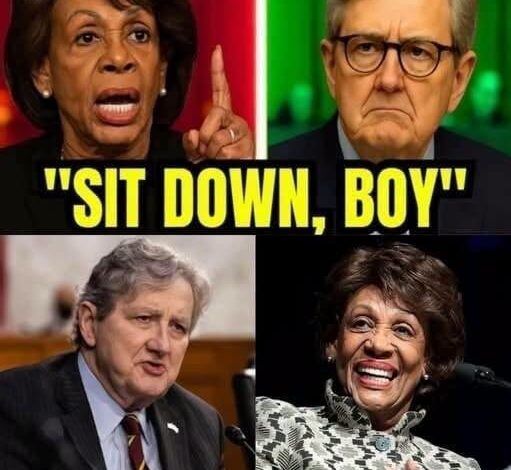
Everyone in the studio seemed to feel it before he said a word.
The conversation had already grown tense, the kind of political exchange where every sentence carries more weight than it should. Cameras were rolling. People were watching. The atmosphere had tightened into that familiar stillness that comes just before someone says something unforgettable.
Then Kennedy paused.
He did not raise his voice.
He did not lean into anger.
He did not answer insult with insult.
Instead, he let the silence do part of the work.
Across from him, Maxine Waters had delivered a sharp remark meant to cut him down and shift the tone of the exchange. It was the kind of line that often dominates political television: quick, personal, and designed to provoke a reaction.
But Kennedy did not give her the reaction she seemed to be reaching for.
That was what made the moment so striking.
In an era when public figures often treat outrage like a performance, Kennedy stayed almost unnervingly calm. His expression barely changed. His posture remained controlled. He did not scramble to defend himself or rush to strike back.
He simply waited.
And when he finally spoke, the room seemed to hold its breath.
His response was not long.
It did not need to be.
With a single measured sentence, he made it clear that Waters’ comment had fallen beneath the dignity of the office she holds and beneath the seriousness of the issues they had supposedly gathered to discuss.
There was no shouting.
No theatrical outrage.
No attempt to humiliate her with volume or spectacle.
That restraint made the words land harder.
The power of the moment came from the contrast. Waters’ remark had been designed to diminish him, but Kennedy’s composure shifted the focus away from the insult and back onto the behavior itself. He refused to let the exchange become a contest of who could be louder, crueler, or more dramatic.
Instead, he framed it as something larger.
A question of seriousness.
A question of standards.
A question of whether public officials could still debate urgent national issues without sinking into personal attacks.
For those watching in the studio, the effect was immediate.
The room did not erupt.
It quieted.
That kind of silence is rare in political confrontations.
Usually, insults produce noise. Supporters cheer. Opponents object. Commentators rush to interpret the moment before it has even finished unfolding.
But this was different.
Kennedy had taken a remark meant to unsettle him and turned it into a display of discipline.
That is why the clip began spreading so quickly online.
People were not merely sharing another heated political argument. They were sharing a moment that seemed to interrupt the usual pattern.
In most modern political exchanges, escalation is expected.
One jab leads to another.
A personal attack becomes a louder counterattack.
The conversation stops being about policy, principle, or public responsibility and becomes a contest of ego.
Kennedy declined that contest.
And by refusing to descend to the same level, he changed the meaning of the exchange.
His calmness became the story.
For supporters, the moment showed strength under pressure. They saw a public figure unwilling to be baited, someone capable of calling out disrespect without losing control. To them, his response demonstrated that restraint can be more forceful than anger.
Even some viewers who disagreed with him politically found the exchange notable for its tone.
Because there is something powerful about watching someone remain composed when provoked.
It creates a different kind of authority.
Not the authority of volume.
Not the authority of dominance.
But the authority of self-command.
That kind of control is increasingly rare in a political culture built around instant reaction.
Outrage travels fast.
Insults clip easily.
A raised voice can become a headline within minutes.
Social media rewards the most dramatic version of every conflict, and political figures know it. Many have learned to perform anger because anger draws attention.
But attention is not the same as persuasion.
And noise is not the same as strength.
That was the larger lesson embedded in Kennedy’s response.
He did not need to overpower the moment.
He needed only to remain steady inside it.
The insult came and passed.
His composure remained.
That is why Waters’ remark appeared to backfire. It was meant to make him look smaller, but his response made the attack itself seem small. He did not have to tear her down to make that clear.
He simply refused to be pulled into the tone she had set.
In politics, that refusal can be more damaging than any comeback.
Because when one person throws a personal jab and the other responds with restraint, the imbalance becomes visible. Viewers can see who is trying to provoke and who is trying to stay grounded.
That visibility matters.
It reminds people that public debate does not have to be a shouting match.
It does not have to reward the harshest line or the most viral insult.
Sometimes the strongest response is the one that restores seriousness to a conversation that is drifting away from it.
Kennedy’s reply worked because it did not sound rehearsed for applause.
It sounded controlled.
Intentional.
Firm.
He drew a boundary without turning the exchange into theater.
And in doing so, he gave the moment a kind of weight that louder reactions often fail to achieve.
The clip continued circulating because it touched a nerve.
Many viewers are exhausted by political exchanges that feel more like performances than discussions. They are tired of debates where personal attacks replace substance and where every disagreement becomes a test of tribal loyalty.
Kennedy’s response offered something different, if only briefly.
A reminder that restraint is not weakness.
That calm can be confrontational.
That dignity can be sharper than anger.
And that sometimes the most devastating answer is the one delivered without losing control.
In the end, the exchange was not remembered because of the insult.
It was remembered because of the refusal to mirror it.
A tense studio.
A pointed remark.
A moment of silence.
Then one sentence that changed the temperature of the room.
Waters had tried to knock him off balance.
Instead, Kennedy stood still.
And that stillness said more than anger ever could.