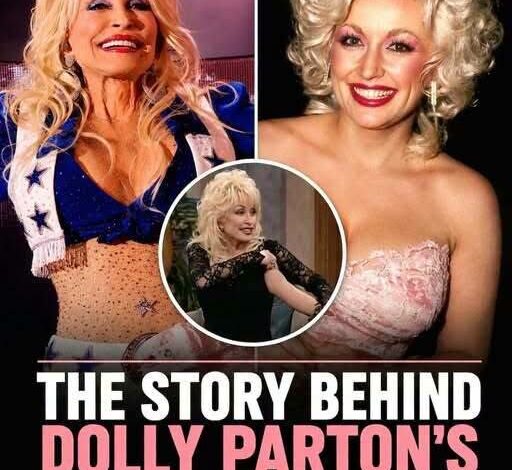
For decades, Dolly Parton kept her arms covered so consistently that people became convinced there had to be a secret underneath.
They were right.
But the truth was far more personal than the rumors.
Beneath the rhinestones, lace, gloves, and long sleeves were small tattoos—delicate butterflies, flowers, ribbons, and other soft designs that Dolly rarely allowed the public to see. They weren’t sprawling pieces of body art or rebellious statements hidden from disapproving eyes.
For Dolly, some of that ink had another purpose.
It helped her make peace with scars.
Dolly had explained that her skin had a tendency to develop keloid scarring. When injured or affected by medical procedures, some areas could heal with raised, discolored marks.
She didn’t like how certain scars looked.
So, in typically Dolly fashion, she decided to make them prettier.
Instead of allowing an unwanted mark to have the final word, she sometimes placed something beautiful over or around it.
A flower.
A butterfly.
A bow.
Pastel colors rather than heavy black ink.
It was an extraordinarily fitting choice for a woman who spent much of her life transforming things.
Poverty became songs.
Heartbreak became anthems.
Rejection became determination.
And some scars became art.
Still, Dolly never considered herself heavily tattooed.
Whenever the subject came up, she tended to approach it with humor, gently deflating the wild stories that had grown around her body.
People imagined entire sleeves hidden underneath her clothes.
Some rumors suggested she was secretly covered in tattoos.
The reality, according to Dolly, was considerably less dramatic.
She had a few.
They were tasteful.
They were personal.
And most weren’t intended for public inspection.
That last part mattered.
Because despite being one of the most recognizable women in entertainment, Dolly understood the value of keeping something for herself.
Her entire public image was built around a fascinating contradiction.
She appeared to reveal everything.
She talked openly about growing up poor in Tennessee.
She discussed ambition, marriage, heartbreak, faith, cosmetic procedures, songwriting, business, and the exaggerated appearance she had deliberately constructed.
She could make an interviewer feel as though they were sitting at the kitchen table with an old friend.
Yet Dolly maintained remarkably firm boundaries.
She knew the difference between openness and access.
The audience could have her stories.
That didn’t mean they automatically owned every detail of her body.
Her marriage to Carl Dean demonstrated the same philosophy.
Dolly lived under enormous public attention while Carl largely remained outside it. Their relationship survived for decades partly because she protected the private world they shared.
The public knew Dolly Parton.
Carl knew Dolly.
There was a difference.
Her tattoos occupied that same protected territory.
Some could occasionally be glimpsed. Others remained concealed. Dolly offered hints without ever providing the public with a complete inventory.
Naturally, that only increased people’s curiosity.
Why all the long sleeves?
Why the gloves?
What was underneath?
Celebrity culture tends to interpret privacy as evidence of scandal. If somebody consistently conceals something, people assume whatever is hidden must be extraordinary.
But sometimes privacy is simply privacy.
Dolly’s explanation was much more human.
Her body had accumulated marks.
She preferred to cover some of them.
And tattoos offered one way of transforming what she didn’t enjoy seeing into images she did.
There is something quietly powerful about that.
Scars can carry memories whether we want them to or not.
A surgical scar can recall a frightening diagnosis.
A medical procedure can leave evidence long after the crisis itself has passed.
An injury can remain visible years after the pain disappears.
The body keeps records.
Dolly couldn’t always choose what marks life placed on her.
She could choose what she did with them afterward.
That philosophy appears throughout her story.
She never denied the poverty of her childhood.
She transformed it.
The one-room cabin and patched clothing weren’t erased when she became wealthy. They became part of the mythology she willingly carried forward.
Her famous “Coat of Many Colors” took something that could have represented embarrassment and turned it into a story about a mother’s love.
The same instinct existed in her songwriting.
Pain wasn’t something Dolly necessarily tried to conceal.
She reshaped it until it could become useful.
A broken heart became a lyric.
Loneliness became harmony.
Fear became humor.
Perhaps that helps explain why butterflies were such an appropriate motif for her.
Few symbols could have suited Dolly Parton better.
A butterfly represents transformation without pretending the earlier form never existed.
It doesn’t erase what came before.
It becomes something else.
Dolly understood that process intimately.
Her public appearance itself was an act of transformation.
The towering blond hair wasn’t accidental.
Neither were the enormous eyelashes, sparkling costumes, high heels, or elaborate nails.
Dolly took elements that other people might have dismissed as excessive and amplified them until they became unmistakably hers.
She wasn’t trying to disappear into conventional ideas of elegance.
She created her own.
That makes the subtlety of her tattoos particularly interesting.
The woman famous for visual excess chose surprisingly gentle body art.
Soft colors.
Small designs.
Flowers.
Butterflies.
Images that didn’t demand attention.
They weren’t really for the audience.
They were for the person underneath the costume.
And that person was always more complicated than the caricature.
Behind the jokes was a highly disciplined songwriter.
Behind the glamorous image was a formidable businesswoman.
Behind the apparent openness was someone intensely protective of certain relationships and experiences.
And beneath some of those famous sleeves was physical evidence that even Dolly Parton’s body had endured things she couldn’t simply smile away.
That vulnerability doesn’t diminish the image.
It deepens it.
Dolly’s glamour was never convincing because people believed she naturally woke up looking like Dolly Parton.
Everybody knew it was constructed.
She knew they knew.
That was part of the fun.
The magic came from watching someone deliberately create joy, beauty, and spectacle despite knowing life itself was rarely so polished.
The tattoos belonged to that same instinct.
If there was an unwanted scar, perhaps a flower could grow across it.
If there was a mark associated with pain, perhaps a butterfly could change what she saw when she looked at it.
Not erase it.
Transform it.
There is an important difference.
Dolly never needed to pretend difficult things hadn’t happened in order to move beyond them.
That may be one reason her music connected with so many people.
She didn’t promise a painless life.
She sang from inside the mess.
She understood betrayal.
Poverty.
Longing.
Ambition.
Sacrifice.
Growing older.
Losing people.
Wanting something you couldn’t have.
Yet somehow, the sadness rarely became the entire story.
There was usually another ingredient.
Humor.
Faith.
Defiance.
Hope.
A melody beautiful enough to carry the weight.
The same could be said of those hidden tattoos.
The scar remained underneath.
But something beautiful had been added.
And despite decades of curiosity, Dolly never gave the world a complete tour.
There was no definitive public map explaining every tattoo, every location, every scar, and every story behind it.
That feels appropriate.
Modern celebrity culture encourages the idea that famous people owe audiences complete access.
Every room photographed.
Every relationship explained.
Every medical struggle disclosed.
Every secret eventually converted into content.
Dolly managed to spend decades at the highest levels of fame without entirely surrendering to that bargain.
She gave enormously.
She gave songs that became part of people’s lives.
She gave performances.
She gave laughter.
She gave money and time to causes she believed in.
Through the Imagination Library, she helped place books into the hands of children she would never meet.
But generosity does not require giving away every piece of yourself.
Dolly understood that.
Some things remained hers.
Her tattoos were among them.
And perhaps that is why the mystery shouldn’t really be “What was Dolly hiding?”
A better question is what those hidden designs represented.
They represented ownership.
Her body had changed.
Life had marked it.
Medicine had marked it.
Time had marked it.
And Dolly decided she was allowed to respond creatively.
She could cover a scar with a butterfly simply because seeing the butterfly made her happier.
There didn’t need to be a darker explanation.
There didn’t need to be a scandal underneath the sleeve.
There only needed to be a woman looking at something painful and deciding it wasn’t finished yet.
That’s what Dolly had been doing all along.
Give her poverty, and she’d write a song.
Give her heartbreak, and she’d find a chorus.
Give her ridicule, and she’d make the better joke.
Give her a scar, and she might put a butterfly over it.
That may be the most Dolly Parton response imaginable.
The world saw the rhinestones, wigs, impossible heels, and carefully constructed glamour.
Underneath were scars.
And over some of those scars, there was color.
Not because pain had never happened.
Because pain didn’t get to decide what the finished picture looked like.
Even now, some of those designs remain private, their exact locations and meanings known only as far as Dolly chose to reveal them.
Maybe they should stay that way.
After giving so much of herself to millions of strangers, she was entitled to leave a few doors closed.
Some stories belonged on records.
Some belonged beneath stage lights.
Some belonged only to the people she loved.
And some, perhaps, were meant to remain exactly where Dolly kept them all those years—
quietly hidden beneath the sleeves.