Some losses are too personal to turn into a public statement, even when the person you are mourning belonged, in some way, to the entire world.
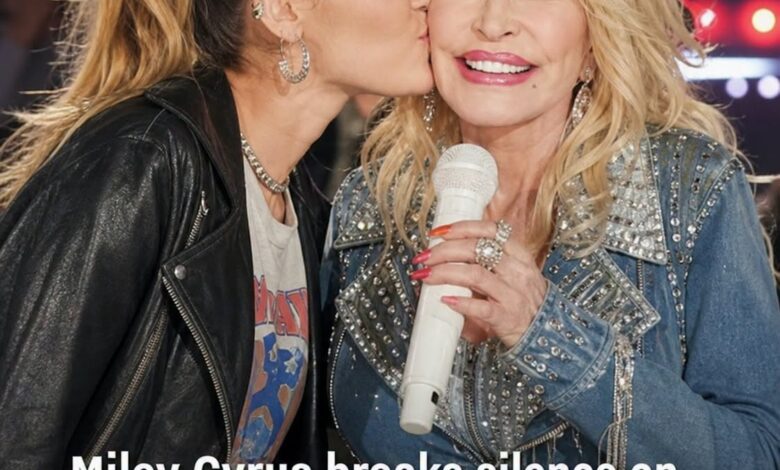
That was the impossible position Miley Cyrus found herself in as she tried to put her grief for Dolly Parton into words.
To millions, Dolly was a country music legend, a songwriter, actress, philanthropist, and cultural icon. To Miley, she was something far more intimate.
She was Aunt Dolly.
She was family.
And in Miley’s tribute, that distinction matters.
Rather than offering a polished summary of Dolly’s achievements, Miley wrote from the place where public history ends and private memory begins. She acknowledged that some of what they shared simply could not—and would not—be handed over to strangers.
There were conversations behind the stage.
Quiet words exchanged before the lights came up.
Looks that needed no explanation.
Advice given when cameras weren’t recording.
Those memories, Miley suggested, belonged somewhere “behind the stage, beneath the glamour & between our hearts.”
It was a striking boundary to draw for someone whose life has unfolded so publicly.
Miley grew up in front of cameras. Audiences watched her transform from a child star into one of the most recognizable performers of her generation. Her successes became headlines. Her mistakes became headlines. Her relationships, reinventions, controversies, and heartbreaks were dissected by millions of people who had never met her.
Dolly understood that world better than most.
She also understood how dangerous it could be to let the world consume every part of you.
Long before Miley became famous in her own right, Dolly occupied a unique place in her life. She wasn’t simply an industry veteran offering occasional career advice. As Miley’s godmother, she represented continuity—a trusted voice connecting family, music, ambition, and identity.
Their relationship eventually became visible to the public through performances and interviews, but what audiences saw was only the surface.
Onstage, their chemistry appeared effortless.
There was humor between them, but also admiration. Miley could stand beside one of music’s most celebrated figures without appearing intimidated, perhaps because Dolly had never made her feel like she was standing beside a monument.
She was standing beside Aunt Dolly.
That familiarity made their musical moments special.
It also makes the loss different.
When a famous person dies, the public often mourns through the work.
People replay songs.
They watch old interviews.
They share photographs.
They quote favorite lyrics.
But relatives and close friends grieve the things nobody else knew existed.
A particular laugh.
A nickname.
The way someone entered a room.
A phone call after a terrible day.
The sentence they always used when you were afraid.
The expression on their face seconds before stepping onto a stage.
Those are the fragments Miley seems determined to protect.
And perhaps that protection is one of the greatest honors she could offer Dolly.
Because Dolly herself understood privacy.
For all her flamboyance, she carefully guarded parts of her personal life. She could walk onto a stage covered in rhinestones and tell thousands of people stories about herself while still keeping certain doors firmly closed.
Miley appears to understand the difference.
She can tell the world what Dolly meant to her without giving the world everything Dolly gave her.
Still, one lesson was too important not to share.
When pain comes, use it.
Feel it.
Don’t pretend it isn’t there.
Then transform it.
That philosophy sits at the center of both women’s careers.
Dolly spent decades turning experiences that could have hardened her into songs filled with tenderness, humor, longing, and resilience. Poverty became storytelling. Rejection became melody. Heartbreak became something millions of strangers could sing along with.
She didn’t deny pain.
She gave it somewhere to go.
Miley learned the same instinct.
Her own career has repeatedly been shaped by reinvention. Public heartbreak, criticism, controversy, aging out of childhood fame, and the uncomfortable process of discovering who she was outside the expectations placed upon her all eventually found their way into her music.
So it feels fitting that one of Dolly’s enduring lessons would be about metamorphosis.
Feel everything.
Write it down.
Make something from it.
Then get back up.
Not because the pain disappears.
Because you become capable of carrying it differently.
That is especially powerful now.
There is no song Miley can write that will bring Dolly back.
No performance can recreate a private conversation.
No tribute can reproduce decades of affection.
And no amount of applause can replace the person who once stood beside her before the applause began.
But music can give grief somewhere to live.
Perhaps that is what Dolly taught her all along.
Artists don’t escape heartbreak because they can write about it. If anything, their work often requires them to walk directly into feelings other people spend years avoiding.
The transformation comes afterward.
Pain becomes a verse.
Memory becomes a melody.
Someone else’s loneliness hears it and recognizes itself.
Suddenly, something intensely private becomes useful without becoming meaningless.
Dolly mastered that alchemy.
Now Miley faces the painful responsibility of continuing it without her.
Her description of Dolly as an angel she has always had beside her carries particular weight because their bond never seemed limited to professional mentorship.
Dolly wasn’t merely telling Miley how to navigate the music business.
She was showing her how to remain herself inside it.
That may have been the more important lesson.
Fame encourages performance even when the stage is empty.
It can convince artists that every emotion needs to be explained, every relationship displayed, every private moment converted into something consumable.
Miley’s tribute quietly rejects that demand.
Some memories will become music.
Others will remain hers.
Both choices honor Dolly.
There is something deeply moving about imagining those backstage moments now.
Two women separated by generations but connected by an understanding few people possess.
Both knew what it meant to become a character in the public imagination.
Both understood the strange experience of hearing strangers confidently explain who you are.
Both knew the pressure of stepping beneath lights while carrying something painful nobody in the audience could see.
Perhaps that is why the advice mattered.
Dolly didn’t need Miley to become another Dolly Parton.
She wanted her to become more completely Miley.
Take the hurt.
Take the confusion.
Take whatever life hands you.
Make something truthful from it.
Then keep moving.
That philosophy is now part of Dolly’s inheritance to her.
Not money.
Not awards.
Not a famous name.
A way of surviving.
And Miley’s promise to continue making her proud suggests that grief will not become an ending.
It will become another transformation.
There will eventually be another song.
Another stage.
Another moment when Miley stands beneath the lights and remembers who once stood beside her.
Maybe there will be an instant before a performance when an old piece of advice suddenly returns.
Maybe she’ll hear Dolly’s harmony in her head.
Maybe she’ll catch herself laughing at something Dolly would have found ridiculous.
That is how people remain with us.
Not as ghosts haunting every room, but as voices incorporated so deeply into our own that eventually we stop knowing where their influence ends and we begin.
The public will remember Dolly through recordings, photographs, films, performances, Dollywood, charitable work, and songs that will continue long after the people who first heard them are gone.
Miley will remember something else.
The woman before the curtain opened.
The private jokes.
The encouragement.
The conversations nobody recorded.
The moments the internet will never receive.
And that is exactly where some memories belong.
Grief does not require total disclosure to be genuine.
Love does not become more meaningful because strangers are allowed to inspect every piece of it.
Sometimes protecting a memory is part of protecting the person who gave it to you.
Miley has shared enough for the world to understand the shape of her loss without opening every door.
She lost a mentor.
A musical partner.
A godmother.
A confidante.
A woman she called Aunt Dolly.
But she also inherited something from her that death cannot easily take away: the ability to turn sorrow into creation without pretending the sorrow never existed.
So perhaps the most fitting tribute will not be a statement at all.
It will happen sometime later.
A studio will grow quiet.
Miley will stand before a microphone with something painful she hasn’t yet figured out how to say.
She’ll remember the woman who taught her not to run from that feeling.
And she’ll sing.
Not because she has stopped grieving.
Not because she has moved on.
But because Dolly taught her what to do with a broken heart.
Feel everything.
Turn it into something beautiful.
Then stand back up.
And keep going.