Miley Cyrus Breaks Her Silence on ” Aunt Dolly”- What She Revealed About One Of Their Last Conversation Hits Hard

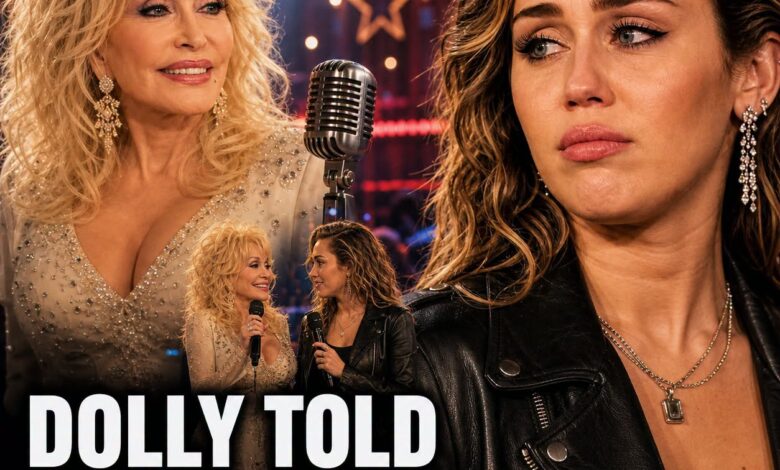
Miley Cyrus had known Dolly Parton for so long that she could barely remember a life without her.
To the rest of the world, Dolly was a country music legend—a rhinestone-covered force of nature whose songs had crossed generations, genres, and borders.
To Miley, she was something much simpler.
“Aunt Dolly.”
Her godmother.
Her mentor.
The woman who had been standing nearby since Miley was a little girl, long before anyone knew what that little girl’s life would eventually become.
So when Miley was forced to say goodbye, she wasn’t mourning only an icon.
She was mourning family.
And perhaps the most revealing part of her tribute was what she refused to reveal.
There were memories she wouldn’t share.
Private conversations.
Stories that belonged only to them.
Moments of laughter and tears that would remain protected from an audience accustomed to knowing almost everything about Miley Cyrus.
That boundary felt appropriate.
Dolly had spent her life mastering the strange art of being extraordinarily public without giving the public everything.
Miley had learned from her.
Their relationship began because of Billy Ray Cyrus, but it eventually became something entirely its own.
Dolly and Billy Ray had been friends for years, and when Miley entered the world, Dolly became her godmother.
There was no biological connection.
There didn’t need to be.
Family isn’t always created by blood.
Sometimes it is created by showing up often enough that a person can no longer imagine their life without you.
Dolly showed up.
When Miley became a child star, Dolly understood what was happening around her in a way very few adults could.
She knew fame.
She knew scrutiny.
She knew what happened when an entertainer’s public image became so enormous that strangers began believing they owned the person underneath it.
Miley experienced that extraordinarily young.
“Hannah Montana” transformed her into one of the most famous teenagers on the planet.
Millions of children knew her face.
Parents knew her name.
Her clothes were sold in stores.
Her image appeared on products around the world.
She wasn’t simply a teenager growing up.
She was a business, a character, a role model, and a cultural phenomenon—all before she had fully figured out who Miley Cyrus actually was.
Dolly understood the danger.
She had spent decades playing with the difference between image and identity.
The enormous blond hair wasn’t an accident.
Neither were the rhinestones, the makeup, the heels, or the jokes.
Dolly created a public character so deliberately exaggerated that she could live behind it without necessarily being consumed by it.
Miley had to learn a similar lesson under much harsher circumstances.
When “Hannah Montana” ended, the world didn’t simply allow her to grow up.
It demanded explanations for every stage of the process.
Every haircut meant something.
Every outfit meant something.
Every relationship became news.
Every performance became evidence in an argument about what kind of woman Miley was becoming.
When she rebelled against her child-star identity, people called her reckless.
When she experimented, people called her desperate.
When she changed musical styles, people questioned whether she knew who she was.
Dolly rarely seemed frightened by any of it.
She knew reinvention wasn’t necessarily confusion.
Sometimes it was survival.
That may be one reason their relationship became so important.
Dolly didn’t need Miley to remain the little girl she remembered.
She allowed her to become someone else.
Then someone else again.
And again.
Because Dolly understood metamorphosis.
She had done it herself.
Country singer.
Songwriter.
Actress.
Businesswoman.
Theme-park owner.
Philanthropist.
Pop-culture icon.
Dolly changed constantly while somehow remaining unmistakably Dolly.
That paradox became one of the lessons she passed down.
You can evolve without abandoning yourself.
You can shed an old identity without betraying the person you were when you needed it.
You can change your sound, your appearance, your relationships, and your ambitions while still carrying the same heart forward.
One of Miley and Dolly’s final conversations returned to that idea.
Music.
Transformation.
What to do with pain.
For two women whose lives had been translated into songs, perhaps there could have been no more appropriate subject.
Dolly’s philosophy was simple.
Feel it.
Then make something from it.
She had practiced that alchemy for her entire career.
Heartbreak became “I Will Always Love You.”
Jealousy became “Jolene.”
Childhood poverty became “Coat of Many Colors.”
Frustration became “9 to 5.”
Dolly didn’t avoid difficult emotions.
She processed them through melody.
Pain went in.
Music came out.
That didn’t mean the pain disappeared.
Art isn’t magic in that sense.
A song can’t undo a betrayal.
It can’t resurrect someone.
It can’t return lost years.
But it can give suffering somewhere to go.
And that was the wisdom Dolly offered Miley.
Take what hurts.
Don’t run from it.
Don’t pretend it doesn’t matter.
Feel all of it.
Then transform it.
For Miley, that advice now carries a devastating new meaning.
Because the pain she must transform is the loss of Dolly herself.
How do you write about someone who helped teach you how to write through grief?
How do you turn the absence of your mentor into the very art she encouraged you to create?
Perhaps there is no immediate answer.
Miley’s relationship with Dolly contained too much history to compress into one tribute.
There were television appearances together.
Performances.
Interviews.
Family moments.
Professional advice.
Private conversations.
And those small interactions that never reached cameras.
The public saw some of the most memorable ones.
Dolly appeared alongside Miley during her “Hannah Montana” years, playing Aunt Dolly on screen—an amusing reflection of the role she already occupied in Miley’s real life.
Years later, they could stand together as equals onstage.
That evolution was remarkable.
The little girl who once looked toward Dolly for guidance became an accomplished artist capable of trading vocals with her.
Their voices were different.
Their generations were different.
Their musical identities were different.
But when they performed together, the affection between them was difficult to miss.
One of their most meaningful musical connections came through “Jolene.”
Miley performed Dolly’s classic repeatedly over the years, bringing her own rasp and intensity to a song written decades before she was born.
It became almost symbolic.
Miley didn’t imitate Dolly.
She inherited something from her and made it her own.
That is what real artistic mentorship looks like.
Not creating a copy.
Creating permission.
Dolly gave Miley permission to be loud.
To be strange.
To change.
To survive public embarrassment.
To laugh at herself.
To refuse to let criticism become identity.
And perhaps most importantly, to keep working.
Both women understood that music could become an emotional language when ordinary conversation failed.
Miley had already demonstrated that throughout her own career.
She turned divorce, identity, regret, freedom, and aging into songs.
She repeatedly returned to the studio after public upheaval and created something from the wreckage.
Dolly recognized that instinct.
She encouraged it.
So their final conversations about music and metamorphosis weren’t abstract philosophical discussions.
They were instructions from one survivor to another.
Keep changing.
Keep creating.
Don’t waste the hurt.
That doesn’t mean Miley shared everything Dolly told her.
Quite the opposite.
Her decision to protect certain memories may be one of the most meaningful parts of her farewell.
Celebrity grief is peculiar.
When a famous person dies, millions of strangers mourn sincerely.
Their feelings can be real.
A song may have accompanied someone’s wedding.
Another may have played during a parent’s funeral.
An interview may have helped somebody through depression or loneliness.
Fans can have profound emotional relationships with artists they’ve never met.
But that doesn’t erase the private grief of the people who actually knew them.
Miley knew Dolly without the audience.
She knew the voice when it wasn’t speaking into a microphone.
She knew conversations that weren’t designed to become quotes.
She knew what Dolly said when there was nothing to promote.
Those memories belong to her.
Protecting them doesn’t diminish Dolly’s public legacy.
It preserves something human inside it.
Dolly understood that distinction better than almost anyone.
She gave the public an enormous amount of herself while fiercely protecting certain parts of her life.
Her marriage to Carl Dean remained famously private for decades.
Her home life largely stayed home.
She could be candid without surrendering ownership of herself.
Now Miley appears to be extending that same courtesy back to her.
Some stories will remain stories between Miley and Aunt Dolly.
Some tears don’t need an audience.
Some final words become less meaningful when transformed into content.
And some relationships deserve a room with the door closed.
What Miley has chosen to share is enough.
Dolly loved her.
Dolly guided her.
Dolly encouraged her to keep evolving.
And Dolly reminded her to make something from whatever life handed her—even pain.
Now Miley faces the cruelest test of that advice.
There will be another studio session.
Another blank page.
Another melody.
Perhaps a lyric will arrive unexpectedly and Miley will recognize where it came from.
Perhaps she’ll hear Dolly’s phrasing inside a harmony.
Perhaps she’ll laugh while remembering some outrageous piece of advice that wouldn’t make sense coming from anyone else.
Grief has a way of changing shape.
At first, it is absence.
Then gradually, almost imperceptibly, absence becomes presence of another kind.
A phrase you still hear.
A habit you inherited.
A lesson that suddenly makes sense years later.
A voice inside your head asking what you’re going to do next.
For Miley, Dolly’s voice may never completely disappear.
How could it?
Dolly helped shape the artist Miley became.
Not by telling her exactly what to be, but by demonstrating that becoming yourself can be a lifelong process.
That may be Dolly’s most enduring gift to her goddaughter.
Miley doesn’t have to remain one version of herself to honor Dolly.
She should do the opposite.
Change.
Experiment.
Fall apart when necessary.
Rebuild.
Write another song.
Become someone neither of them could have predicted.
And keep enough of herself private that the world never gets everything.
Miley’s promise now is not simply to remember her godmother.
It is to continue.
To love her.
To evolve.
To create.
To keep trying to become someone Aunt Dolly would be proud of.
There is heartbreaking beauty in that.
Dolly spent decades standing beside Miley while Miley became herself.
Now Miley must keep becoming herself without Dolly physically beside her.
But mentors have a strange way of surviving inside the people they teach.
Their sentences become instincts.
Their advice becomes reflex.
Their encouragement returns precisely when it is needed.
One day Miley will walk into another studio carrying something painful.
She’ll sit with it.
Feel it.
Maybe cry.
Maybe laugh.
Then she’ll turn toward the microphone.
And somewhere between the hurt and the melody, she may hear that familiar lesson again.
Don’t hide from it.
Turn it into something.
Sing.
That is how Miley Cyrus can keep her promise.
Not by freezing Dolly Parton in memory.
But by carrying her forward.
Song by song.
Transformation by transformation.
With an angel still, somehow, by her side.