For a few extraordinary minutes outside Buckingham Palace, centuries of British military tradition sounded unmistakably like Tennessee.
The scarlet uniforms were there.
The bearskin hats were there.
Tourists crowded against the barriers as they had countless times before, phones raised to capture one of London’s most recognizable ceremonies.
Then the Band of the Coldstream Guards began playing a melody almost everyone knew.
“9 to 5.”
Dolly Parton’s song.
And suddenly the Changing of the Guard didn’t feel quite so routine.
For people still absorbing the news of Dolly’s death at 80, hearing one of her most exuberant songs performed at the gates of Buckingham Palace was almost overwhelming.
Some spectators smiled immediately.
Others wiped away tears.
Phones rose higher.
Within hours, recordings spread online, carrying the moment far beyond the palace gates.
There was something wonderfully improbable about it.
Dolly had been born into poverty in the Smoky Mountains of Tennessee, one of twelve children in a family that knew what it meant to stretch everything—food, clothes, beds, money—as far as it could possibly go.
Now her music was echoing through one of the world’s most famous royal settings.
A poor mountain girl had made it all the way to Buckingham Palace.
Not literally on that morning.
Something more remarkable had.
Her song had.
That distinction seemed to make the tribute even more powerful.
“9 to 5” wasn’t a royal anthem.
It was a working person’s anthem.
Dolly wrote it around the frustrations of people trapped inside jobs where power belonged to somebody else. The song was funny and infectious, but underneath its irresistible rhythm was anger about inequality, ambition, exhaustion, and being denied a fair share of what your labor created.
It belonged to secretaries rushing into offices.
To workers watching clocks.
To people making somebody else richer.
And now a British military band was playing it outside a palace.
The contrast was almost too perfect.
Yet the performance didn’t feel mocking or strange.
It felt affectionate.
That was the peculiar reach Dolly Parton had achieved during her lifetime.
She could move between worlds that shouldn’t naturally fit together.
Country and pop.
Church and camp.
Poverty and enormous wealth.
Small-town Tennessee and Hollywood.
Conservative country audiences and devoted LGBTQ+ fans.
And apparently, eventually, Smoky Mountain songwriting and Buckingham Palace.
Dolly had become culturally borderless.
You didn’t need to be American to understand her.
You didn’t need to grow up poor.
You didn’t need to listen primarily to country music.
You might not even know much about the woman herself.
But chances were you knew something she created.
Maybe “Jolene.”
Maybe “I Will Always Love You.”
Maybe “Coat of Many Colors.”
Maybe “9 to 5.”
Or perhaps Dolly entered your home without music at all.
Maybe she arrived inside a children’s book.
That part of her legacy became especially important as tributes appeared after her death.
The Dollywood Foundation’s Imagination Library had grown from a local literacy effort inspired by Dolly’s father into an enormous international program.
The concept was beautifully simple.
Send children books.
Let them own those books.
Let them turn the pages until they wear out.
Let stories arrive in homes where buying new books might otherwise be a luxury.
Over time, hundreds of millions of books were distributed through the program.
For Dolly, literacy wasn’t an abstract charitable cause.
It was personal.
Her father had been intelligent and hardworking, but he had not had the opportunity to learn to read and write. Dolly spoke openly about how deeply that affected him.
So she built something in his honor.
The woman known worldwide for writing songs created a legacy dedicated to helping children read words.
That symmetry was pure Dolly.
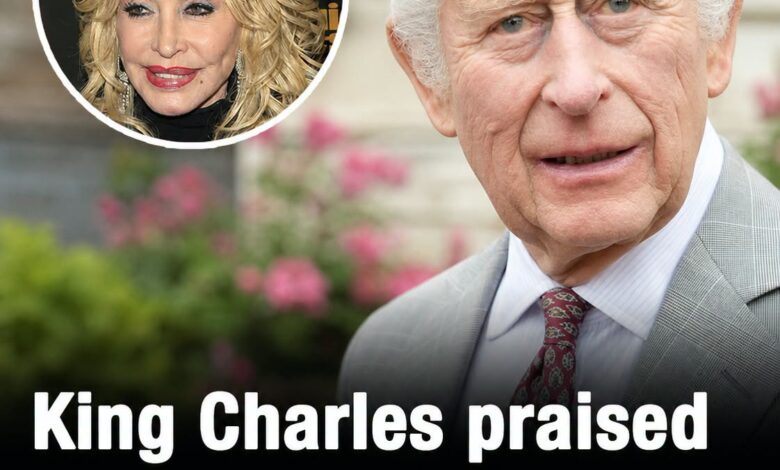
King Charles III and Queen Camilla’s tribute highlighted that commitment, connecting the entertainer remembered for rhinestones and enormous hair with something quieter and arguably even more consequential.
Children.
Books.
Opportunity.
The royal recognition mattered because Dolly’s relationship with Britain had long exceeded the boundaries of ordinary American celebrity.
British audiences adored her.
Her humor traveled.
So did her music.
Perhaps most importantly, her personality never seemed dependent on people understanding every detail of where she came from.
Dolly could make Appalachian references in her unmistakable Tennessee accent and somehow have audiences thousands of miles away feel included rather than excluded.
She invited people into her world.
That was one of her greatest talents.
She didn’t abandon the mountains to become international.
She took the mountains with her.
So when the Coldstream Guards played “9 to 5,” many watching online experienced the moment almost as a completed circle.
Dolly had started in a one-room cabin.
Now royalty was honoring her.
But that interpretation risks missing something important.
Dolly’s greatness wasn’t validated because a palace finally acknowledged her.
She didn’t need Buckingham Palace to prove she mattered.
The remarkable thing was that an institution representing centuries of hierarchy paused to play the music of a woman whose songs so often centered ordinary people.
That was the reversal.
The palace bent toward Dolly.
And Dolly’s song remained exactly what it had always been.
Bright.
Funny.
Defiant.
Impossible not to recognize.
Online reactions captured the emotional contradiction.
People laughed through tears.
Some wrote that their hearts had swelled hearing the familiar melody.
Others imagined Dolly looking down on the spectacle and enjoying every second of it.
That image felt particularly believable.
Dolly possessed a wonderfully developed sense of the absurdity of fame.
She knew exactly how improbable her life looked.
She had deliberately created an exaggerated public image and then spent decades making jokes before anyone else could make them for her.
She understood spectacle.
And the thought of guards in bearskin hats playing “9 to 5” outside Buckingham Palace would almost certainly have qualified.
You could practically imagine the one-liner.
But underneath the humor was the ache of why the performance mattered.
Dolly was gone.
That reality transformed familiar songs almost immediately.
Music behaves strangely after an artist dies.
A song you’ve heard hundreds of times suddenly contains new weight.
Lyrics you barely noticed become unbearable.
A cheerful melody can make you cry because you realize the person who created it will never sing it again.
Yet recordings remain stubbornly alive.
Dolly’s voice doesn’t know she’s gone.
Press play and there she is.
Young again.
Laughing again.
Belting out a chorus.
Telling Jolene exactly what she thinks.
Promising someone she will always love them.
Complaining about working nine to five.
That contradiction is part of grief.
The person disappears.
The art refuses to.
At Buckingham Palace, the contradiction became public.
Dolly wasn’t standing there.
But her melody was.
And hundreds of people recognized it within seconds.
That is what cultural immortality actually looks like.
Not statues.
Not official declarations.
Recognition.
A few notes enter the air and strangers know what comes next.
Dolly spent decades creating that kind of memory.
But she also created another kind.
Somewhere, a child who has never heard “9 to 5” may still know Dolly Parton because her name appeared inside a book mailed to their home.
That child may eventually forget the packaging.
They may not remember exactly when the books arrived.
But perhaps one of those stories makes them love reading.
Perhaps reading changes what they believe is possible.
Perhaps that changes everything afterward.
How do you measure a legacy like that?
Record sales can be counted.
Awards can be displayed.
Concert attendance can be totaled.
Books can even be counted into the hundreds of millions.
But consequences cannot.
Nobody can calculate every life changed downstream from a child discovering stories.
Dolly understood that.
She had come from a family where opportunity wasn’t guaranteed.
When success finally gave her the ability to create opportunity for others, she did.
That may explain why the grief following her death crossed so many boundaries.
People weren’t simply mourning a singer.
They were mourning a particular kind of public figure.
Someone enormously famous who seemed to understand that fame was most useful when it could be converted into something larger than attention.
Dolly converted hers into jobs.
Books.
Medical research.
Tourism for her home region.
Opportunities for performers.
And joy.
Never underestimate the joy.
That morning outside Buckingham Palace, joy and grief occupied the same space.
People were mourning.
The band was playing one of the catchiest songs ever written.
Some spectators cried.
Others grinned.
Many did both.
That combination might have been the most appropriate tribute imaginable.
Dolly’s work had always understood that sadness and happiness aren’t opposites.
Sometimes they live inside the same song.
“Coat of Many Colors” remembers poverty with love.
“I Will Always Love You” turns separation into tenderness.
“9 to 5” wraps frustration in a melody people want to dance to.
Dolly knew how to put pain in rhinestones.
So perhaps a solemn march wouldn’t have suited her nearly as well.
Instead, the guards played something that moved.
Something playful.
Something unmistakably hers.
The palace didn’t fall silent for Dolly Parton.
It filled with Dolly Parton.
And for a few minutes, tourists standing beneath Britain’s royal balconies heard the musical imagination of a girl who had once lived in a Tennessee cabin with eleven brothers and sisters.
Think about the distance between those two places.
Not just geographically.
Socially.
Economically.
Culturally.
Almost everything about Dolly’s beginnings suggested Buckingham Palace belonged to another universe.
Yet she crossed that distance without ever pretending the cabin hadn’t existed.
That was the triumph.
She didn’t escape her origins and erase them.
She turned them into songs and carried them around the world.
Eventually, the world sang back.
And on a day of mourning, one of its oldest ceremonial institutions did exactly that.
Trumpets and brass rose outside the palace.
Phones recorded.
Strangers cried.
“9 to 5” floated through London.
Somewhere else, another Dolly song was undoubtedly playing from a kitchen radio.
Somewhere, a child was opening an Imagination Library book.
Somewhere, somebody newly heartbroken was discovering “I Will Always Love You.”
Those moments are harder to photograph than a royal ceremony.
But together, they are the real memorial.
Palaces can offer tributes.
Flags can be lowered.
Famous people can issue statements.
Eventually, all those gestures end.
The guards march away.
The crowds disperse.
The news cycle moves forward.
Legacy is what keeps happening afterward.
A song gets played.
A book gets opened.
A child learns a new word.
Someone laughs at an old Dolly interview.
A frightened young artist hears her story and decides not to give up.
And somewhere, perhaps years from now, a band will strike up those familiar opening notes and people who never lived during Dolly Parton’s lifetime will still recognize them.
That morning at Buckingham Palace wasn’t proof that Dolly had finally reached greatness.
She had done that long before.
It was proof of something even rarer.
The little girl from the Smoky Mountains had become part of the world’s memory.
And memory, unlike even the grandest palace, doesn’t need gates to keep someone inside.