For decades, Bruce Willis seemed almost indestructible.
On screen, he was the man who survived explosions, gunfire, impossible odds, and villains who underestimated him.
He became synonymous with toughness.
But behind the familiar face and legendary career, Willis and his family have been confronting something no action hero can simply fight his way out of.
Frontotemporal dementia.
And for the people who love him, the disease has changed far more than one man’s life.
It has changed the emotional landscape of an entire family.
The public first learned in 2022 that Willis was stepping away from acting after being diagnosed with aphasia, a condition affecting communication.
For fans, the announcement was shocking.
For his family, however, it was the beginning of a much more complicated reality.
In 2023, they shared that his condition had progressed and that doctors had reached a more specific diagnosis: frontotemporal dementia, commonly known as FTD.
FTD is not simply another name for Alzheimer’s disease.
Both fall under the broad umbrella of dementia, but they can affect people differently. Frontotemporal dementia often involves changes in language, behavior, personality, judgment, and emotional functioning.
For a man whose career depended so heavily on timing, expression, dialogue, and presence, the diagnosis carried a particularly cruel symbolism.
But diseases don’t understand symbolism.
They simply change things.
Gradually.
Relentlessly.
And often unpredictably.
For Willis’s daughters, that means living through a kind of grief that doesn’t fit neatly into ordinary language.
Their father is still here.
They can visit him.
Sit beside him.
Touch his hand.
Share a room with him.
And yet dementia can alter familiar parts of a person in ways that force loved ones to repeatedly adjust their understanding of what remains possible.
There is a term often associated with experiences like this:
Ambiguous loss.
It describes grief surrounding someone who is physically present but psychologically or cognitively changing.
There is no single goodbye.
No clean dividing line between before and after.
Instead, families may experience hundreds of smaller losses.
A conversation that can no longer happen.
A memory that no longer connects.
A familiar routine that becomes difficult.
A response that doesn’t come in the way it once did.
Each change requires another adjustment.
And the people experiencing it don’t always have time to recover from one before another arrives.
Bruce’s daughter Scout has spoken publicly about the emotional complexity surrounding her father’s condition.
Her words resonated with many families facing dementia because they revealed something celebrity coverage often hides:
Fame does not provide immunity from grief.
Money can provide resources.
It can provide medical access, caregivers, privacy, and practical support.
But it cannot make watching someone you love change emotionally painless.
And among Bruce’s daughters, Tallulah has also spoken publicly over the years about deeply personal struggles of her own.
That context matters.
Not because she should be reduced to those struggles.
And certainly not because outsiders should speculate about her private mental state.
But because grief doesn’t arrive in an empty room.
It enters a life already filled with history.
Tallulah grew up with one of Hollywood’s most recognizable surnames.
From childhood, her family was photographed, discussed, criticized, and analyzed.
Her parents’ marriage became public entertainment.
Their divorce became public entertainment.
Their later friendship became public entertainment.
Her appearance became something strangers felt entitled to discuss.
Eventually, even deeply personal aspects of her life became subjects of headlines.
Living under that kind of scrutiny can create a strange contradiction.
Millions of people may recognize your face.
Very few actually know you.
And when a family crisis arrives, that difference becomes painfully important.
The public sees Bruce Willis.
Tallulah sees Dad.
Fans remember John McClane crawling through air ducts in Die Hard.
His daughters remember a father inside their home.
Fans can replay his old movies whenever they want to see him as he once was.
His family has to live in the present.
That’s a much harder place to stand.
There is also something uniquely painful about watching a parent become vulnerable.
Children—even adult children—often carry an unconscious image of their parents as permanent structures.
They’re the people who existed before us.
The people who knew what to do.
The people we called when something broke.
Then one day the direction of care begins reversing.
The person who once protected you may need protection.
The person who once answered your questions may struggle to communicate.
The person who once seemed larger than life becomes unmistakably human.
For the Willis family, that transformation is happening while millions of strangers are watching from outside.
Every photograph can become a headline.
Every family comment can generate speculation.
Every public appearance can trigger questions about Bruce’s condition.
That creates an impossible balancing act.
Share information, and people may demand more.
Remain private, and rumors fill the silence.
There is no perfect way to manage something this painful.
What has remained striking, however, is the family’s visible commitment to surrounding Bruce with love.
His wife, Emma Heming Willis, has become a prominent voice around caregiving and FTD awareness.
His former wife, Demi Moore, has remained part of the family circle.
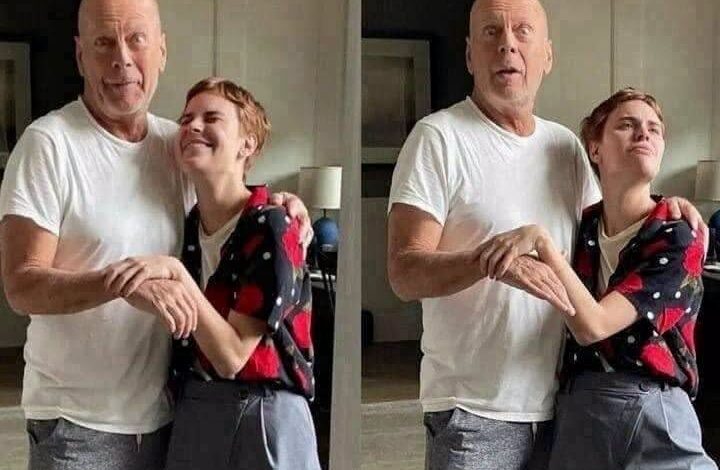
Their daughters continue to share moments of connection.
It’s an unconventional family structure by traditional Hollywood standards, yet perhaps that’s precisely what makes it meaningful.
Divorce did not erase family.
New marriages did not require old relationships to become enemies.
When illness arrived, the boundaries expanded rather than hardened.
Everyone appears to understand the same fundamental truth:
Bruce needs people around him.
But caregivers and family members need support too.
That second part is frequently forgotten.
When someone receives a devastating diagnosis, almost all attention understandably goes toward the patient.
How are they doing?
What treatments are available?
How quickly is the condition progressing?
But illness creates concentric circles of impact.
Spouses become caregivers.
Children become advocates.
Siblings become support systems.
Friends learn how to interact with someone whose behavior or communication may be changing.
Everyone begins adapting.
And adaptation has an emotional cost.
That’s why protecting the emotional well-being of family members matters so much.
Not because they’re weak.
Because they’re human.
There is no medal for suffering silently while someone you love deteriorates.
There is no requirement that a daughter remain composed simply because her father is famous.
And there is no correct timetable for accepting something that changes every day.
Some days may contain laughter.
Others may contain grief.
Sometimes both happen within minutes.
That’s the strange reality families dealing with dementia often describe.
A beautiful moment doesn’t mean the situation isn’t devastating.
A devastating day doesn’t mean there can never be joy again.
Both can exist.
That is perhaps one of the most important lessons surrounding Bruce Willis’s family.
Their story doesn’t need another dramatic villain.
The disease is difficult enough.
What the family needs is not speculation about who is “breaking” or who is “strongest.”
They need room to experience an extraordinarily complicated chapter in whatever way allows them to remain connected.
For Tallulah especially, public compassion should mean respecting the difference between what she chooses to share and what strangers imagine about her.
Concern can easily become intrusion.
And celebrity does not eliminate the right to emotional privacy.
Someone can speak openly about personal struggles without giving the world permission to diagnose every expression, photograph, or difficult day.
The healthiest response from outsiders is often surprisingly simple:
Believe what the family actually says.
Respect what they don’t.
That distinction becomes increasingly important in an internet culture built around filling informational gaps with speculation.
Bruce Willis spent much of his career portraying men who solved problems through force.
Dementia offers no such confrontation.
There is no final battle scene.
No villain to defeat.
No moment when the hero stands up and everything returns to normal.
Instead, the work becomes quieter.
Being present.
Adjusting expectations.
Learning new ways to communicate.
Creating comfortable routines.
Accepting help.
Preserving dignity.
Finding moments of connection without demanding that they look exactly like they once did.
That kind of strength rarely makes blockbuster cinema.
But families facing dementia understand how enormous it is.
Perhaps the same is true for Bruce’s daughters.
Their task isn’t to remain perfectly strong while their father changes.
Their task is to continue living while loving him through that change.
That means allowing themselves grief.
Accepting support.
Protecting their own health.
Laughing without guilt.
Building lives that continue beyond the diagnosis.
And understanding that caring for themselves does not mean caring less about their father.
Bruce Willis’s legacy will always include the movies.
The unmistakable smirk.
The action sequences.
The wisecracks.
The roles that turned him into one of Hollywood’s most recognizable stars.
But to his family, his legacy is something much more intimate.
He is their father.
Their husband.
Their former husband who remained family.
Their grandfather.
The man behind all the characters.
And now, as frontotemporal dementia changes what everyday life looks like, the people closest to him are confronting one of love’s hardest lessons:
Sometimes loving someone means accepting that you cannot rescue them.
You can only accompany them.
And sometimes protecting a family means remembering that the people standing beside the person who is ill are carrying something heavy too.
They deserve care.
They deserve patience.
And above all, they deserve the space to remain a family rather than becoming characters in someone else’s tragedy.