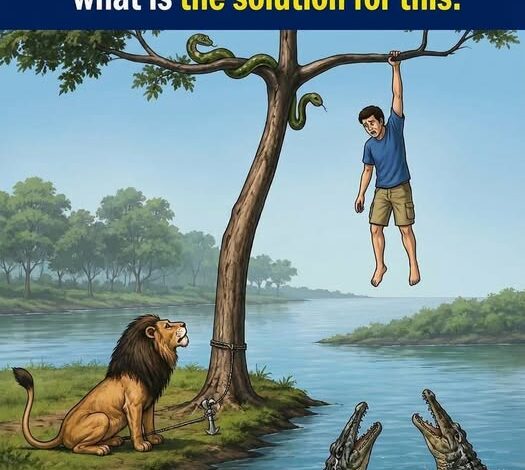
The first instinct was to run.
Everything inside him screamed it.
Move.
Now.
Don’t think.
Don’t wait.
Just get out.
But there was nowhere to go.
In front of him, danger.
Behind him, danger.
To either side, another possibility of being attacked before he could make it more than a few steps.
His heart hammered so violently that he could hear it.
Every muscle in his body was begging for action.
And that was precisely what could get him killed.
So he did the most unnatural thing imaginable.
Nothing.
He stayed where he was.
At first, remaining still felt like surrender.
Fear told him that people who survived were people who acted.
People who ran.
People who fought.
People who refused to become helpless.
But movement and progress are not the same thing.
Sometimes movement is simply panic with momentum.
The predators surrounding him were not frozen.
They shifted.
Watched.
Circled.
Their attention moved from him to one another and back again.
He began noticing something his terror had initially hidden.
They weren’t a single force.
They had separate instincts.
Separate hungers.
Separate calculations.
He had been experiencing them as one enormous wall of death because fear had placed him at the center of everything.
But the animals weren’t thinking about his story.
They weren’t villains cooperating to destroy him.
They were animals.
And animals had priorities of their own.
So he waited.
Seconds felt like minutes.
His mind continued producing commands.
Run now.
He ignored it.
This is your chance.
Not yet.
Do something.
He watched.
Then the system around him began changing.
One animal shifted its attention.
Another reacted.
Distance opened where there had been none.
The predators became more interested in each other than in him.
And suddenly the impossible situation was no longer identical to the one he’d entered moments earlier.
There was space.
Not much.
But enough.
Only then did he move.
That story stays with us because it contradicts almost everything fear teaches.
Fear worships urgency.
It says that if the situation is terrible, the response must be immediate.
The greater the danger, the faster we should move.
Sometimes that’s true.
If a building is burning, leave.
If immediate physical danger is present, seek safety.
If someone needs emergency help, act.
But many of life’s crises aren’t fires.
They’re complicated systems.
And complicated systems can punish frantic movement.
Think about debt.
The bills arrive.
Your stomach drops.
You begin imagining everything collapsing at once.
So you reach for the fastest solution.
Another loan.
Another credit card.
A desperate investment.
A decision designed not to solve the underlying problem but to make today’s fear disappear.
Movement.
But not necessarily progress.
Or consider a relationship collapsing.
You feel someone pulling away.
Fear demands action.
Text again.
Call again.
Explain yourself differently.
Make another promise.
Demand an answer tonight.
Force the relationship into certainty because uncertainty feels unbearable.
Sometimes the wiser move is to stop.
Observe.
Listen.
Let the other person’s behavior become information.
Not every silence needs to be filled.
Not every distance needs to be chased.
Sometimes chasing prevents you from seeing what the distance is trying to tell you.
The same principle appears during career crises.
You lose a job.
Immediately your mind begins shouting.
Apply everywhere.
Accept anything.
Fix this before anyone realizes you’re scared.
There is nothing wrong with taking action.
But fear can make every opportunity look like rescue.
It can send you into another bad workplace simply because unemployment feels worse than choosing carefully.
A pause can reveal questions panic doesn’t allow.
What can I actually afford?
What kind of work do I want?
Which skills do I have?
Who can help?
Which opportunities are real?
What would make the next decision different from the last one?
Waiting long enough to ask those questions isn’t laziness.
It’s strategy.
That’s the distinction people often miss.
Stillness is not automatically passivity.
A person standing still can be doing enormous amounts of work.
Watching.
Calculating.
Listening.
Recovering.
Gathering information.
Allowing circumstances to reveal themselves.
The outside may see nothing happening.
Inside, an entire map is being drawn.
The man surrounded by predators wasn’t waiting because he had given up.
He was waiting because premature movement belonged to the predators.
Timing belonged to him.
That difference matters.
Most of us have experienced a moment when every available option looked terrible.
Stay, and something hurts.
Leave, and something else hurts.
Speak, and there are consequences.
Remain silent, and there are different consequences.
Spend the money, and tomorrow becomes harder.
Don’t spend it, and today becomes harder.
We look around desperately for the correct move.
Sometimes there isn’t one.
Yet.
That final word changes everything.
Yet.
Fear presents the current situation as permanent.
This is how things are.
These are your choices.
Choose immediately.
Reality is usually more fluid.
People change positions.
New information appears.
Deadlines move.
Emotions cool.
Resources emerge.
Someone reveals their intentions.
An opportunity closes.
Another opens.
The landscape you’re trying to escape may look completely different after one hour, one night, or one careful conversation.
But you have to remain still enough to notice.
This is especially difficult because modern life rewards visible action.
We admire decisiveness.
We praise hustle.
We celebrate people who “take control.”
Nobody posts inspirational photographs about sitting quietly for three days before making a decision.
But some of the most consequential mistakes in life begin with the sentence:
“I had to do something.”
Did you?
Or did you need relief from the feeling that you weren’t doing anything?
Those are different needs.
Urgency can become emotional anesthesia.
Action temporarily makes us feel powerful.
Send the message.
Make the purchase.
Quit the job.
Confront the person.
Sign the contract.
Say yes.
Say no.
Anything is better than this horrible uncertainty.
Then the adrenaline fades.
And we discover that we didn’t choose an exit.
We simply chose movement.
This doesn’t mean waiting forever.
Indecision can become its own hiding place.
People sometimes call fear “patience” because they’re afraid to commit.
That’s not the lesson.
The lesson is timing.
Wait while waiting produces information.
Watch while watching improves the decision.
Prepare while circumstances are shifting.
Then, when the opening becomes real, move.
Decisively.
The stillness before action is what makes decisive action possible.
A skilled boxer doesn’t throw every punch available.
A good driver doesn’t accelerate simply because the light will eventually turn green.
A surgeon doesn’t cut before understanding where the problem is.
A firefighter doesn’t enter a structure without assessing what the fire is doing.
Restraint is part of competence.
So why do we treat restraint in our personal lives as weakness?
Perhaps because panic feels productive.
It creates enormous internal activity.
Thoughts race.
Possible futures multiply.
The mind rehearses catastrophes.
We mistake that noise for problem-solving.
But panic is often terrible at distinguishing danger from discomfort.
To panic, uncertainty itself becomes danger.
Waiting becomes danger.
Not knowing becomes danger.
Silence becomes danger.
So panic keeps demanding movement.
The wiser question is simpler:
What has actually changed?
Not what are you afraid might happen.
What is happening?
What evidence do you have?
What remains unknown?
Which dangers are immediate?
Which are imagined?
Which options disappear if you wait?
Which options improve if you wait?
Those questions return you to reality.
And reality is where exits live.
There is another powerful idea hidden in the image of the predators.
The moment the man stopped seeing himself as the center of their attention, the situation changed.
Not physically.
Perceptually.
Humans naturally interpret events through ourselves.
Someone doesn’t answer.
They’re ignoring me.
A manager seems distant.
I’m getting fired.
Friends make plans without us.
They don’t want me anymore.
A partner is quiet.
Something is wrong with us.
Sometimes those interpretations are correct.
Often, however, other people are living inside stories that have almost nothing to do with us.
They’re exhausted.
Distracted.
Afraid.
Busy.
Grieving.
Managing problems we cannot see.
Like predators following separate instincts, the forces around us aren’t necessarily coordinating against us.
That realization can reduce panic dramatically.
Not everything is hunting you.
Some things are simply happening near you.
And once you understand that, you can stop responding to every movement as though it requires defense.
You watch.
You learn.
You conserve energy.
Then something shifts.
A threat loses interest.
A possibility appears.
Someone reveals what they actually want.
The pressure moves elsewhere.
The opening that didn’t exist ten minutes ago suddenly does.
That’s when you go.
Life rarely gives us exits marked with glowing signs.
More often, they’re temporary gaps.
A conversation someone is finally ready to have.
A job opening appearing after months of searching.
A moment when emotions have cooled enough for honesty.
A chance to refinance.
An unexpected person offering help.
A realization that the thing you’ve been desperately trying to preserve is actually the thing keeping you trapped.
These openings are easy to miss when you’re thrashing.
That’s the tragedy of panic.
It narrows vision at exactly the moment wider vision is needed.
Sometimes survival requires speed.
Sometimes survival requires strength.
And sometimes survival requires the discipline to remain still while every frightened cell in your body begs you to run.
That kind of stillness isn’t glamorous.
Nobody watching from outside may even understand it.
They might say you’re doing nothing.
Let them.
You know what you’re doing.
You’re watching the field.
You’re separating real danger from imagined danger.
You’re letting other people’s motives reveal themselves.
You’re refusing to spend energy merely to satisfy fear’s demand for motion.
You’re waiting for reality to change enough that your next move actually matters.
Then it happens.
The attention shifts.
The opening appears.
And because you haven’t exhausted yourself fighting every possible threat, you’re ready.
You move.
Not because panic ordered you to.
Because the path finally exists.
That’s the lesson worth carrying into the moments when life seems to close around you.
You do not always need to escape immediately.
You need to understand what you’re escaping from.
You do not always need another move.
You need the right move.
And when every direction looks dangerous, that may be reality telling you something important:
Not yet.
Stay alert.
Keep watching.
Let the situation breathe.
The exit may already be forming.
You simply haven’t been still long enough to see it.