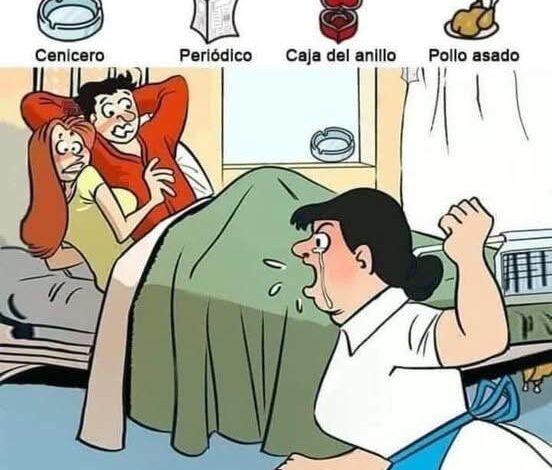
At first glance, the illustration looks like an ordinary cartoon frozen in the middle of a dramatic scene. Three characters, expressive faces, and plenty of action immediately pull your attention toward the obvious story unfolding before you. But don’t let that distract you. Hidden within the artwork are four cleverly disguised objects: an ashtray, a newspaper, a ring box, and a roast chicken.
Think you’ve got the attention to detail to find them all?
Take a moment to study the picture before reading any further. Resist the temptation to scan quickly. The secret to solving puzzles like this is slowing down and examining every corner of the image. The longer you look, the more likely you’ll notice something that doesn’t quite belong.
So why are hidden-object puzzles so deceptively difficult?
The answer lies in the way our brains process visual information. Rather than analyzing every detail equally, our minds naturally focus on the biggest, most meaningful elements first—people, facial expressions, movement, and the main action. Anything that doesn’t seem important is often filtered into the background without us even realizing it.
Puzzle designers use that tendency against us.
Instead of hiding objects behind something obvious, they disguise them as ordinary parts of the drawing. A familiar shape becomes part of someone’s clothing, a hairstyle, a curtain, or a piece of furniture. Unless you’re actively searching for unusual patterns, your brain accepts them as part of the illustration and moves on.
That’s exactly what makes these puzzles so satisfying to solve.
One of the most common mistakes people make is assuming hidden objects will appear in logical places. You might expect an ashtray to be sitting on a bedside table, a newspaper folded on a chair, a ring box held in someone’s hand, or a roast chicken resting on a dinner plate.
This puzzle ignores all of those expectations.
Instead, each object is carefully blended into a completely different part of the scene, making it surprisingly easy to overlook.
If you’ve finished searching—or are ready for a few hints—here’s where each hidden object can be found.
The Ashtray
Most people instinctively search the furniture first, but that’s a trap. Shift your attention toward the curtain hanging beside the bed. The folds of the fabric create a circular outline that perfectly mimics the shape of an ashtray. Clever shading helps it blend so naturally into the curtain that it looks like part of the pattern instead of a separate object.
It’s an excellent example of camouflage hiding in plain sight.
The Newspaper
This one often surprises people.
Rather than lying on a table or tucked beneath someone’s arm, the newspaper is hidden in the man’s hair. The artist has shaped and shaded sections of his dark hair to resemble the folded pages and printed lines of a newspaper. At first it simply looks like hair texture, but once you recognize the outline, it’s impossible to unsee.
It’s one of those discoveries that makes you wonder how your eyes skipped over it.
The Ring Box
Next, focus on the woman lying in bed.
The small red object nestled within her hair may appear to be nothing more than a decorative accessory. Look more closely, however, and you’ll notice its distinctive shape. It’s actually a tiny ring box, cleverly disguised as part of her hairstyle. The sharp edges and subtle clasp help reveal its true identity once you know what you’re looking for.
The Roast Chicken
The final hidden object is perhaps the most unexpected.
Rather than sitting on a plate or table, the roast chicken appears near the curtain rod, blending into what initially looks like a shadow or decorative element. Once your eyes adjust, the rounded body and familiar drumstick shape become much easier to recognize.
It’s a wonderfully imaginative hiding place that rewards patient observation.
To summarize, here’s where all four hidden objects are concealed:
- Ashtray: Hidden within the folds of the curtain beside the bed.
- Newspaper: Camouflaged in the man’s hair.
- Ring Box: Disguised as a red accessory in the woman’s hairstyle.
- Roast Chicken: Blended into the area near the curtain rod or wall decoration.
So, how many did you find before checking the answers?
If you spotted all four on your own, congratulations—you have an exceptionally sharp eye for visual detail. If you only found one or two, don’t be discouraged. Hidden-object puzzles are designed to challenge the way our brains naturally interpret images, and even experienced puzzle enthusiasts can overlook cleverly disguised objects.
The real benefit of puzzles like these goes beyond simple entertainment.
They encourage careful observation, improve visual attention, and train your brain to question first impressions. Instead of accepting every shape at face value, you begin looking for subtle inconsistencies, unusual outlines, and patterns that don’t quite fit.
Those are the same skills we use every day when solving problems, recognizing details, and making careful observations.
Now that you know where everything is hidden, take one more look at the illustration.
You’ll probably spot each object immediately—and you’ll likely discover yourself noticing other small details you completely missed the first time around.
That’s the lasting appeal of hidden-picture puzzles. They remind us that the most interesting discoveries aren’t always the ones sitting out in the open. Sometimes, all it takes is a slower look, a fresh perspective, and the willingness to see beyond the obvious.