Miley Cyrus Makes First Public Appearance Since Dolly Parton’s Death — Fans Notice Something on Her Arm — Photos

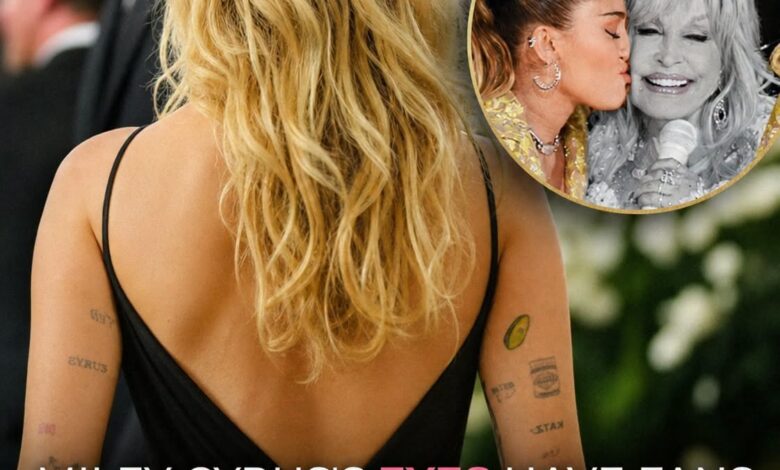
Outside the Los Angeles studio, Miley Cyrus didn’t look much like the woman who had spent most of her life commanding arenas.
There was no dramatic entrance.
No carefully staged wave toward the cameras.
No obvious attempt to turn the moment into anything larger than it already was.
Dressed entirely in black, sunglasses covering her eyes, Miley walked quietly toward the building while photographers captured her from a distance.
It was only one day after Dolly Parton’s death.
And suddenly every detail seemed to carry meaning.
The black clothing.
The lowered head.
The silence.
Even a faint image visible on Miley’s arm became the subject of intense speculation, with some fans wondering whether it might be connected to Dolly.
Perhaps it was.
Perhaps it wasn’t.
Grief has a way of making people search photographs for evidence of what cannot be photographed.
A tattoo becomes a message.
A piece of jewelry becomes a tribute.
A facial expression becomes a window into someone’s private pain.
But the truth was already visible without any detective work.
Miley had lost someone fundamental to her life.
Dolly wasn’t simply a famous country singer whom Miley admired.
She was her godmother.
Mentor.
Collaborator.
Defender.
Friend.
Family.
Their relationship stretched back to Miley’s childhood, long before she had to figure out what it meant to become famous herself.
Dolly understood that world better than almost anyone could.
She knew what it meant to have strangers decide who you were based on a costume, a photograph, a performance, or a headline.
She knew how quickly the public could embrace someone and how quickly that affection could become judgment.
Most importantly, she understood that surviving fame required something stronger than popularity.
You had to know who you were when the applause stopped.
That lesson became especially important as Miley grew beyond the Disney image that first made her famous.
The transition was messy.
Publicly messy.
Every haircut, outfit, performance, relationship, and reinvention seemed to become evidence in some enormous cultural trial over what Miley Cyrus was allowed to become.
There were periods when criticism seemed relentless.
To some people, Miley wasn’t simply changing.
She was disappointing them.
Dolly refused to join that chorus.
She didn’t pretend to approve of every decision automatically.
But she understood something many critics seemed to forget:
Miley had to become Miley.
Not Hannah Montana.
Not the version audiences remembered from childhood.
Not the version executives preferred.
Not even the version Dolly herself might have chosen.
Her own version.
Dolly had built her entire career around essentially the same principle.
People underestimated her because of the hair.
The rhinestones.
The exaggerated femininity.
The jokes.
Then they discovered the songwriter underneath.
The businesswoman.
The philanthropist.
The woman who had deliberately created an image so unmistakable that nobody else could own it.
So when Miley began tearing apart expectations surrounding her own identity, Dolly recognized the instinct.
Do it your way.
That didn’t mean recklessness.
It meant authorship.
And Dolly repeatedly offered Miley something rare in celebrity life: affection that didn’t disappear when public opinion changed.
When Miley was praised, Dolly celebrated her.
When Miley was attacked, Dolly defended her.
When Miley changed direction again, Dolly remained there.
That kind of loyalty becomes priceless when millions of strangers feel entitled to evaluate your every transformation.
Their connection eventually became part of their public work as well.
They performed together.
They laughed together.
They spoke openly about their bond.
Whenever they shared a stage, the affection rarely felt manufactured.
There was teasing.
Admiration.
Musical chemistry.
But beneath all of it was something simpler.
They liked each other.
Miley didn’t merely respect Dolly’s career.
She loved Dolly.
And Dolly seemed enormously proud of the woman Miley had become.
That is why photographs taken outside a recording studio now feel different.
Under ordinary circumstances, Miley entering a studio would barely require interpretation.
Artists record.
That’s what they do.
But timing changes an image.
One day after losing Dolly, Miley was walking back into the place where she transforms experience into music.
That doesn’t necessarily mean she was recording a tribute.
Nobody outside that room can know what she was working on or why she chose to be there.
But symbolically, the image was almost impossible to ignore.
Because music was one of the languages they shared.
Dolly had taught Miley through conversation and example, but she had also taught her through songs.
How to tell the truth without explaining everything.
How to make pain beautiful without pretending it wasn’t painful.
How to write something personal enough to belong to you and universal enough to belong to strangers.
How to stand beneath lights while carrying things nobody in the audience can see.
Those lessons don’t disappear when the teacher does.
Perhaps that is what fans were really responding to when they studied the photographs.
Not the possible tattoo.
Not the sunglasses.
Not even the black clothing.
Continuity.
The idea that Dolly’s influence was still walking into that studio.
Grief is strange because the world expects visible rituals.
Funerals.
Flowers.
Statements.
Black clothing.
Tears.
But some people mourn by moving.
They return to familiar places because standing still is harder.
They work because work gives pain somewhere to go.
For a songwriter, the studio can become both refuge and confrontation.
There is nowhere to hide once the microphone turns on.
A voice reveals things a face can conceal.
Miley has spent years demonstrating that she understands this.
Her voice has changed with her life.
It has become rougher, deeper, more weathered.
Less interested in perfection.
More interested in truth.
Dolly appreciated that honesty.
She had spent her own career proving that vulnerability and strength weren’t opposites.
You could write about heartbreak without being weak.
You could be glamorous without being shallow.
You could be ambitious without becoming cruel.
You could be famous without forgetting where you came from.
And perhaps most importantly, you could remain kind without becoming small.
That may be the inheritance Miley carries now.
Not an inheritance measured in money or possessions.
A way of moving through the world.
Dolly had watched Miley experience something she understood intimately: the strange loneliness of being known by millions of people who don’t actually know you.
She offered perspective.
She reminded Miley that public approval is temporary.
Character lasts longer.
Songs last longer.
Love lasts longer.
Now Miley has to continue without being able to call the woman who taught her those things.
That is the cruelty hidden inside losing a mentor.
You don’t only lose the person.
You lose future conversations.
Future advice.
Future laughter.
The person you expected to call when something wonderful happened is suddenly the person you most desperately wish you could tell about it.
No tribute can repair that.
Neither can a tattoo.
Neither can an award-show performance.
Neither can millions of sympathetic comments from fans.
Grief remains stubbornly private, even when the person grieving is famous.
That is why there was something almost uncomfortable about watching Miley walk past those cameras.
The public knows the relationship.
The public recognizes the loss.
But the deepest part of it belongs to her.
We know Dolly the icon.
Miley knew the woman who called.
The woman who joked.
The woman who offered advice.
The woman who defended her when criticism became deafening.
The woman who had known her before so many versions of Miley existed.
There is no photograph capable of showing what losing that person feels like.
But there was still something fitting about where Miley went next.
A recording studio.
A room built for turning things that cannot be held into something that can.
Words.
Melody.
Breath.
Memory.
Maybe she recorded that day.
Maybe she simply needed to be there.
Maybe the work had been scheduled long before grief rearranged everything.
The reason almost doesn’t matter.
What matters is the image left behind:
Miley moving forward while carrying someone with her.
Because that is eventually what grief asks.
Not that we leave people behind.
That we learn how to carry them differently.
Dolly will no longer be standing beside Miley onstage.
She won’t be there to offer another joke, another piece of advice, another reminder to trust herself.
But influence doesn’t require physical presence.
Every time Miley refuses to become the person someone else demands, there will be something of Dolly in that courage.
Every time she chooses kindness without surrendering strength, there will be something of Dolly there too.
And every time she walks into a studio carrying pain and turns it into a song, she will be continuing a language they both understood.
So perhaps the most meaningful detail in those photographs wasn’t what Miley wore.
It wasn’t what might have been visible on her arm.
It was the door she walked through.
One day after losing Dolly Parton, Miley Cyrus entered a place where songs are made.
And if Dolly taught her anything, it was that people eventually leave us.
But sometimes, if we’re lucky, what they taught us keeps singing long after they’re gone.