The phone landed in my hand just as my wife reached for it.
My daughter’s finger was still trembling.
“Make her play the video,” she whispered. “The one from before I fell.”
For several seconds, nobody moved.
My eight-year-old daughter sat propped against a hospital pillow with fresh gauze covering one eye. Her hair was still damp near her temple. The nurses had already changed her out of the wet clothes she arrived in, but she kept her shoulders pulled inward as though she were still standing outside in the cold.
My wife’s hand rested over the phone in her pocket.
“There’s nothing on there that changes what happened,” she said.
That answer chilled me.
She hadn’t said there was no video.
“Is there a video?” I asked.
“She’s confused.”
“That wasn’t my question.”
My wife finally pulled out the phone.
My daughter flinched.
It was barely noticeable, but I felt her fingers clamp down around mine.
My wife unlocked the screen and scrolled.
“There,” my daughter said.
She stopped.
Then looked at me.
“What exactly do you think this proves?”
“I haven’t seen it yet.”
She hesitated before turning the phone toward me.
The video started.
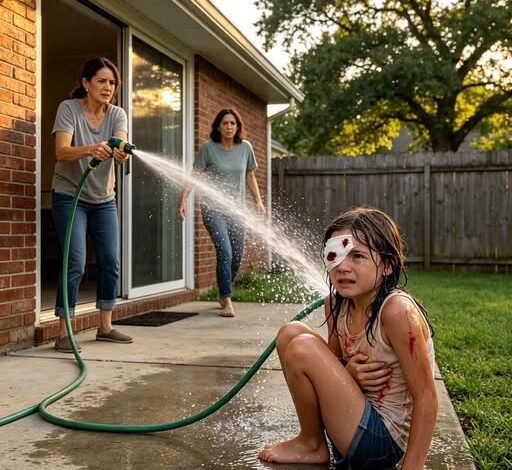
Our patio filled the screen.
Bright afternoon sun.
Concrete.
Outdoor chairs.
The garden hose lying across the ground.
Then my daughter entered the frame.
She was already soaked.
Already backing away.
And the stream of water was following her.
That was all I needed to understand the first lie.
The spraying had started before she fell.
My daughter raised an arm over her face.
She stepped backward again.
Her shoe slipped.
Then she disappeared from view.
I reached for the phone.
My wife pulled it back.
“You saw it. She fell.”
“After you kept spraying her while she was trying to get away.”
“She was dirty.”
“She told you to stop.”
“You’re making it sound like I attacked her.”
I recognized the maneuver immediately.
She wanted an argument about wording.
Was it an attack?
Was it discipline?
Was it cleaning?
Was it an accident?
If we argued about labels long enough, maybe we would stop talking about what the video plainly showed.
So I refused.
“She asked you to stop. You kept spraying her. She backed away. She fell. Then you told her to say the fall happened first.”
“I never told her to lie.”
My daughter’s entire hand stiffened inside mine.
I turned to her.
“You don’t have to answer anything right now.”
My wife let out a sharp breath.
“She’s eight. She doesn’t understand what she’s accusing me of.”
And suddenly everything became very simple.
This was no longer an argument between husband and wife.
My child was injured.
She was frightened.
And the adult standing beside her hospital bed seemed more concerned with controlling the story than comforting her.
I stood.
“Give us some space.”
My wife stared at me.
“You can’t order me out. She’s my daughter too.”
I looked at my child.
“Do you want her here right now?”
My daughter stared down at the blanket.
Then slowly shook her head.
My wife looked stunned.
“You’re letting an eight-year-old make decisions now?”
“I’m listening to her.”
My daughter moved closer to me.
“I want Mommy to go.”
The room became completely still.
My wife’s face hardened.
And in that silence, I remembered every message she had sent while I was driving to the hospital.
It was an accident.
You’re frightening her by making this dramatic.
Bring her home and we’ll talk like adults.
Not one message had asked whether our daughter could see clearly.
Not one had asked if her eye hurt.
Not one had asked whether she was scared.
I pointed toward the phone.
“Do not delete that video.”
My wife stared at me.
“You seriously think I’d destroy evidence?”
“I’m telling you not to.”
Before she could answer, a hospital employee entered.
The transformation in my wife was immediate.
Her voice softened.
Her expression changed.
Suddenly she was composed and reasonable.
She explained that emotions were running high and that there had been a misunderstanding.
But I wasn’t watching her.
I was watching my daughter.
She wasn’t looking at her mother.
She was looking at the phone.
When the staff member asked whether we needed privacy, I said yes.
“My daughter doesn’t want to leave with her tonight.”
The employee turned directly toward my daughter.
“Is that what you want?”
She nodded.
My wife started talking.
The employee calmly asked her to wait outside.
For the first time all day, my wife encountered a boundary she had not chosen.
The door closed.
My daughter’s shoulders dropped.
Her fingers loosened around mine.
Then she took the deepest breath I had seen her take since we arrived.
That breath told me more than any argument could have.
A few minutes later, she asked, “Are we going home?”
“No.”
She looked at me.
“Not tonight.”
“Will she be there?”
“No.”
She studied my face, as though checking whether I meant it.
Then she nodded.
For the rest of that evening, I stopped asking questions.
When she wanted water, I gave her water.
When she wanted silence, I let the room stay silent.
When she asked whether her mother was still outside, I answered honestly.
And when she said she didn’t want to talk about the patio anymore, we stopped talking about the patio.
My wife kept messaging me.
Where are you taking her?
When are you coming back?
We can’t fix this if you refuse to talk.
Eventually, I sent one reply.
Our daughter would not be returning home with her that night.
Her medical care came first.
Everything else could wait.
My phone rang immediately.
I declined the call.
My daughter noticed.
She didn’t ask whether I was angry.
She simply reached for my hand.
When the hospital released her, I helped her dress carefully.
At the door, she asked, “Where are we going?”
“Somewhere you can sleep without worrying about anyone coming into your room.”
She stared at me.
Then nodded.
That night became the first night of a completely different life.
Not a simple one.
There were bags to pack.
Schedules to rearrange.
Legal conversations I had never imagined needing.
There were mornings when my daughter woke up and looked around the room before she got out of bed.
She wanted to know who was visiting before anyone arrived.
She asked that doors remain partly open.
Sometimes she asked whether she had to answer messages from her mother.
“No,” I told her.
Every time.
Slowly, she began telling me more.
I never demanded a complete account.
If she remembered something and wanted to share it, I listened.
If she stopped, I stopped.
If she changed details because memory came back in pieces, I didn’t correct her into silence.
One afternoon she asked me a question that stayed with me.
“Why did you believe me?”
“Because I listened.”
“But she said I was confused.”
I sat beside her.
“You can be eight years old and still know whether someone was spraying you before you fell.”
She thought about that.
“What if I remember something wrong?”
“Then tell me what you remember. You don’t have to make it perfect.”
Her shoulders relaxed.
That was when I realized how frightened she had become of giving the wrong answer.
She thought truth only counted if she could present it flawlessly.
The video had confirmed the sequence of events.
But she should never have needed a recording to deserve being heard.
Eventually, my wife and I spoke without our daughter present.
She insisted she had never intended to hurt her.
I told her intention did not erase what happened after our daughter said stop.
She said the hose was meant to clean her off.
I reminded her that our daughter was backing away.
She said the fall itself was accidental.
“The fall may have been,” I said. “Ignoring her when she told you to stop wasn’t.”
Then I asked the only question I still cared about.
“Why was she afraid to tell me what happened?”
My wife had answers.
Misunderstandings.
Poor wording.
What she had intended.
What our daughter might have interpreted incorrectly.
But I had already seen the real answer.
I had felt it in my daughter’s grip.
I had watched some of that fear leave her body when the hospital door closed.
Finally, my wife asked, “What exactly do you want from me?”
For the first time, I answered without thinking about saving the marriage.
“I want our daughter to stop being afraid of telling me the truth.”
Everything became clearer after that.
Contact with her mother would happen only in ways that felt safe.
My daughter would not be made to apologize for speaking.
She would not be pressured into forgiveness.
And I would not return her to the same environment simply because changing our lives was difficult.
The injury near her eye healed.
The emotional part took longer.
For several weeks, she still startled easily.
The nightmares became less frequent.
She stopped looking over her shoulder in parking lots.
Then one afternoon, we visited a relative.
A garden hose lay beside the lawn.
My daughter froze.
I immediately started toward it.
“Can I do it?” she asked.
I stopped.
“Do what?”
“Turn it on.”
I let her.
She picked up the nozzle with both hands.
Twisted it carefully.
Water burst across the grass.
She jumped.
But she didn’t let go.
She aimed the stream at the dirt.
Then the flowers.
Then she lifted it slightly and made a crooked rainbow in the sunlight.
I stayed beside her without touching the hose.
After a minute, she switched it off herself.
Then she handed it to me.
“I’m done.”
“Okay.”
That was it.
Nobody argued.
Nobody told her she couldn’t be done yet.
Nobody made her continue.
Months later, her mother began supervised visits after agreeing to counseling and clear boundaries.
The first visit lasted twenty minutes.
I waited nearby.
When my daughter came out, I asked only one question.
“How was it?”
She shrugged.
“Okay.”
“Do you want to go again?”
She thought for a moment.
“Maybe.”
“Okay.”
Maybe was enough.
Not yes.
Not no.
Maybe.
For once, nobody tried to turn uncertainty into consent.
A year after the hospital, my daughter and I were outside washing my car.
She had the hose.
She sprayed one tire.
Then another.
Suddenly she looked at me with a smile I knew immediately meant trouble.
“Don’t you dare,” I said.
She sprayed my shoes.
I jumped backward.
She screamed with laughter.
I grabbed a towel and chased her around the driveway while she kept the stream pointed safely toward the ground.
Eventually, she collapsed onto the grass laughing so hard she could barely breathe.
I sat beside her.
The hose rested between us.
She stared at it for a few seconds.
Then she looked at me.
“I’m not scared of it anymore.”
I smiled.
“You don’t have to be.”
She shook her head.
“No. I mean I know I can turn it off.”
And there it was.
The ending I hadn’t known I was waiting for.
The video on my wife’s phone proved what happened that afternoon.
But healing was never supposed to become an endless courtroom where my daughter had to keep proving the past.
Healing meant teaching her something about the future.
Her “stop” mattered.
Her memory mattered.
Her fear mattered.
Her choices mattered.
And the people who loved her were supposed to listen before she had to scream.
For a long time, that hose had represented the moment she learned that saying stop did not necessarily make someone stop.
Now it meant something else.
Control.
Choice.
Trust.
She could turn the water on.
She could play.
She could laugh.
And when she had enough, she could simply say, “I’m done.”
Then reach down.
Turn the handle.
And know that this time, everyone around her would respect the silence that followed.