At My Wedding My Husbands Daughter Asked Can I Tell You Daddys Secret Now That Youre My Mommy What She Said Next Made My Stomach Drop

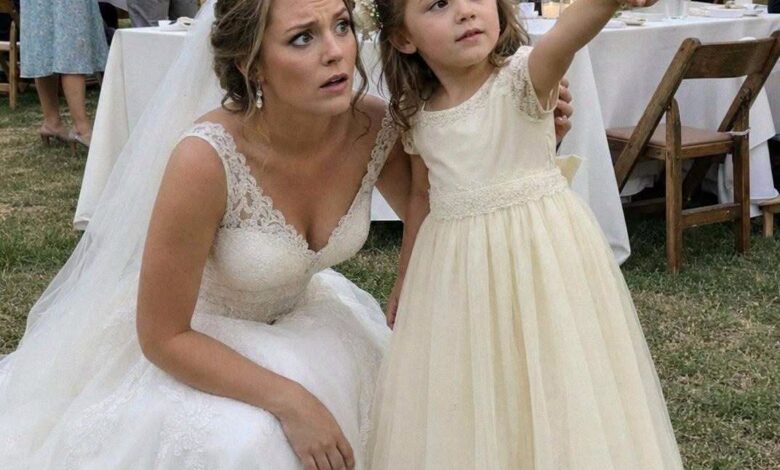
Less than three hours after I married Graham, his six-year-old daughter tugged on my wedding dress and asked a question that ended our marriage before the cake had even been cut.
“Now that you’re my mommy, can I tell you the secret?”
I smiled.
Millie had been bursting with excitement all day. I expected something harmless—a hidden present, a plan involving the cake, maybe something she’d overheard Graham say about our honeymoon.
I crouched beside her.
“Of course.”
Her smile disappeared.
She glanced across the reception hall toward her father.
Then she whispered, “Daddy says I’m never supposed to tell you that my mommy isn’t dead.”
For several seconds, I couldn’t move.
Across the room, Graham was laughing with his brother, still wearing the suit I’d helped him choose.
My husband of three hours.
The man who had told me Millie’s mother died giving birth.
Graham’s story had been one of the first deeply personal things he’d shared with me. He described holding a newborn while grieving the woman he’d expected to raise her with. He talked about sleepless nights and learning to parent alone.
I had believed every word.
And I had been careful with Millie because of it.
I never called myself her mother.
I never tried to replace someone I believed she had lost.
Instead, we built something of our own.
Saturday pancakes.
School pickups.
Animated movies under blankets.
Burned cookies we ate anyway.
Eventually, Millie began asking when I was going to “join the family for real.”
Now she was staring at me with frightened eyes.
“What do you mean, sweetheart?”
“My mommy is Claire.”
I kept my voice steady.
“Who’s Claire?”
“Daddy calls her Aunt Claire when we go see her.”
My stomach tightened.
Millie told me about a small apartment outside town.
She had visited several times.
Claire hugged her.
Sometimes she cried.
She gave Millie presents and once explained that she’d been very sick after Millie was born and couldn’t take care of a baby.
“When did you see her last?”
Millie looked toward Graham again.
“Two weeks ago.”
Two weeks before our wedding.
“Why couldn’t you tell me?”
Her answer hurt more than anything else.
“Daddy said people would get mad and our family might break.”
I took her hands.
“You didn’t do anything wrong.”
“But I told.”
“You were allowed to tell me.”
I brought Millie to my sister and asked her to stay with her.
Then I crossed the reception hall.
“Graham. We need to talk.”
He followed me into an empty side room.
I closed the door.
“Who is Claire?”
His expression barely changed.
“Claire who?”
Wrong answer.
“Millie’s mother.”
Everything in his face shifted.
He tried denial first.
Millie was confused.
She misunderstood.
Claire was an old family friend.
Then I repeated details.
The apartment.
The gifts.
The crying.
The visit two weeks earlier.
Finally, Graham sat down.
“Claire didn’t die.”
Four words.
Four words dismantled years of history.
Claire was Millie’s biological mother.
After giving birth, Graham explained, she had experienced a severe psychiatric crisis. Her condition became serious enough that her family arranged long-term treatment. Eventually, custody was transferred to Graham.
That part was tragic.
It was also understandable.
What came afterward wasn’t.
Graham told people Claire had died.
“At first it was easier,” he said. “People kept asking questions.”
“So you told them she was dead?”
“I was trying to protect Millie.”
“From what?”
He had no good answer.
Years later, Claire stabilized and asked to see her daughter. Graham eventually agreed to supervised contact.
But instead of correcting the lie, he created another one.
Claire became “Aunt Claire.”
Millie was instructed never to tell me.
I stared at him.
“You made a six-year-old protect your lie.”
“I was going to tell you.”
“When?”
“After the honeymoon.”
I actually laughed.
Not because anything was funny.
“You were going to wait until after I married you?”
“I needed to know you weren’t going to leave.”
That sentence clarified everything.
He hadn’t delayed because he couldn’t find the right moment.
He had delayed because he wanted the marriage to make leaving harder.
“You took the decision away from me.”
“I knew you’d react like this.”
“You lied about a woman’s death.”
“I was scared.”
“And you made Millie carry your fear.”
Outside the room, our wedding reception continued.
People were drinking champagne.
Music was playing.
Someone was probably wondering when we would cut the cake.
I could have walked into that room and exposed him.
I didn’t.
Not because I wanted to protect Graham.
Because Millie had already spent enough time trapped inside adult drama.
I returned to her.
She looked terrified.
“Are you mad?”
“No.”
“Is Daddy mad?”
“That isn’t something you need to fix.”
Then I told her the most important thing I could think of.
“Adults should never ask children to keep secrets that make them scared.”
She started crying.
I held her.
My sister took Millie home, and I ended the reception early.
There was no dramatic announcement.
No smashed cake.
No public confrontation.
Just confusion among guests and a bride leaving her own wedding knowing she no longer understood the man she’d married.
The following days were not about revenge.
They were about facts.
I contacted a family lawyer.
Then I found a therapist experienced in working with children dealing with parental separation and complicated family histories.
And I asked to meet Claire.
We met somewhere neutral.
I had imagined that meeting dozens of ways.
None prepared me for the woman who sat across from me.
Claire did not resemble the villain a secret like Graham’s might make someone imagine.
She was nervous.
Careful.
She brought documentation.
Court records supported the custody history. Treatment records supported what Graham had told me about her psychiatric crisis after Millie’s birth.
Claire had been very ill.
She had needed treatment.
She had not been capable of parenting safely during that period.
But she had not died.
And she had spent years living with the consequences of an illness while Graham told the world she was buried.
“I don’t want to take Millie away,” Claire told me.
“What do you want?”
“To know her.”
Her voice broke.
“And I don’t want her thinking she has to lie about loving me.”
That was when the real damage became impossible to ignore.
Millie loved her father.
She loved me.
And she was beginning to know Claire.
None of those relationships needed to cancel the others.
Adults had created that impossible choice.
Graham and I separated.
I couldn’t decide immediately whether our marriage was repairable.
I loved him.
That was true.
It was also true that he had constructed a fundamental part of our relationship around a lie and deliberately withheld the truth until he believed marriage would make me less likely to leave.
Love did not erase that.
Neither did Claire’s medical history.
Her illness explained her absence.
It did not justify erasing her existence.
And nothing justified placing the secret inside a six-year-old.
So we slowed everything down.
Lawyers handled legal questions.
Professionals helped determine what contact would be healthiest for Millie.
Claire agreed that consistency mattered more than suddenly trying to claim a role she had not been able to occupy.
And Graham had to confront something far more difficult than being caught.
He had to understand what his lie had done to his daughter.
Millie had spent ordinary happy days carrying extraordinary fear.
Every time she baked with me, watched movies beside me or asked whether I’d become her mother, another thought had been sitting quietly underneath:
If I tell the truth, this family might disappear.
No child should carry that.
One evening, Millie asked me the question I had been dreading.
“Are you leaving because I told?”
I knelt in front of her.
“No.”
“But the wedding stopped.”
“That was because of choices adults made.”
Her eyes filled.
“If I didn’t tell, you’d still be married.”
I took her face gently between my hands.
“Listen to me. Telling the truth did not cause the problem. The problem already existed.”
She stared at me.
“You didn’t break anything.”
That was the sentence I wanted her to remember.
Whatever happened between Graham and me, I refused to let Millie grow up believing honesty destroyed our family.
Months later, I still didn’t have a simple answer about my marriage.
Some betrayals do not fit neatly into forgiveness or divorce.
Trust, once deliberately manipulated, takes time to evaluate.
But I knew exactly what I wanted for Millie.
No more secret identities.
No more whispered instructions.
No more making a child responsible for protecting adults from consequences.
She deserved relationships where she could love people without hiding them.
Looking back, I think about the question she asked while holding the fabric of my wedding dress.
“Now that you’re my mommy, can I tell you the secret?”
To Millie, becoming her mother had not been about biology.
It wasn’t even really about marriage.
It meant becoming someone safe enough to tell.
Graham’s secret made my stomach drop.
It changed my wedding day and possibly my future with him.
But the most important thing that happened that afternoon was much smaller.
A frightened six-year-old decided to trust me with the truth.
I cannot control what Graham did before that moment.
I cannot rewrite Claire’s illness.
I cannot give Millie back the years when her mother was reduced to a secret.
But I can honor what that little girl believed when she tugged on my dress.
That a mother—or anyone worthy of that kind of trust—is someone who can hear the truth without making the child pay for it.
Whatever happens to my marriage, Millie will never again be asked to carry an adult’s lie.
That burden was never hers.
And the moment she handed it to me, I decided I would never give it back.