My Best Friend Grew His Hair Out and Cut It off to Have a Wig Made for Me During Chemo 25 Years Later, He Didnt Recognize Me, so I Returned Something Id Kept for Years

When I was fifteen, cancer took my hair before I was ready to lose anything else.
The doctors talked about treatment schedules, blood counts, side effects, and percentages.
I mostly thought about mirrors.
I hated them.
I hated the way my reflection made the illness feel official. I hated the way my scalp showed beneath the thin patches of hair that remained before I finally shaved it all off. I hated walking through school hallways and imagining that every glance lasted half a second too long.
Cancer had already made me feel like my body no longer belonged to me.
Losing my hair made me feel visible in all the ways I did not want to be.
People tried to help.
Adults said things like, “It’ll grow back.”
Classmates told me I was brave.
Some meant well.
None of it touched the fear underneath.
I did not feel brave.
I felt fifteen.
And frightened.
And painfully aware that everyone else still looked like themselves while I looked like a diagnosis.
Noah was the only person who never tried to talk me out of feeling that way.
He had been my best friend for years.
We had grown up together, survived middle-school disasters together, and knew how to sit beside each other without filling every silence.
When I cried about my hair, Noah did not say it was “just hair.”
He did not tell me appearance did not matter.
He did not pretend I should be above caring.
He simply listened.
Then, without announcing it, he stopped cutting his own hair.
At first, I did not understand why.
Neither did anyone else.
As the months passed, his hair got longer.
Then much longer.
Kids at school started commenting.
Some asked whether he was trying to look like a girl.
Others made jokes behind his back.
A few laughed directly at him.
Noah never explained himself.
He just shrugged.
“I like it.”
That became his answer.
He never told them the real reason.
He did not turn my illness into a defense.
He did not say, “I’m doing this for Sarah.”
He let them think whatever they wanted.
For an entire year.
Then one afternoon, when his hair was finally long enough, he cut it.
And he gave it to me.
Not loose in a bag.
Not as some symbolic gesture.
He had arranged for it to be turned into a wig.
For me.
I remember staring at it and not understanding what to say.
Noah looked embarrassed by my reaction.
“It’s just hair,” he said.
That made me laugh.
Because coming from anyone else, I would have hated those words.
From him, they meant something different.
It was just hair to him.
That was why he could give it away.
To me, it was armor.
The first time I wore that wig to school, I still felt scared.
I still noticed people looking.
I still worried someone could tell.
But beneath all of that was something new.
I knew where the hair had come from.
I knew somebody had spent a year being laughed at so I might have one less thing to fear.
That changed the way I walked.
Not dramatically.
I did not suddenly become fearless.
I just stopped feeling completely alone.
Noah had given me more than hair.
He had given me evidence.
Evidence that somebody saw what I was going through and had decided my discomfort was worth sharing.
I survived.
Treatment ended.
My hair eventually grew back.
High school ended too.
Then life did what life does.
It carried us in different directions.
College.
Jobs.
Relationships.
Moves.
Years.
Noah and I gradually lost touch.
There was no fight.
No dramatic goodbye.
Just distance.
Still, I kept reminders.
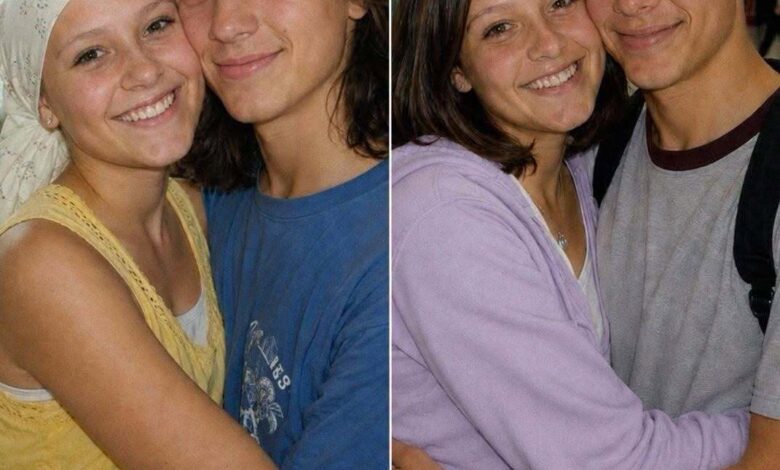
A photograph of the two of us when his hair had grown almost to his shoulders.
A small box with a few things from treatment.
And the memory of what he had done.
I thought about him sometimes.
Especially when I saw teenagers trying desperately not to look scared.
Twenty-five years passed.
By then, I was volunteering every Tuesday in a pediatric oncology unit.
I had not planned on ending up there.
For years, hospitals were the last places I wanted to revisit.
The smells alone could pull me backward.
Disinfectant.
Plastic tubing.
Something metallic in the air.
Eventually, though, the fear changed.
The corridors became familiar again, but differently.
I began noticing what frightened children noticed.
The squeak of the paperwork cart.
The soft voices adults used when they were trying not to cry.
The steady beeping that never completely disappeared.
The silence after doctors left the room.
I understood things the staff sometimes could not.
Not medically.
Emotionally.
I knew what it felt like to have strangers discuss your body as though you were not sitting there.
I knew what it felt like to avoid mirrors.
I knew what it felt like to worry that everyone at school would see illness before they saw you.
Volunteering became my way of returning some of what had been given to me.
One Tuesday, I stopped outside room 214.
New patient.
I checked the name.
Then entered.
A girl lay in the bed, pale and exhausted.
Her father sat beside her.
He looked like every parent I had seen trying to remain composed for a child.
Tired.
Alert.
Terrified.
At first, nothing about him seemed familiar.
Then he spoke.
Just one sentence.
Something about whether his daughter wanted another sip of water.
I froze.
The voice reached somewhere memory had been waiting.
I looked at him more carefully.
Older now.
Different hair.
Lines around the eyes.
Time had changed him.
But not completely.
Noah.
He did not recognize me.
Why would he?
I introduced myself.
“Sarah.”
The name did not immediately register.
His attention returned to his daughter.
As it should have.
I did not force recognition.
That moment was not about me.
Over the next few visits, I learned how difficult things had become.
His daughter was struggling with treatment.
She hated the physical changes.
She did not want friends visiting.
She did not want photographs.
She sometimes refused to look at herself.
Every word felt familiar.
Noah encouraged her.
He asked her to eat.
Reminded her about medication.
Tried to make jokes.
Sometimes she ignored him.
Sometimes she snapped.
He never left.
One afternoon, I asked him to step into the hallway.
He looked confused.
“What is it?”
I smiled.
“Do you remember graduation?”
He stared.
Then I mentioned the jokes kids used to make about his hair.
Something changed in his face.
I watched recognition move slowly across it.
“Sarah?”
I nodded.
For a moment, he simply looked at me.
Then his eyes filled.
“You’re here.”
“I’m here.”
He shook his head.
“I didn’t know.”
“I know.”
He covered his mouth with one hand.
The years between us seemed to disappear.
“I always wondered what happened to you,” he said.
“I always wondered how I could repay you.”
He frowned.
“Repay me?”
“For the wig.”
He looked away almost immediately.
“That was nothing.”
“Noah.”
“It was hair.”
“It wasn’t.”
He looked back at me.
I told him what he had never known.
How much I hated school.
How terrified I had been.
How wearing that wig did not make cancer disappear but made me feel less exposed.
How knowing he had grown it through a year of jokes mattered more than the wig itself.
Then I looked through the doorway toward his daughter.
“I think maybe I finally know why I kept that story.”
We went back inside.
I sat beside her.
She barely looked at me.
“I heard you’re having a hard time with people seeing you.”
Her shoulders tightened.
I continued carefully.
“When I was about your age, I had cancer too.”
That got her attention.
I told her I lost my hair.
I told her I hated mirrors.
I told her I wanted to disappear.
Then I pointed toward Noah.
“Your dad was my best friend.”
She looked at him.
I smiled.
“He grew his hair for a full year.”
Noah lowered his head.
“People made fun of him. A lot.”
Her eyes moved between us.
“He never told them why.”
“Why?”
“Because he was growing it for me.”
The room became quiet.
“When it was long enough, he cut it and had it made into a wig.”
She stared at her father.
Until that moment, Noah had been Dad.
The anxious man reminding her to eat.
The person asking nurses too many questions.
The adult saying, “You can do this,” when she did not want to hear it.
Now she saw something else.
A fifteen-year-old boy letting people laugh at him for a year because his friend was scared.
I opened the small box I had brought.
Inside was the old photograph.
Noah with long hair.
Me beside him.
Both of us impossibly young.
His daughter took it carefully.
“That’s you?”
“That’s me.”
She studied my face.
“You look normal.”
I laughed softly.
“I did not feel normal.”
She looked again.
Then at me now.
“You got better?”
“Yes.”
Her eyes stayed on mine.
Not every patient gets the same outcome.
I knew that.
So I did not promise her anything medicine could not promise.
I only gave her what was true.
“I got older.”
She nodded slowly.
“You were scared?”
“Very.”
“And you still went back to school?”
“Eventually.”
She looked down at the photograph.
Then she handed it back.
Not casually.
Carefully.
Like something she might want to see again.
I could not take away her illness.
I could not guarantee that treatment would become easier.
I could not erase the fear she felt when she looked in a mirror.
But I could stand in front of her as proof of one possible future.
Twenty-five years earlier, Noah had helped a frightened girl believe she might still belong in the world.
Now that girl was standing beside his daughter’s hospital bed.
That felt larger than coincidence.
Over the next several weeks, I visited often.
Sometimes we talked.
Sometimes we did not.
His daughter eventually asked to see the photograph again.
Then she asked what the wig looked like.
Then she laughed when I told her Noah had been furious because the stylist made it shinier than his actual hair.
Noah protested.
“It was ridiculous.”
“It was perfect.”
“It was extremely shiny.”
His daughter smiled.
That was enough.
One afternoon, Noah walked me to the elevator.
“I don’t know how to thank you.”
I looked at him.
“You already did.”
He shook his head.
“That was twenty-five years ago.”
“Exactly.”
That was when I finally understood something I had spent decades missing.
Kindness is not a debt.
You do not repay it by recreating the exact gesture.
I did not need to grow my hair for Noah.
I did not need to return an object of equal value.
I needed to carry forward what his kindness had given me.
Courage.
Presence.
The knowledge that one person standing beside you can change how survivable something feels.
Years earlier, Noah had taken some of my fear and carried it without making a performance of the sacrifice.
Now he was the frightened one.
Not for himself.
For his child.
And I could finally stand beside him.
Not as payment.
As continuation.
Months later, I saw his daughter walking slowly down the hospital hallway.
Noah was beside her.
She wore a soft cap.
She did not hide when another family passed.
She looked tired.
But she kept moving.
When she saw me, she lifted one hand.
I waved back.
Noah looked at me.
There was no need to say anything.
Twenty-five years had closed a circle neither of us knew we were drawing.
At fifteen, I believed his gift was a wig.
It was not.
The real gift was the message underneath it.
You are not facing this alone.
That message stayed with me longer than the hair.
Longer than treatment.
Longer than high school.
Long enough to reach another frightened child.
Noah once helped me step back into the world when I wanted to disappear from it.
Years later, his daughter began taking her own steps.
And I finally understood how kindness survives.
It does not come back looking exactly the same.
It moves forward.
One person carries it until another person needs it.
Then they pass it on.
And sometimes, if enough years go by, the courage you thought belonged to the past finds its way home.