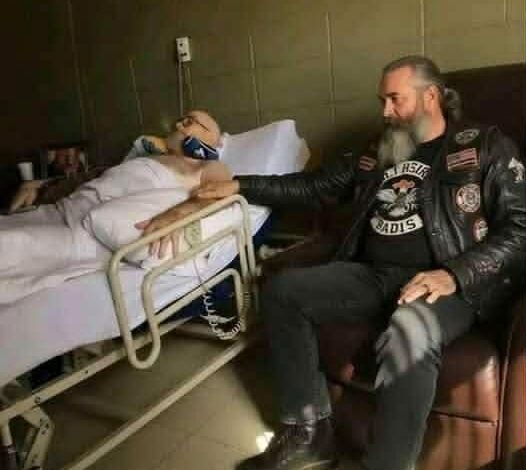
Russell Douglas spent his final months waiting for a sound that rarely came.
Not the nurse entering his hospice room.
Not the medication cart rolling down the hallway.
The phone.
At seventy-three, Russell knew his time was running short. His health had declined enough that doctors were no longer talking about recovery. Hospice had become less about fighting death and more about making whatever time remained comfortable and dignified.
Russell understood that.
What he had not expected was how lonely dying could be.
He was a retired veteran, a man who had spent much of his life serving, working, providing, and raising a family. For years, he had imagined old age differently.
He thought there would be visits.
Grandchildren.
Stories repeated too many times.
Arguments over what to watch on television.
People complaining that his house was too warm.
Then his wife died.
Afterward, the family seemed to loosen one thread at a time.
His children had careers.
Families.
Responsibilities.
Some lived far away.
Nobody announced that they were abandoning their father.
That was what made it so painful.
There was no single fight.
No slammed door.
No final declaration.
Just postponement.
“I’ll call Dad tomorrow.”
“We’ll visit next month.”
“Work is crazy right now.”
“The kids have activities.”
“Maybe over the holidays.”
One missed call made the next easier to miss.
One canceled visit became two.
Then months passed.
Russell waited.
His children assumed there would always be another weekend.
Eventually, there wasn’t.
Hospice workers came to know him as gentle and grateful.
He thanked people for bringing water.
Apologized when he needed help.
Asked nurses about their families.
He told stories about military service, his wife, his children when they were young.
He did not spend his days angrily condemning the people who rarely visited.
If anything, he protected them.
“They’re busy,” he would say.
Sometimes he said it before anyone asked.
Then one afternoon, a stranger walked into his life.
The man was a local biker.
He had heard about Russell and asked whether the veteran might like some company.
They had never met.
Russell looked at the leather vest, the boots, and the stranger standing awkwardly near his doorway.
“You here to arrest me?” Russell joked.
The biker laughed.
“Wrong uniform.”
That was enough.
He pulled up a chair.
The first visit could easily have lasted ten minutes.
Instead, they talked.
Russell spoke about the military.
The biker listened.
Russell talked about his wife.
The biker listened to that too.
Then Russell started talking about getting older.
Not dramatically.
Just honestly.
How strange it was to watch the world continue when your own world had become one room.
How difficult it was when people began speaking around you as though illness had replaced personality.
And how loneliness was different when you knew you did not have years to wait for it to end.
The biker didn’t offer inspirational clichés.
He stayed.
Then, days later, he came back.
That mattered.
Anybody can make one compassionate visit.
Returning turns kindness into relationship.
Over the following weeks, the biker kept showing up.
Sometimes they talked about serious things.
Sometimes they laughed.
Sometimes Russell repeated a story the biker had already heard.
He listened anyway.
For a few hours at a time, Russell was no longer merely a hospice patient.
He was Russell.
A veteran.
A husband who still missed his wife.
A father who remembered teaching his children things they had probably forgotten.
A man with opinions, jokes, regrets, memories, and stories worth hearing.
The biker could not cure him.
He could not restore Russell’s family.
He could not add years to his life.
He gave him something simpler.
Time.
And near the end of a life, time may be the most honest gift anyone can offer.
As Russell weakened, he began reconsidering his affairs.
There were papers to review.
Possessions to account for.
Final instructions to make clear.
And there was his will.
His children probably assumed whatever Russell possessed would eventually pass to them.
That assumption wasn’t unusual.
Blood creates expectations.
Family titles can make inheritance feel automatic.
But Russell had spent his final months learning something he wished he had never needed to learn.
A title describes a relationship.
It does not maintain one.
“Son” means something.
“Daughter” means something.
“Father” means something.
But none of those words can make a phone ring.
They cannot sit beside a bed.
They cannot listen.
They cannot notice that somebody is lonely.
Only people can do that.
Russell changed his final wishes.
Not because he wanted his last act to be revenge.
Bitterness would have been easy.
Instead, he wanted his decisions to reflect the reality of his final months.
Who had shown up?
Who had stayed?
Who had treated him like a person when there was nothing left to gain except another conversation?
The answer was uncomfortable.
A stranger had done what family had postponed.
Then Russell died.
His children gathered afterward expecting the ordinary administrative ritual that follows a parent’s death.
Documents.
Property.
Possessions.
Numbers.
Instead, Russell’s final decisions confronted them with something no inheritance could soften.
Their father had noticed their absence.
Maybe they had imagined he understood.
Maybe they thought their explanations were enough.
Jobs really were demanding.
Travel really was difficult.
Children really did have schedules.
Life really does become overwhelming.
All of those things can be true.
And someone can still be lonely because you did not come.
That is the painful distinction Russell’s story exposes.
An explanation is not the same as an absence having no consequence.
His children had not necessarily stopped loving him.
But love that is endlessly postponed becomes difficult for the person waiting to feel.
Russell’s possessions could be divided after his death.
His remaining time could not.
That was the inheritance they could never recover.
The conversations they didn’t have.
The questions they didn’t ask.
The stories they assumed they already knew.
The ordinary afternoon visits that seemed inconvenient until there were no afternoons left.
And standing silently at the center of that realization was the biker.
He did not need to accuse anyone.
His presence had already made the argument.
He had no childhood obligation to Russell.
No inheritance to expect.
No family reputation to protect.
He simply heard that an older veteran was lonely and decided to visit.
Then he decided to visit again.
That second decision may have mattered even more than the first.
Compassion is often imagined as something dramatic.
Saving someone.
Donating enormous amounts of money.
Making a sacrifice everyone can see.
But much of human kindness is far less cinematic.
It is sitting in a chair.
Putting your phone away.
Listening to the same story twice.
Coming back when nobody would blame you for being busy.
The biker could not change Russell’s ending.
He changed how lonely the road toward it felt.
That is no small thing.
Russell’s children were left with a lesson far more difficult than simply losing money from a will.
They had to live with the knowledge that they had mistaken availability for permanence.
Dad was there.
Until he wasn’t.
There would always be another call.
Until there couldn’t be.
Another Christmas.
Another weekend.
Another chance to say, “I’ve been busy, but I’m coming soon.”
Then hospice turns “soon” into a dangerous word.
Russell’s story does not mean adult children must abandon jobs, families, or responsibilities whenever an aging parent wants attention.
Relationships are complicated.
Distance can be real.
Families can carry histories outsiders never see.
But the larger warning remains.
Do not confuse loving someone with making sure they know it.
Those are different things.
Love may exist silently inside you.
The other person experiences what reaches them.
The call.
The visit.
The chair pulled beside the bed.
The hand held during a difficult afternoon.
Russell had spent much of his life serving others.
Near the end, he needed very little.
Nobody could give him his youth back.
Nobody could bring his wife home.
Nobody could guarantee another year.
He needed presence.
A stranger understood.
His family understood too late.
That is what makes the story linger.
Not the amount of money involved.
Not who received which possession.
Not even the shock of a changed will.
It is the image of an elderly veteran sitting in hospice while people who loved him assumed there would always be more time.
And then another man—someone with no obligation whatsoever—walking through the door and staying.
Russell’s final lesson was not really about inheritance.
It was about what cannot be inherited.
Time.
You cannot receive yesterday from an estate.
You cannot recover a missed conversation from a bank account.
You cannot hug someone through regret.
You cannot finally make the call once the number belongs only to memory.
Russell left his children whatever final decisions he believed were right.
But the most valuable thing he left behind belonged to anyone willing to hear the story.
Call while someone can answer.
Visit while there is still a chair beside the bed.
Listen while the story can still be told by the person who lived it.
Because eventually, all the excuses that once seemed urgent become strangely small.
And when that day comes, love will not be measured by what you meant to do.
It will be remembered by who showed up when showing up was all that remained.