I Went to the Hospital to Care for My Son After He Broke His Leg – Then the Nurse Slipped Me a Note, ‘He’s Lying. Check the Camera at 3 a.m.’

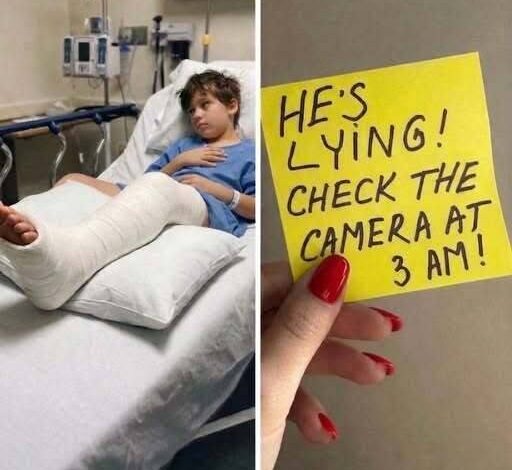
When my ex-husband called to tell me our son had broken his leg, his voice was almost too calm.
“Howard slipped,” Jasper said. “It was just an accident.”
Just an accident.
He repeated those words twice.
I wanted to believe him.
God, I wanted to.
Because accidents happen. Kids climb things they shouldn’t, run too fast, miss a step, land wrong. A broken leg was awful, but simple. Painful, but explainable.
What unsettled me was the way Jasper told the story.
Too quickly.
Too cleanly.
Every detail arrived in the right order, as if he had already gone over it in his head before dialing my number.
By the time I reached the hospital, that uneasy feeling had settled somewhere beneath my ribs.
Howard looked tiny in the bed.
He was ten years old, but beneath the thin hospital blanket he suddenly looked six. His face was pale with exhaustion, and the bright white cast wrapped around his leg seemed almost absurdly large against his small body.
I pulled a chair close and brushed his hair away from his forehead.
“Hey, sweetheart.”
His eyes filled immediately.
“I’m sorry, Mom.”
I froze.
“Sorry?”
He looked down at the blanket.
“For falling.”
Something inside me tightened.
Kids apologize for breaking windows.
For sneaking cookies.
For doing something they were specifically told not to do.
They usually don’t apologize for getting hurt.
I leaned closer.
“You don’t have to be sorry for an accident.”
Before Howard could respond, Jasper stepped toward the bed.
“He just slipped,” he said.
I looked at him.
“I was asking Howard.”
Jasper’s jaw tightened for half a second.
Then the smile returned.
“Of course. I’m just saying, I was there. I saw it happen.”
Howard’s eyes stayed fixed on the blanket.
That was when I knew.
I didn’t know what was wrong yet.
But something was.
I told Jasper I was staying overnight.
He seemed annoyed, though he tried to hide it.
“You don’t have to. I can stay.”
“I know.”
I smiled politely.
“I’m staying anyway.”
Hours passed.
Machines beeped softly in the hallway. Nurses came and went. Howard finally drifted into an uneasy sleep.
Near midnight, a charge nurse entered to check his vitals.
She was older, maybe in her fifties, with tired eyes and the calm movements of someone who had spent years noticing things other people missed.
She checked Howard’s IV.
Adjusted the blanket.
Reviewed his chart.
Then Jasper leaned over the bed to move Howard’s pillow.
Howard flinched.
Barely.
Just a tiny tightening through his shoulders.
But I saw it.
The nurse saw it too.
Our eyes met for less than a second.
She said nothing.
A few minutes later, she left the room.
As she passed me, her hand brushed mine.
Something folded was pressed into my palm.
I waited until the door closed.
Then I opened it.
Three sentences.
He’s lying.
Check the camera at 3 a.m.
Don’t warn him.
My heartbeat became so loud I could hear it.
I didn’t sleep after that.
At exactly three in the morning, I stood in a cramped security room beside a guard who looked like he had been pulled out of the middle of a long shift.
“I need to see footage from my son’s room.”
He frowned.
“I can’t normally—”
“Please.”
Something in my face must have convinced him.
After a few calls and a conversation with hospital staff, the footage appeared on the monitor.
Howard’s room.
Dark.
Quiet.
My son asleep beneath the blanket.
For several minutes, nothing happened.
Then the door opened.
Jasper walked in.
I leaned toward the screen.
A woman followed him.
I had never seen her before.
She stayed near the wall while Jasper sat beside Howard’s bed.
Even through the grainy footage, I recognized the way my son’s body stiffened.
Jasper lowered his voice.
“Make sure we’re telling the story the right way.”
Howard stirred.
“I told everybody I fell.”
“Good.”
A pause.
“That’s what we stick to.”
My stomach dropped.
Howard whispered, “I don’t want to lie to Mom.”
Jasper’s expression changed.
The softness disappeared.
“You have to.”
Howard looked scared.
“Why?”
“Because your mom can’t know I wasn’t there.”
Everything inside me went cold.
I stared at the screen.
He hadn’t been there.
Jasper had lied from the first phone call.
The woman beside him finally spoke.
“Maybe we should just tell her.”
Jasper snapped his head toward her.
“No.”
Then Howard said the name.
“Kelly said I could climb it.”
The woman looked away.
Piece by piece, the truth came together.
Kelly had been watching him.
Jasper had left.
Howard had climbed somewhere he shouldn’t have while Kelly wasn’t paying enough attention.
He fell.
The accident itself may have been preventable.
But what came afterward was deliberate.
Jasper coached him.
He told him what to say.
What not to say.
Who needed protecting.
And worst of all, he made our ten-year-old son believe the burden belonged to him.
When the recording ended, the room felt too small.
The security guard looked at me carefully.
“Do you want this preserved?”
“Yes.”
My voice barely sounded like mine.
“Please save everything.”
By morning, the hospital social worker was involved.
Statements were taken.
The footage became part of the official record.
What had happened was no longer a private disagreement between divorced parents.
It was evidence.
When I confronted Jasper, he denied it first.
Then he changed tactics.
“You’re blowing this out of proportion.”
“You told him to lie.”
“It was one mistake.”
“You told our child to lie.”
“I was gone for ten minutes.”
I stared at him.
“You still don’t understand.”
He threw his hands up.
“Then explain it.”
“It isn’t about ten minutes.”
My voice shook, but I didn’t raise it.
“It’s about what you did when something went wrong.”
He went quiet.
“You protected yourself,” I said. “And you made Howard help you do it.”
The weeks after that were brutal.
Lawyers.
Custody meetings.
Statements.
Schedules changed.
Conversations I never imagined having.
Howard began seeing a therapist.
Not because of his leg.
Bones heal.
What worried me was everything beneath the cast.
The fear.
The guilt.
The secret.
The belief that keeping his father safe somehow mattered more than telling the truth.
One afternoon, after therapy, Howard sat beside me in the car.
He stared out the window for a long time.
Then he whispered, “Mom?”
“Yeah?”
“I don’t like keeping secrets.”
My throat tightened.
I reached over and took his hand.
“You don’t have to.”
He looked at me.
“Even if someone gets mad?”
“Even then.”
“What if it’s Dad?”
“Even then.”
His eyes filled.
“What if it’s you?”
That nearly broke me.
I squeezed his hand.
“Especially then.”
He leaned against my shoulder.
And I finally understood the worst thing Jasper had done.
It wasn’t leaving Howard unsupervised.
It wasn’t even the lie.
It was teaching him that an adult’s comfort was more important than a child’s truth.
So I made him a promise.
“You never have to protect me from the truth,” I said. “You never have to protect any adult from it.”
Howard nodded slowly.
The cast came off months later.
His leg healed.
He ran again.
Played again.
Climbed again, though I’m pretty sure he enjoyed watching me panic every time he did.
But the thing I cared most about healing wasn’t visible on an X-ray.
It was his trust in his own voice.
Children should never be forced to carry the weight of choices adults are too afraid to own.
They should never believe silence is the price of love.
And they should never be taught that keeping a family together matters more than telling the truth.
Jasper gave our son a lie to carry.
I made sure he learned how to put it down.
And from that day forward, Howard knew one thing with absolute certainty:
No matter who asked him to stay quiet, he would never again have to carry someone else’s secret.