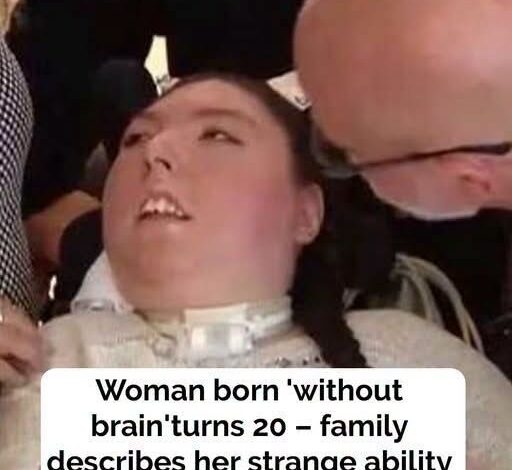
The day Alex was born was supposed to be the beginning of a lifetime of firsts—first smiles, first words, first steps, and dreams her parents had barely begun to imagine. Instead, Shawn and Lorena found themselves sitting in a hospital room listening to words that would change everything they thought they knew about the future.
Doctors delivered a diagnosis few parents ever expect to hear: hydranencephaly, a rare condition in which the cerebral hemispheres fail to develop. They explained the medical realities as gently as they could, but the message felt devastating. The prognosis was bleak. They were told their daughter would likely survive only a few years. Some estimated she might not live beyond the age of four.
In that moment, it felt as though they had been handed not just a diagnosis, but a countdown.
They carried their newborn home with hearts divided between overwhelming love and overwhelming fear. While other parents filled baby books with plans for birthdays, school, and family vacations, Shawn and Lorena learned to measure time differently. Every quiet night carried uncertainty. Every illness became frightening. Every morning they woke beside Alex felt like a gift they had not been promised.
For years, Lorena slept close to her daughter, listening to each breath in the darkness. She feared the silence that might one day replace it, never knowing whether the next sunrise would arrive with another chance to hold her little girl or with unimaginable heartbreak. It was an exhausting way to live, but love rarely asks whether the journey will be easy.
As the months became years, something remarkable happened.
Alex kept breathing.
She celebrated her first birthday.
Then her second.
Then her fourth—the milestone doctors had doubted she would ever reach.
Still, she continued surprising everyone.
Five became ten.
Ten became fifteen.
Before long, the little girl whose future had once been measured in months had grown into adulthood, quietly rewriting expectations simply by continuing to live.
Although Alex cannot see or hear in the ways most people do, her family believes she experiences the world through connection. They describe how she appears to respond to the gentle touch of a familiar hand, the comforting presence of loved ones nearby, and the emotional atmosphere surrounding her. Whether through touch, routine, or forms of perception science is still working to understand, they believe she recognizes the love that fills the room.
Her younger brother, SJ, has spent his entire life growing up alongside her.
To him, Alex has never been defined by a medical diagnosis. She is simply his sister. He has watched moments that convinced him she understands far more than many people assume. During difficult days, when emotions run high or tension fills the house, he says Alex often seems to bring an unexpected calm, as though her quiet presence reminds everyone to slow down and remember what truly matters.
Their family’s experience has also brought them face-to-face with painful assumptions made by others. Over the years, they have encountered people who reduced Alex to her condition, describing her in ways that overlooked her humanity and dismissed the value of her life. Those moments have been among the hardest to bear—not because of the diagnosis itself, but because of how quickly some people judged a life they had never truly taken the time to understand.
Shawn and Lorena respond to those judgments not with anger, but with unwavering conviction.
They do not see a mistake.
They do not see a life defined solely by medical limitations.
They see their daughter.
They see the child they have loved through every uncertain night, every difficult milestone, and every unexpected year that followed. To them, Alex is not a collection of diagnoses or predictions. She is a person whose life has brought immeasurable meaning to those fortunate enough to know her.
Their journey has taught them lessons they never expected to learn. They discovered that hope can survive even when certainty disappears. They learned that joy is often found in moments others might overlook—a hand gently squeezing back, a peaceful afternoon together, another birthday once thought impossible. They came to understand that love is not measured by how closely life follows a plan, but by the willingness to embrace each day exactly as it comes.
Today, Alex’s story continues to inspire conversations about resilience, compassion, and the limits of medical prediction. Her life does not erase the seriousness of her condition, nor does it diminish the challenges her family has faced. Instead, it stands as a reminder that every individual journey is unique and that statistics can never fully capture the depth of a person’s impact on those who love them.
For Shawn and Lorena, the greatest lesson has never been about defying expectations or proving anyone wrong. It has been about discovering that the value of a life cannot be measured by its limitations, its prognosis, or the milestones it does or does not reach.
It is measured in love.
In quiet moments shared between family members.
In hands held through uncertainty.
In birthdays celebrated when none were promised.
Looking back, they no longer think of the diagnosis as the story’s defining moment. The defining moments came afterward—in every sunrise they were grateful to witness together, every year they were blessed to celebrate, and every reminder that a life need not be ordinary to be extraordinary.
In loving Alex, they say they discovered something far greater than they ever expected.
They discovered that being fully alive is not measured by how much a person can do, but by how deeply they can be loved—and how completely they can teach others to love in return.