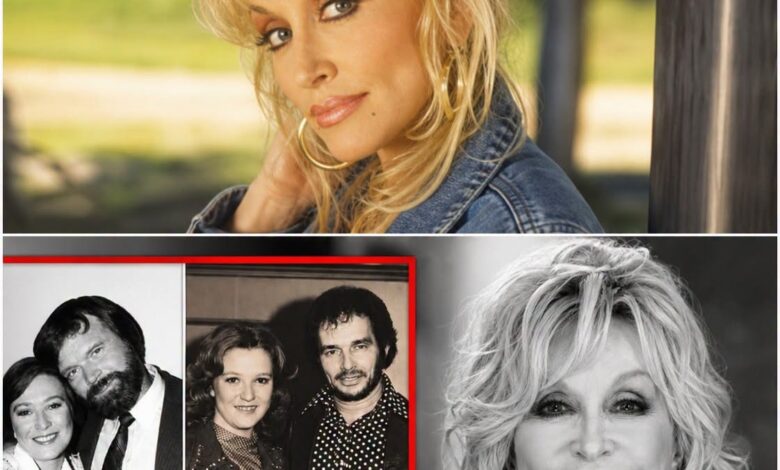
In those final recorded reflections, Dolly Parton did not seem interested in counting trophies.
She did not linger over chart records, sold-out theaters, movie roles, business ventures, or the songs that had traveled farther than the girl who first dreamed them up in the Tennessee mountains.
Again and again, she returned to one name.
Carl.
For most of her public life, Carl Dean had been described as the mysterious husband—the man who stayed away from cameras while his wife became one of the most recognizable women in the world. His absence from red carpets created its own mythology. People wondered why he rarely appeared beside her, how their marriage survived her fame, and what their life looked like when the wigs came off and the doors closed.
But Dolly never seemed to believe Carl was a mystery requiring explanation.
To her, he was shelter.
The world knew the rhinestones.
Carl knew the woman who took them off.
And as his health declined, that private distinction became even more important.
She spoke of caregiving without trying to make herself heroic. There were sleepless nights, appointments, medications, hospital corridors, interrupted schedules and the particular exhaustion that comes from loving someone whose world is becoming smaller.
There were nights when she barely slept before obligations pulled her back toward the public version of herself.
Makeup.
Hair.
Smile.
Lights.
Then home again.
What outsiders might have called sacrifice, Dolly described more simply.
She had made a promise.
She was keeping it.
That mattered because marriage, in her telling, had never been defined by how beautifully two people could stand together for a photograph.
It was measured by who remained when there was nothing glamorous left to witness.
Carl had spent decades giving her room to become Dolly Parton without demanding that her spotlight illuminate him too.
When he needed her, she returned that gift in the language she understood best:
presence.
Not performance.
Not publicity.
Presence.
There is something striking about imagining those two lives running beside each other.
Outside their home, Dolly belonged to millions.
Fans felt they knew her through songs, interviews, jokes, movies and decades of carefully cultivated warmth. Her voice could fill arenas. Her image could tower over highways. Her name could become attached to businesses, charities, books and institutions.
Inside, she could simply be Carl’s wife.
The woman bringing water.
Straightening a blanket.
Waiting for a doctor.
Listening for movement in the middle of the night.
As his needs increased, the distance between those worlds became harder to manage.
Dolly acknowledged that she pushed herself.
She ignored signals from her own body.
She postponed rest.
She convinced herself she could keep doing one more thing because there was always one more thing that needed doing.
People who love caregivers often tell them the same thing:
You have to take care of yourself too.
It sounds obvious.
Living it can be much harder.
When someone you love is suffering, your own exhaustion can feel negotiable.
Their pain feels urgent.
Your fatigue can wait.
Their appointment matters.
Your warning signs become tomorrow’s problem.
Tomorrow becomes next week.
Then months have passed.
Dolly did not romanticize that completely. She understood, looking back, that she had asked too much of herself.
But regret was not the emotion that dominated her words.
Tenderness was.
She had protected Carl’s privacy throughout their marriage, and illness did not suddenly make his suffering public property.
That boundary became almost sacred.
The world had been invited into enormous portions of Dolly’s life.
It did not automatically deserve access to his decline.
So she kept smiling when she could.
She redirected questions.
She fulfilled commitments.
She carried private worry beneath public sparkle.
That did not mean every smile was false.
Human beings are capable of holding joy and grief simultaneously.
She could laugh with an audience and still worry about Carl.
She could sing a beloved song and still count the hours until she returned home.
She could be grateful for her career while wishing, somewhere beneath the applause, that the person she loved were stronger.
That contradiction had always existed inside their marriage.
Dolly was intensely public.
Carl was intensely private.
Her career required visibility.
His peace depended partly on avoiding it.
Instead of treating those differences as proof that the marriage was strange, they built a life around respecting them.
Perhaps that was one reason it lasted.
They did not demand identical ways of existing.
Carl did not have to become a celebrity husband.
Dolly did not have to become less ambitious to prove she loved him.
They found a way to let two very different temperaments share one commitment.
Then aging changed the terms.
The glamorous years did not disappear, but eventually marriage became what long marriages often become:
practical love.
Remembering medications.
Changing plans.
Sitting in waiting rooms.
Helping someone stand.
Repeating an answer.
Watching.
Waiting.
Worrying.
Staying.
There are no awards for those things.
No standing ovations.
Nobody announces that you successfully made it through another difficult night.
That may be why Dolly regarded caregiving as some of the purest work of her life.
It asked for something fame rarely does.
It asked her to do important things without being seen doing them.
For a woman whose professional existence had unfolded beneath lights, there was something almost poetic about the most intimate expression of her love happening beyond them.
No audience.
No applause.
Just Carl.
And her word.
When she spoke about having pushed herself too far, there was an uncomfortable truth beneath it.
Love does not make the body limitless.
Devotion cannot replace sleep indefinitely.
Keeping a promise does not mean a person should destroy themselves in the process.
Caregiving can be sacred and exhausting at the same time.
Dolly seemed able to hold both truths.
She could recognize that she should have listened more carefully to her own body without wishing she had loved Carl less.
That distinction mattered.
If given another chance, perhaps she would have accepted more help.
Perhaps she would have rested sooner.
Perhaps she would have admitted when she was frightened or exhausted.
But none of that meant she wanted those years back.
Because to her, the cost and the love could not be separated neatly.
Carl had been there before much of the mythology.
Before the empire.
Before generations knew her simply as Dolly.
He represented a place where achievement was irrelevant.
A bad review could not change it.
Neither could a number-one record.
She did not have to earn belonging there.
She could simply come home.
That was the sanctuary she had spent decades protecting.
Not because it was perfect.
Because it was theirs.
Near the end of those reflections, her voice softened.
The woman famous for turning pain into melodies seemed to reduce an entire lifetime to something simpler than any lyric.
Love costs.
Not always dramatically.
Usually in pieces.
Time.
Sleep.
Patience.
Convenience.
Pride.
Plans.
Sometimes, eventually, nearly everything you thought you still had to give.
But Dolly’s measure was not whether love had been expensive.
It was whether, knowing the price, you would choose it again.
For Carl, her answer remained yes.
The world could keep the records.
The awards could sit on shelves.
The songs could continue without her.
What mattered in the quietest accounting of her life was that when the man she had promised to love needed her most, she stayed.
The world called it sacrifice.
She called it marriage.
And in the end, the woman who had spent a lifetime giving millions of people pieces of herself seemed most certain about the part she had kept private:
If love asked everything of you, and knowing the cost you would still pay it again, then perhaps you had not lost yourself at all.
Perhaps you had lived exactly as you meant to.