For several seconds, I forgot how to move.
The wind tore across the beach hard enough to sting my face, carrying salt and sand with it, but I barely noticed. Waves crashed behind me, rushed up the shore, and retreated again with a hiss.
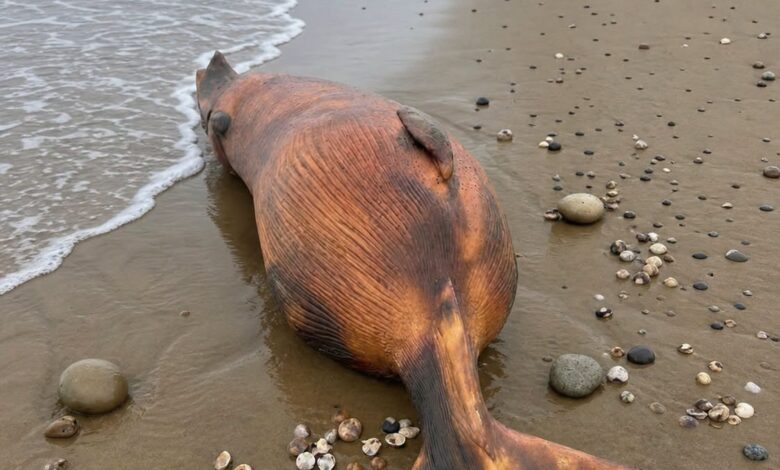
At my feet lay something enormous.
Pale.
Smooth.
And completely wrong.
I had been walking without paying much attention, looking down occasionally for shells or driftwood, when I noticed the shape farther ahead. From a distance, I assumed it was debris—maybe a tarp wrapped around something, or part of an overturned boat.
Then I got closer.
It looked like an animal.
At least, I thought it did.
The body was several feet long, thick through the middle and narrowing toward a strange curved tail. Its surface was almost white, with patches of gray where sand and seawater clung to it. There were no obvious scales, no fur, and nothing that immediately told me what species I was looking at.
The tail bothered me most.
It bent upward and around at an angle that looked impossible, as though some tremendous force had twisted it before the creature washed ashore.
But the longer I stared, the stranger that explanation felt.
The curve was too smooth.
Too deliberate.
Not like a broken bone.
More like something designed that way.
I took one cautious step closer.
Then stopped.
Every sensible part of my brain told me not to touch it.
I had no idea whether it was alive, dead, dangerous, decomposing, or carrying something I shouldn’t be anywhere near.
So I pulled out my phone.
My hands were shaking enough that the first photograph blurred.
I took another.
Then another from several steps to the side.
The camera somehow made the thing look even stranger.
I zoomed in.
The surface appeared almost skinlike, but there was something unnaturally uniform about it. At the time, I couldn’t identify what bothered me. Fear had already supplied the explanation my eyes wanted.
Dead animal.
Unknown animal.
Maybe something from deep water.
I started searching.
“Large pale sea creature curved tail.”
The results were useless.
Whales.
Dolphins.
Sharks.
Sunfish.
Decomposed marine mammals so distorted by time and water that they barely resembled living animals.
For a moment, whale seemed possible.
I compared the photographs.
No.
The tail was wrong.
Dolphin?
Not quite.
The body didn’t make sense.
Some kind of deep-sea creature?
That possibility sent my imagination in exactly the direction it did not need to go.
I had seen photographs of animals dragged from parts of the ocean humans rarely encounter—transparent bodies, enormous mouths, eyes adapted to permanent darkness.
Maybe this was something unusual.
Something carried toward shore by currents after dying far offshore.
I searched again.
Nothing matched.
And the more photographs I compared, the less certain I became.
Every animal had one feature that seemed close, followed by three that clearly weren’t.
I zoomed into my own pictures again.
That was when I noticed something near the side of the body.
A line.
At first I thought it might be an injury.
But it was unusually straight.
I enlarged the image until it became grainy.
There was definitely some kind of seam.
Or maybe I only thought there was.
I looked from the phone to the object lying in front of me.
A wave reached it and rolled underneath one edge.
The body shifted slightly.
I jumped backward.
Nothing happened.
No breath.
No twitch.
No sudden movement.
Just another wave.
I laughed once, nervously, at myself.
Then immediately stopped because the beach felt too empty for laughter.
I decided I needed someone who actually knew what they were looking at.
There was a local wildlife group online where people posted photographs of injured birds, unusual tracks, stranded marine animals, and everything else found along the coast.
I uploaded three pictures.
Anyone know what this is? Found washed up on the beach. Not touching it.
Then I waited.
The first responses arrived almost immediately.
“Looks like a whale.”
Someone else disagreed.
“No way. Tail is completely wrong.”
“Could be badly decomposed.”
“Call wildlife authorities and stay away.”
One person suggested a shark whose body had deteriorated.
Another guessed a large ray.
Then somebody wrote:
“Are you sure that’s real?”
I stared at the comment.
Real?
Of course it was real.
I was standing ten feet from it.
Then I understood what they meant.
Was it actually an animal?
I looked again.
The smoothness suddenly seemed different.
Not biological.
Manufactured.
The strange curve of the tail no longer looked like an injury. It looked posed.
Another comment appeared.
“Wait. There was filming up the coast recently.”
A few minutes later, someone posted the answer.
It wasn’t a whale.
It wasn’t a dolphin.
It wasn’t some undiscovered monster hauled from the darkness.
It wasn’t an animal at all.
It was a movie prop.
Apparently, a production had recently been filming along the coast using hyper-realistic creature effects. The object on the beach appeared to be one of those props, somehow separated from the production and carried away before eventually washing ashore.
I read the explanation twice.
Then looked at the enormous pale “creature” again.
Suddenly everything made sense.
The seam.
The flawless curve.
The strange skin.
The anatomy that seemed almost right but never quite matched anything living.
It had been designed to fool the eye.
And it had worked spectacularly.
I had spent the better part of an hour convincing myself I had discovered something from the depths of the ocean.
Instead, I had discovered somebody’s forgotten special effect.
The fear drained away so quickly that embarrassment replaced it.
I started laughing.
Really laughing this time.
The beach no longer felt sinister.
The wind was just wind.
The waves were just waves.
And the mysterious corpse at my feet was foam, silicone, latex, or whatever combination of materials filmmakers had used to make audiences believe in something that had never lived.
Still, I didn’t touch it.
Movie prop or not, it was large, waterlogged, and not mine to move.
The wildlife group continued exploding with comments.
People who had initially guessed sea monsters were laughing at themselves.
Others wanted to know what movie it came from.
Someone joked that the prop deserved an acting award because it had apparently convinced half the group.
I looked back through the photographs I had taken.
Now that I knew the truth, the clues seemed embarrassingly obvious.
That’s the strange thing about certainty.
Once someone gives you the correct answer, you begin believing you should have seen it all along.
But standing alone on that beach, I hadn’t possessed the answer.
I had possessed a shape.
A few clues.
A racing imagination.
And an ocean stretching beyond sight.
The ocean makes mystery easy.
We know enough about it to understand how much remains beyond ordinary experience. So when something strange appears on a beach, imagination immediately fills whatever gaps knowledge leaves behind.
That morning, mine certainly did.
But I kept thinking about the object even after I walked away.
Somewhere, someone had designed it.
Artists had sculpted that unnatural tail.
Someone had painted the pale skin.
Technicians had worked to make the surface convincing.
A director had probably positioned it beneath lights while cameras rolled.
Actors may have stood beside it pretending to be terrified.
Then filming ended.
The illusion was supposed to remain inside someone else’s story.
Instead, somehow, it escaped.
The sea took it.
Carried it.
Turned it over in the surf.
And delivered it onto an ordinary beach where I happened to find it.
For an hour, fiction had become completely real to me.
That was the part I loved afterward.
Not the embarrassment.
Not even the relief.
The transformation.
When I first saw it, the thing seemed almost monstrous.
Once I understood it, it became strangely beautiful.
Not because the object had changed.
Because the story around it had.
I had arrived expecting nothing more than a walk.
Instead, I found a mystery, imagined a monster, conducted an amateur investigation, and eventually discovered that the terrifying creature belonged not to the ocean but to someone’s imagination.
By the time I left, the tide had begun creeping higher.
Water gathered around the prop again, lifting the strange curved tail slightly before letting it settle.
I stopped once and looked back.
From that distance, even knowing everything I now knew, it looked alive.
For a second, the old uneasiness returned.
Then I smiled and kept walking.
Some mysteries disappear when you learn the truth.
Others become better stories.
This one had washed out of somebody else’s fiction and landed, briefly, inside my reality.
And for one windswept morning, before I knew what it was, the ocean had made me believe it was keeping a secret.