Most people hear the words “pest control” and imagine the same unpleasant scene.
A technician arrives carrying chemicals. The house fills with a sharp smell. Children and pets have to stay away from treated areas. Traps appear behind furniture, and everyone spends the next several days wondering what was sprayed where.
It is understandable that gentler alternatives sound appealing.
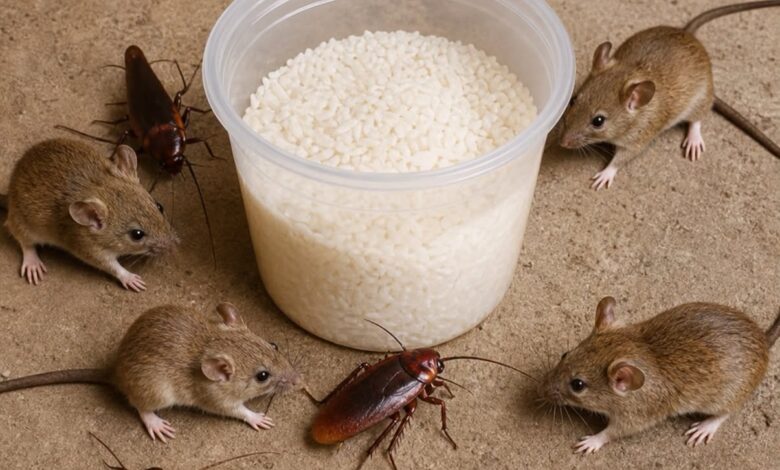
That is how ordinary pantry ingredients such as rice sometimes become the stars of viral pest-control recipes. Add a few household ingredients, the posts promise, and suddenly rats and cockroaches will want nothing to do with your home.
The idea contains one useful truth—but also an important misunderstanding.
You absolutely can make a home far less attractive to pests without saturating it in pesticides.
Rice, however, is not a magical repellent.
In fact, because rice is food, leaving it loose around the house can do the opposite of what you want. Rodents and some insects may investigate accessible grains rather than flee from them.
The safer natural approach begins not with adding food, but with removing the things pests came looking for.
That means thinking like a rat or cockroach for a moment.
They need food.
They need water.
They need shelter.
And they need a way inside.
Take away those four advantages and your home becomes dramatically less welcoming.
Start with the pantry.
Rice, flour, cereal, oats, pasta, pet food, seeds, and other dry foods should be stored in sturdy containers with tight-fitting lids. A paper or thin plastic package may look closed to us while still being vulnerable to pests.
This is where rice really can become part of your pest-control strategy:
Keep it sealed.
The same applies to crumbs and spills.
A few grains beneath a cabinet may mean nothing to a person, but pests survive on much smaller quantities of food than we do. Vacuum beneath appliances when possible, wipe grease from cooking areas, clean up spills promptly, and avoid leaving dirty dishes overnight.
Pet food deserves special attention.
A bowl sitting on the floor through the night can become an unintended feeding station. Store the larger bag securely and, where practical, remove leftover food after feeding.
Then look for water.
A cockroach does not need a kitchen faucet pouring into a bowl.
Tiny moisture sources can be enough.
A slow leak beneath the sink.
Condensation around plumbing.
A perpetually wet sponge.
Water collecting beneath an appliance.
Dampness in a bathroom or basement.
Repair leaks, improve ventilation, and dry persistently wet areas.
These changes may seem almost too simple to qualify as pest control.
But that is exactly the point.
You are not merely trying to kill individual pests.
You are changing the environment that allows them to stay.
Rodents require another step: exclusion.
Walk around the exterior of the house and look carefully at where pipes, vents, cables, doors, foundations, roofs, and utility lines create openings.
Small gaps matter.
Rodents can exploit spaces that seem surprisingly narrow, especially when an opening leads toward warmth, food, or shelter.
Seal appropriate entry points with durable materials suited to the location. Weather stripping and door sweeps can help around doors, while larger structural openings may require proper repair.
If you suspect rodents are already nesting inside a wall, attic, or enclosed area, however, don’t simply seal every opening immediately and risk trapping animals inside.
That is when professional assessment can be worthwhile.
Cockroaches also reveal themselves through patterns.
Rather than spraying strong-smelling products everywhere, find out where activity is concentrated.
Check beneath sinks.
Behind refrigerators.
Around plumbing.
Inside cabinet corners.
Near cracks and crevices.
Sticky monitoring traps can help identify travel routes and determine whether your changes are working.
This is an important difference between “natural” pest management and internet folklore.
Good low-chemical pest control is not about discovering one secret ingredient pests supposedly hate.
It is about observation.
Where are they entering?
What are they eating?
Where are they hiding?
Where is the moisture?
Fix those conditions and you begin solving the underlying problem.
Some people also use strongly scented herbs or essential oils because certain odors may discourage pests from particular spots.
That can be reasonable as a supplementary measure, but scent alone should not be treated as an invisible force field.
A hungry rat with access to food may tolerate an odor it dislikes.
A cockroach population established behind cabinets will not necessarily abandon a reliable source of food and water because the kitchen smells pleasantly herbal.
And “natural” does not automatically mean harmless.
Concentrated essential oils and other homemade mixtures can still irritate skin, eyes, or lungs, and some can be unsafe around particular pets.
Never assume that something is safe to scatter or spray throughout a home simply because it came from a plant or pantry.
Use any product according to reliable safety guidance for the people and animals in your household.
That same caution applies to homemade poisons.
A recipe may be marketed as chemical-free while combining substances intended to injure or kill an animal.
If something is toxic enough to poison a pest, its placement matters.
Children matter.
Pets matter.
Wildlife matters.
That is why prevention, sanitation, exclusion, monitoring, and appropriately used traps or labeled products are generally better foundations than improvised mixtures.
There is also an environmental benefit to this approach.
Reducing unnecessary pesticide use can reduce unnecessary exposure.
But environmental responsibility does not require pretending that every infestation can be solved with rice, herbs, or kitchen ingredients.
Sometimes an established infestation requires targeted treatment.
The goal should be using the least hazardous effective intervention, not avoiding professional pest control at any cost.
A responsible professional does not necessarily begin by spraying every surface.
Modern pest management can combine inspection, exclusion, sanitation, monitoring, trapping, baiting, and carefully targeted treatments.
The best solution is the one that solves the problem while minimizing unnecessary risk.
That philosophy can begin today.
Put the rice into a sealed container.
Clean beneath the stove.
Fix the dripping pipe.
Empty the garbage.
Remove clutter.
Check the gap beneath the back door.
Move pet food into secure storage.
Inspect the dark spaces under sinks and behind appliances.
Those actions lack the drama of a viral “secret recipe.”
But they change something much more important than the smell of your house.
They change whether pests can comfortably live there.
And that is the deeper appeal of gentler pest control.
You are not declaring war on your home because you saw one cockroach.
You are making the home work better.
Drier.
Cleaner.
Better sealed.
Less cluttered.
More carefully maintained.
Those improvements help with pests while also creating a healthier living environment overall.
So yes, there is a way to rethink pest control without automatically reaching for the strongest-smelling chemical on the shelf.
But the secret is not turning rice into a miracle remedy.
It is understanding what rats and cockroaches actually want—and quietly taking those things away.
The rice belongs sealed in the pantry.
The crumbs belong in the vacuum.
The water belongs inside the pipes.
The gaps belong sealed.
And the pests?
Once your home stops offering an easy meal, a reliable drink, a hiding place, and an open door, they have far fewer reasons to call it home.
Sometimes the gentlest pest-control strategy is also the smartest:
Don’t poison the space you live in unnecessarily.
Change the conditions that invited the pests in the first place.