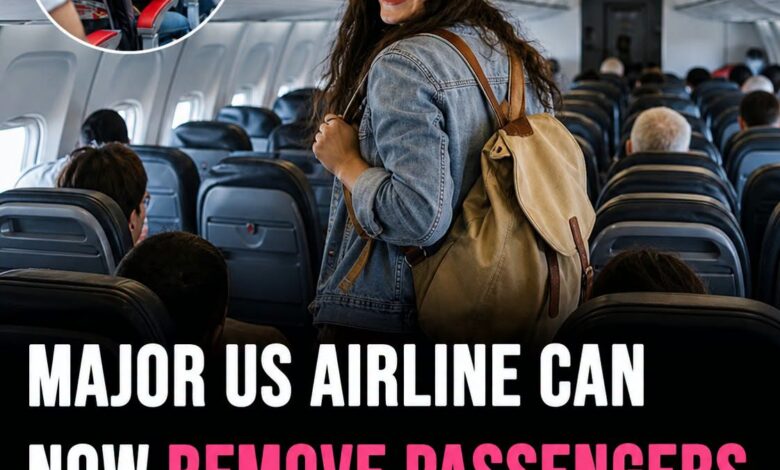
The battle for silence on airplanes usually begins with a sound nobody else asked to hear.
A TikTok starts playing three rows back.
A child’s game begins chirping from a tablet.
Someone watches a movie through a phone speaker as though the aircraft cabin were their living room.
Another passenger turns around.
Someone sighs.
A flight attendant eventually intervenes.
For years, these moments have lived in an awkward territory between etiquette and enforcement. Most travelers understand the unwritten rule: in a confined public space, personal entertainment belongs in headphones. But unwritten rules depend on everyone agreeing to behave as though other people exist.
Increasingly, airlines have been making the expectation explicit.
United Airlines attracted attention after reports highlighted language in its Contract of Carriage addressing the audible use of personal electronic devices without headphones. The behavior has acquired an internet-age nickname: “barebeating,” a play on “barebacking,” referring to playing audio directly from a device’s speakers rather than through headphones.
The word may sound funny.
The underlying conflict isn’t.
An airplane cabin is an unusual social environment.
Hundreds of strangers are compressed into a narrow metal tube for hours. Nobody can simply walk into another room. Seats barely provide personal space, much less acoustic privacy. Babies cry. People cough. Announcements interrupt sleep. Engines create constant background noise.
Much of that is unavoidable.
Someone else’s Instagram feed is not.
That distinction explains why speakerphone videos can create such disproportionate irritation.
Noise becomes more aggravating when it feels unnecessary and controllable.
The crying infant probably isn’t trying to ruin your flight.
The person watching twenty-seven consecutive short videos at full volume has options.
Headphones exist.
Captions exist.
The volume button exists.
And sometimes the most appropriate setting is simply mute.
Clear airline rules help because they remove some of the interpersonal negotiation.
Without a rule, the annoyed passenger faces an unpleasant calculation.
Do I say something?
Will the person become hostile?
Am I being unreasonable?
Should I ask a flight attendant?
Will that make this into a bigger confrontation than the noise itself?
Once an airline explicitly prohibits disruptive speaker audio, the issue becomes less about one passenger imposing personal preferences on another.
The airline has established the standard.
That distinction can also help cabin crews.
Flight attendants already manage far more than snacks and seat belts. They are safety professionals working in an environment where relatively minor disagreements can escalate quickly because people are tired, stressed, intoxicated, frightened, cramped or simply impatient.
Asking someone to use headphones should be trivial.
Sometimes it isn’t.
A clear written policy gives crew members something more concrete than “other passengers find you annoying.”
It allows them to say, effectively:
This is the rule of the aircraft.
That doesn’t mean every accidental sound will result in dramatic punishment.
A phone ringing once isn’t the same as refusing repeated crew instructions.
A child briefly playing audio before a parent notices is different from someone deliberately continuing after being told to stop.
Enforcement normally involves context, judgment and escalation.
And claims that a passenger can simply be “thrown off a plane for TikTok” can exaggerate how such policies operate.
Airlines generally reserve broad authority to address disruptive conduct and failures to comply with crew instructions. Removal or denied transportation can become possible in serious circumstances, particularly when someone refuses to comply, but that is different from suggesting that one unexpected burst of audio automatically triggers expulsion.
The practical lesson is much simpler:
If a crew member tells you to stop playing audio aloud, stop.
Better yet, don’t make them ask.
There is also a useful distinction between the viral term “barebeating” and the actual policy language.
Internet slang makes a rule memorable, but travelers should not assume every catchy phrase appearing in headlines has literally been added as a formal legal term to an airline contract.
What matters is the substance of the rule: audible entertainment from personal electronic devices can be restricted, and passengers are expected to follow crew directions concerning device use and cabin behavior.
The broader trend makes sense because the technological environment aboard airplanes has changed dramatically.
There was a time when passengers brought a paperback, stared out the window or watched whatever movie the airline had selected.
Now everyone carries an entertainment center.
Phones contain games, podcasts, music, streaming services, social media and downloaded movies.
Tablets keep children occupied for hours.
Many flights offer Wi-Fi capable of connecting passengers to an endless stream of content.
That is wonderful—until one person’s entertainment system becomes everyone else’s.
The problem isn’t technology.
It is the disappearance of boundaries around it.
We have become accustomed to consuming media everywhere.
In bed.
At breakfast.
In elevators.
On sidewalks.
In waiting rooms.
On buses.
In restaurants.
The phone follows us so continuously that it can become psychologically easy to forget when private behavior has entered shared space.
Airplanes make that mistake impossible to escape.
There is nowhere for your neighbor to go.
This is especially worth remembering for parents.
Flying with children can be exhausting. A tablet may be the difference between a manageable three-hour flight and a miserable one.
Using technology to entertain a child is not inherently inconsiderate.
But children’s audio doesn’t become communal simply because the user is six.
Kid-sized headphones, volume-limited headphones appropriate for children, downloaded captioned entertainment or muted games can preserve the benefit without requiring twenty nearby strangers to listen.
At the same time, passengers should maintain some perspective.
Children will make noise.
Babies will cry.
Families will struggle with bags.
Someone will sneeze.
Another person will snore.
Public transportation cannot promise sensory perfection.
Courtesy works in both directions.
The goal isn’t a cabin in which every involuntary human sound becomes an offense.
It is reducing avoidable intrusion.
That is what makes the headphones issue so straightforward.
Personal audio has an obvious solution.
Use them.
There is something almost quaint about needing a contractual rule for behavior that once might have been handled by ordinary social awareness.
Yet formal rules often emerge precisely where informal expectations stop working reliably.
“Don’t smoke here” became signage.
“Don’t text while driving” became law.
“Silence your phone” became a theater announcement.
Now airlines increasingly find themselves spelling out another rule of shared life:
Your screen may be personal.
Its speakers are not.
Perhaps other carriers will continue clarifying their own standards as passenger complaints and onboard connectivity increase.
But travelers don’t need to wait for every airline to revise every paragraph of every contract.
The principle already travels well.
If you’re alone, listen however you want.
If you’re sharing a confined space, remember that you’re sharing it.
That doesn’t require extraordinary politeness.
It requires headphones.
And maybe the most interesting thing about the debate is what it says about modern travel.
We have more personal entertainment than any generation of passengers before us. We can cross a continent while watching our favorite series, answering messages, listening to an audiobook and playing games.
Technology has given us astonishing control over what we hear.
Courtesy asks for one small thing in return:
Don’t make everyone else hear it too.
At 35,000 feet, where hundreds of strangers have temporarily surrendered the ability to walk away from one another, peace doesn’t require silence.
It requires restraint.
Your entertainment can travel anywhere.
The sound doesn’t have to.