For Millie Smith and Lewis Cann, the day they became parents was also the day they faced the unimaginable.
They had spent months preparing to welcome twins into the world, celebrating two tiny lives growing side by side. But during the pregnancy, doctors delivered heartbreaking news: one of their daughters had a life-limiting condition and was not expected to survive long after birth.
From that moment forward, every milestone carried two emotions at once.
Hope.
And grief.
They continued preparing for their babies, knowing they would celebrate one child’s future while trying to cherish every possible second with the other. It was a reality no parent imagines facing—a journey where joy and sorrow existed side by side, impossible to separate.
When the twins were born, their predictions became reality.
Their daughter Skye lived for just three precious hours.
By most measures, it was an incredibly short life.
To her parents, it was an entire lifetime compressed into a handful of unforgettable moments.
They held her close.
They memorized every feature of her tiny face.
They whispered to her, kissed her, and surrounded her with the love they had been carrying since the day they learned she existed.
Every breath mattered.
Every heartbeat mattered.
Every second mattered.
Love, they discovered, is never measured by time.
When Skye died, the hospital room became painfully quiet.
The sounds of medical equipment faded, but the silence that followed seemed even louder. It marked the beginning of a different kind of journey—one filled not with medical decisions, but with learning how to carry unimaginable loss while continuing to care for Skye’s surviving twin.
Leaving the hospital did not mean leaving grief behind.
If anything, it became more complicated.
Many people simply didn’t know what to say.
Some avoided mentioning Skye altogether, believing silence might spare the family additional pain. Others focused exclusively on the surviving twin, unintentionally overlooking the daughter whose absence shaped every moment of their lives.
The most painful encounters often came from well-meaning people who didn’t realize the weight of their words.
One comment stayed with Millie long after it was spoken.
Someone remarked that she was “lucky” not to have twins.
The sentence was likely intended as reassurance.
Instead, it erased an entire child.
To Millie, she did have twins.
She always would.
One daughter was simply no longer alive.
That experience revealed a painful reality shared by many bereaved parents.
People are often afraid of acknowledging loss because they worry about saying the wrong thing. Yet avoiding a baby’s name or pretending the child never existed can deepen the loneliness families already feel.
Millie began wondering whether there might be a way to spare other parents from repeatedly explaining the unexplainable.
The answer came in the form of something remarkably simple.
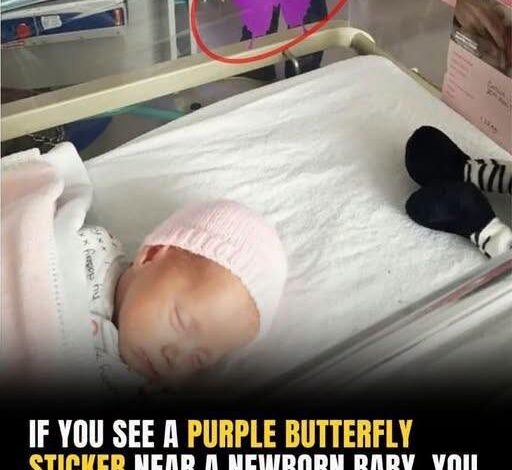
A small purple butterfly.
The idea was elegant in its quietness.
A butterfly sticker placed on an incubator or cot would gently communicate that the baby inside had been part of a multiple pregnancy in which one or more siblings had died.
No lengthy explanations would be necessary.
Hospital staff, visitors, and other families would immediately understand that this was a situation requiring extra sensitivity and compassion.
The symbol carried no dramatic message.
It simply invited kindness.
It reminded people to choose their words carefully.
It encouraged healthcare professionals to acknowledge the baby’s sibling when appropriate and helped prevent unintentionally painful comments about having “just one baby.”
Most importantly, it recognized the existence of children whose lives, however brief, remained profoundly important to their families.
What began as one mother’s deeply personal response to grief soon reached far beyond a single hospital.
The purple butterfly became the foundation of the Skye High Foundation, established in honor of Skye’s memory.
Working alongside hospitals and healthcare professionals, the foundation has helped introduce the butterfly symbol into neonatal units in numerous countries, raising awareness of the unique experiences faced by families grieving the loss of one or more babies from a multiple birth.
Its impact extends beyond the sticker itself.
The initiative encourages education, empathy, and conversations about baby loss that might otherwise never happen. It reminds healthcare providers, volunteers, visitors, and fellow parents that behind every incubator may be a story far more complex than what is immediately visible.
Sometimes the smallest gestures matter most.
Remembering a baby’s name.
Offering quiet support.
Listening instead of searching for perfect words.
Acknowledging both the child who survived and the child who did not.
These acts cannot erase grief.
But they can make grieving parents feel seen.
Today, Skye’s life continues to touch countless families around the world—not because of how long she lived, but because of what her parents chose to do with their heartbreak.
They could have allowed unimaginable loss to remain private.
Instead, they transformed it into compassion for strangers they would never meet.
The purple butterfly has become more than a hospital symbol.
It has become a quiet promise.
A promise that every baby matters.
That every family’s story deserves recognition.
And that even the briefest life can leave an extraordinary legacy.
Skye lived for only three hours.
Yet through the love of her parents and the kindness inspired by her memory, her presence continues to reach hospital rooms across the world, gently reminding people that compassion often begins with something as simple as noticing what cannot be seen.
In the end, that may be the greatest testament to her life.
Not the number of hours she spent in her parents’ arms, but the countless moments of understanding, dignity, and comfort those hours continue to create for families who need them most.