The HOA Told My 81-Year-Old Grandpa to Tear Down His Workshop—Then He Opened a Folder He Had Kept Since 1978

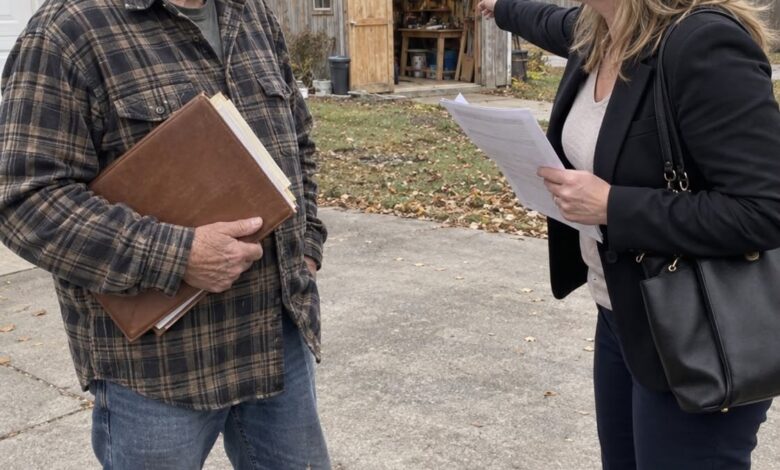
My grandfather Walter was eighty-one when the new HOA president walked onto his property, pointed at the workshop behind his house, and told him he had thirty days to tear it down.
Grandpa didn’t argue.
He didn’t raise his voice.
He didn’t tell her she’d lost her mind.
He just looked at her, nodded once, and asked:
“Did you bring that in writing?”
She smiled.
“I certainly did.”
That was her first mistake.
Walter had lived in that house for more than forty-five years.
When he moved there, the neighborhood barely resembled the one that existed now. There were fewer houses, no decorative entrance sign, no community pool, and certainly no homeowners association sending letters about fences, paint colors, sheds, or landscaping.
His workshop had been there almost as long as the house.
It wasn’t some leaning tin structure held together by rust.
Grandpa had built it himself.
Inside were heavy wooden benches worn smooth by decades of use, old hand tools arranged exactly where he wanted them, coffee cans full of screws, drawers of hinges, clamps, saws, and a radio that seemed permanently tuned to country music.
That building was where he repaired our bicycles when we were kids.
It was where he built my mother’s dining table.
It was where he taught me how to use a hand plane without removing half my knuckles.
To our family, the workshop wasn’t an accessory.
It was part of the house.
Apparently, Denise saw it differently.
Denise had moved into the neighborhood less than two years earlier and somehow became HOA president almost immediately.
She liked rules.
More than that, she liked enforcement.
There were people who enjoyed keeping a neighborhood organized.
Denise seemed to enjoy catching people doing something wrong.
The letter she handed Grandpa said the workshop violated current setback requirements and architectural standards.
If he failed to remove it within thirty days, the association could begin imposing fines.
Grandpa read every line while Denise stood in his driveway.
Then he folded the paper.
“Anything else?”
She seemed irritated by how calm he was.
“You understand this is serious?”
“I understand what the letter says.”
“You’ll need to arrange demolition.”
Grandpa looked back at the workshop.
Then at her.
“No, I won’t.”
Her smile disappeared.
“Mr. Bennett, these rules apply to everyone.”
Grandpa nodded.
“I’m sure they do.”
Then he went inside.
When my mother heard, she panicked.
She called me.
Then my uncle.
By that evening, half the family believed Grandpa was about to get buried under HOA fines because he was too stubborn to cooperate.
I drove over the next morning.
He was sitting at the kitchen table drinking coffee.
The violation notice lay beside the sugar bowl.
“Grandpa, what are you going to do?”
“Finish my coffee.”
“I mean about the workshop.”
He looked at me.
“Nothing today.”
I thought he was being impossible.
Then he told me to follow him.
In the spare bedroom, he opened an old metal filing cabinet and pulled out a thick brown folder.
Across the front, in faded handwriting, was one word:
PROPERTY.
Inside were papers older than I was.
Original surveys.
Building permits.
Inspection records.
County correspondence.
Receipts.
Photographs.
Then Grandpa pulled out a yellowed document dated 1978.
It approved construction of the workshop.
Exactly where it stood.
He tapped it with one finger.
“I built that before half the street existed.”
Then he produced the original survey.
The structure was clearly marked.
I stared at him.
“You knew you still had all this?”
“Of course.”
“Why didn’t you show Denise?”
He shrugged.
“She didn’t ask.”
Three days later, the HOA held a meeting.
Denise expected Grandpa to show up and tell the board when he planned to demolish the workshop.
Instead, he walked in carrying the brown folder.
I went with him.
The room was much more crowded than I expected.
That was when I learned Grandpa wasn’t the only older homeowner receiving threatening letters.
Fences.
Sheds.
Porches.
Driveways.
Additions that had been standing for decades.
When Walter’s name was called, Denise read the violation aloud.
Then she looked at him.
“Do you have a proposed removal date?”
Grandpa stood slowly.
“No.”
She sighed.
“Then the association will have to proceed with fines.”
Grandpa opened the folder.
“I’d like this included in the record first.”
Denise frowned.
“What is it?”
“My permit.”
The room went quiet.
Copies were passed along the board table.
The permit showed that the workshop had been legally approved in 1978.
Then came the inspection sign-off.
Then the survey.
Then county correspondence confirming the structure had been reviewed.
Denise barely glanced at the papers.
“Our regulations are current, Mr. Bennett.”
That was when the HOA’s attorney, who had been sitting quietly near the end of the table, leaned forward.
“When was this association created?”
No one answered immediately.
A board member checked.
“1994.”
Grandpa smiled.
His workshop had already been standing for sixteen years.
The attorney read the documents more carefully.
His expression changed.
Then he asked Denise:
“Did the board review the property’s permitting history before issuing this violation?”
She started talking about the current architectural guidelines.
He repeated the question.
She hadn’t.
That was the real problem.
Grandpa’s workshop wasn’t some unauthorized structure thrown up last month.
It had been legally permitted years before the HOA even existed.
Whether an HOA can regulate, fine, or require changes to an older structure depends on the governing documents, state law, local law, prior approvals, and the specific facts. It isn’t enough to assume that a newer rule automatically erases a lawful older approval.
And the board had done exactly that.
It had assumed.
The violation against Grandpa was suspended that evening.
I thought that was the end.
Walter didn’t.
He didn’t insult Denise.
He didn’t demand her resignation.
He simply looked around the room and asked:
“How many other people got letters like mine?”
Several hands went up.
A seventy-six-year-old widow had received a warning about a back fence.
A retired teacher had been told his enclosed porch violated current standards even though it had been built decades earlier.
Someone else had received a notice about an old storage structure.
Grandpa looked toward the board.
“You might want to check their paperwork too.”
That sentence caused more trouble for the HOA than his workshop ever had.
Over the next few weeks, prior violations were reviewed.
Some turned out to be legitimate.
Others did not.
Several homeowners had older structures with permits, prior approvals, or circumstances the current board had never investigated.
The pattern became obvious.
Letters first.
Research later.
The board had been treating intimidation as due diligence.
That stopped.
New procedures were adopted requiring a property-history review before certain older structures were cited.
Denise remained president for a few more months.
Then another election came.
She lost.
Grandpa never campaigned against her.
He barely mentioned her name.
The workshop remained exactly where it had always been.
A few months later, I visited and found him inside sanding a small wooden box.
The radio was playing.
The original HOA violation notice had been pinned above his workbench.
I laughed.
“You kept that?”
“Yep.”
“Why?”
He looked at me.
“Reminds me to keep my paperwork.”
The following spring, a new family moved in next door.
Their ten-year-old son became fascinated with the workshop.
Within weeks, Grandpa was showing him how to measure a board properly and explaining why forcing a dull saw through good wood was a terrible idea.
I stood in the doorway watching them.
That little building had survived more than forty years.
Storms.
New development.
Changing neighborhoods.
And finally, a board president who looked at an eighty-one-year-old man and assumed he wouldn’t know how to defend himself.
She had misjudged the workshop.
But she had misjudged Walter more.
She mistook quiet for confusion.
Age for helplessness.
Courtesy for surrender.
Grandpa had spent a lifetime making things carefully enough to last.
Furniture.
Shelves.
Cabinets.
A workshop.
And apparently, a filing system.
There is a larger lesson in that story, especially for anyone dealing with an HOA, landlord, contractor dispute, property-line disagreement, or other conflict involving an old home.
Don’t rely only on memory.
Find the deed.
Find the survey.
Find permits.
Look for inspection records.
Keep approval letters.
Save photographs.
Read the governing documents.
And before assuming either side is legally correct, check the applicable local and state rules or get qualified legal advice.
Old structures can raise complicated issues involving grandfathering, nonconforming use, easements, covenants, statutes of limitation, prior approvals, and other doctrines that vary by jurisdiction.
A forty-year-old permit doesn’t magically win every dispute.
But neither does a newly printed HOA rule.
Facts matter.
Dates matter.
Documents matter.
Grandpa understood that before any of us did.
He never needed to shout.
Never threatened anyone.
Never tried to embarrass Denise publicly.
He simply made the board confront the history it should have checked before issuing the letter.
And when the dust settled, the workshop remained.
The tools stayed on the walls.
The radio kept playing.
Grandpa went back to sanding wood.
Sometimes people think power looks like anger.
Walter taught me otherwise.
Sometimes power is an eighty-one-year-old man standing in a meeting room while everyone expects him to surrender.
Then he reaches into an old brown folder.
And lets forty years of paperwork speak for him.