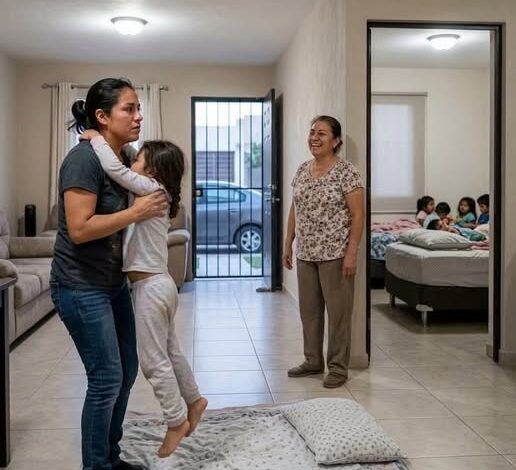
My six-year-old daughter was lying on a sleeping bag on my mother’s cold tile floor when she asked the question I’d spent years avoiding.
“Mommy… does Grandma even like us?”
Three days later, I withdrew my money from the 140,000-peso celebration I’d been helping organize for my mother.
That was when she started calling.
Seven calls before breakfast.
I watched her name flash across my phone, then turned it facedown beside my coffee.
I wasn’t trying to punish her.
I was thinking about Sofía.
My name is Gabriela. I was thirty-three, divorced, raising Sofía and her younger brother, Mateo, while working twelve-hour shifts in an emergency room.
My life wasn’t elegant.
It was lunch boxes packed half-asleep, laundry folded after midnight, childcare arrangements, bills, fevers, school forms and the constant calculation of whether I could squeeze one more obligation into a week already overflowing.
My mother, Elena, had never openly condemned the life I’d built.
She didn’t need to.
She had Patricia.
My sister lived twenty minutes from Mom. She drove her to appointments, brought groceries and stopped by during the week.
I lived almost four hours away.
I never resented Patricia for being available.
What hurt was watching my mother gradually turn availability into a ranking system.
Patricia was the devoted daughter.
I was the one who “moved away.”
Eventually, that ranking reached our children.
I noticed.
I just kept explaining it away.
That November, after finishing a night shift, I loaded lasagna, blankets, snacks, toys and two excited children into my car.
Sofía talked for most of the drive.
“Can I sleep next to my cousin?”
“Probably.”
“Do you think Grandma made cookies?”
“Probably.”
When we arrived, Patricia’s family was already there.
The guest room had been prepared for her children.
Fresh sheets.
Folded blankets.
Water beside the beds.
Cookies waiting for them.
I noticed.
It’s just a room.
At dinner, Patricia’s children ate from the porcelain dishes that had belonged to our grandmother.
Mine received old plastic plates.
It’s just a plate.
That had become my survival strategy.
It’s just a joke.
Just a holiday.
Just because Patricia lives closer.
Just Mom being Mom.
But children don’t experience favoritism as a collection of unrelated details.
They absorb the message beneath them.
Around nine, I asked Mom where we were sleeping.
She opened a closet and pulled out two old sleeping bags.
“There.”
I waited.
“The living room?”
“The floor is clean.”
Sofía looked toward the hallway where her cousins had gone to their prepared beds.
“On the floor, Mommy?”
Before I could answer, Patricia laughed.
“You should’ve booked a hotel.”
Nobody else seemed uncomfortable.
So, naturally, I became uncomfortable enough for everyone.
I spread the sleeping bags across the tile.
Mateo was exhausted and fell asleep quickly.
Sofía couldn’t.
She rolled from one side to the other, eventually stuffing her backpack beneath her head for a pillow.
I found Mom in the kitchen.
“Sofía asked me if you actually like her.”
Mom sighed.
“Gabriela, don’t start.”
“I’m not starting anything. Your other grandchildren have beds. Mine are sleeping on the floor.”
“Patricia comes every week.”
“What does that have to do with Sofía?”
“She helps me. She takes me places. You chose to move away.”
Then came the sentence that changed everything.
“You made choices, Gabriela. Choices have consequences.”
I stared at her.
Maybe my choices did have consequences.
But why was my six-year-old daughter paying them?
Sofía hadn’t moved away.
She hadn’t gotten divorced.
She hadn’t chosen my hospital schedule.
She had spent four hours in a car because she was excited to see her grandmother.
Around eleven, she sat up.
“Mommy?”
“Yes?”
“My back hurts.”
That was enough.
I stopped asking myself how I could persuade my mother to treat my children equally.
I couldn’t control that.
I could control whether they kept lying on the floor waiting for her to decide they deserved better.
“Get your backpack,” I whispered.
“We’re going home?”
“Yes.”
Sofía packed immediately.
That hurt almost as much as the question she’d asked earlier.
She wasn’t disappointed to leave.
She was relieved.
I carried sleeping Mateo outside while Sofía held my hand.
Mom appeared behind us.
“You’re seriously leaving?”
“Yes.”
“Over sleeping bags?”
I didn’t answer.
Anyone who thought it was about sleeping bags had missed the entire story.
During the four-hour drive home, one fact kept circling my mind.
For three months, I had been helping organize a major celebration for my mother.
Venue.
Food.
Decorations.
Music.
Family arrangements.
The total budget exceeded 140,000 pesos, and my contribution represented a substantial portion of what still needed to be paid.
I’d considered that money a family obligation.
You show up.
You contribute.
You don’t keep score.
But somewhere on that highway, I realized something.
I had been financially helping create an elaborate celebration of my mother while teaching my daughter to tolerate being treated as an inconvenience in my mother’s home.
Three days later, I withdrew from the celebration.
I contacted the people handling the portions connected to me and cancelled what I could cancel before payment became due.
No dramatic family message.
No ultimatum.
No revenge.
I simply stopped financing an event that required me to pretend everything was fine.
Then my phone exploded.
When Sofía’s back hurt, I was dramatic.
When she wondered whether Grandma liked her, I was oversensitive.
When we left, I was unreasonable.
But when the celebration budget changed?
Suddenly everyone understood that something serious had happened.
My mother called seven times one morning.
I almost answered.
The old reflex was powerful.
Explain.
Fix.
Calm everybody down.
Be the reasonable daughter.
Then Sofía walked into the kitchen carrying the same backpack she’d packed that night.
“Mom, can you fix this?”
One strap had come loose.
“Of course.”
I turned my phone facedown.
That was the real beginning of my boundary.
Not cancelling the celebration.
Choosing the child standing in front of me over the adult demanding that I manage her feelings.
Mom’s voicemail came later.
She talked about relatives asking questions.
Possible lost deposits.
Patricia being unable to replace my contribution.
Then, near the end:
“I’m sorry Sofía was uncomfortable, but Patricia’s family comes more often.”
There it was again.
An apology immediately followed by an explanation for why my daughter had deserved less.
I didn’t change my decision.
A week later, Mom called again.
This time, I answered.
“You’re really going to ruin my celebration over one bad night?”
“No,” I said. “Because it wasn’t one night.”
I named everything.
The rooms.
The dishes.
The jokes.
The comparisons.
The sleeping bags.
Finally, Sofía’s question.
Mom went silent.
Then she said something different.
“I didn’t realize she noticed.”
“Of course she noticed.”
“But she’s six.”
“Exactly.”
Another silence.
“What do you want me to do?”
Once, I would have handed her instructions.
Call Sofía.
Apologize.
Promise change.
Make everything equal.
Instead I said, “I want you to decide whether my children deserve to feel welcome in your home.”
The celebration happened without me.
It was smaller.
I didn’t organize it.
I didn’t replace the money.
I didn’t attend.
Some relatives called me cruel.
Others privately admitted they’d noticed the favoritism for years.
I refused to turn it into a family election.
Nobody needed to choose teams.
I was choosing my children.
Months later, Mom called.
“Could I come visit you?”
That caught me off guard.
Not When are you coming here?
Could she come to us?
I agreed.
She arrived without extravagant gifts or a theatrical apology.
She sat on the floor building towers with Mateo.
She asked Sofía about school and actually listened.
At bedtime, Sofía disappeared into her room and returned carrying a pillow.
“Grandma, you can sleep in my bed.”
Mom’s face changed.
“No, sweetheart. Your bed is yours.”
“We have a couch.”
Mom smiled.
“The couch will be perfect.”
Later, after the children were asleep, we sat at my kitchen table.
“I keep thinking about what Sofía asked you,” she said.
I waited.
“Whether I liked her.”
I didn’t rush to make her feel better.
Finally, Mom whispered, “I was angry at you for not being here more. I made your children pay for something that was between you and me.”
There it was.
Not perfection.
Not erasure.
Recognition.
Our relationship didn’t return to normal.
I’m grateful it didn’t.
The old normal depended on me pretending not to notice things.
Visits became less frequent but more intentional.
When my children eventually stayed at her house again, there were beds waiting for both of them.
Not identical gifts.
Not ceremonial equality.
Beds.
Welcome.
The basics they should never have had to earn.
Years later, Sofía barely remembered the celebration I cancelled.
But she remembered leaving Grandma’s house.
“Were you angry that night?” she once asked.
“Yes,” I admitted. “But that’s not why we left.”
“Why did we?”
“Because you told me you were uncomfortable.”
She thought about that.
“And you believed me?”
“Yes.”
Her smile told me which part of the story mattered.
Not the sleeping bag.
Not the porcelain plates.
Not the money.
She remembered speaking, and she remembered that her mother listened.
For years, I thought being a good daughter meant making life easier for my mother.
Then I became a better mother by allowing my mother’s life to become uncomfortable.
She once told me choices have consequences.
She was right.
Leaving that house had consequences too.
My daughter learned that being family doesn’t mean remaining somewhere that makes you feel unwanted.
And I learned something even more important:
I didn’t need my mother’s permission to protect my children.
I only needed to believe them when they told me they needed protecting.