The village barely appeared on most modern maps anymore.
Tucked between dense forests and rolling gray hills somewhere deep within rural Europe, it survived quietly through fading stone roads, shuttered cottages, and generations of stories whispered more often than written down. Tourists rarely passed through. Younger families had long since moved toward larger cities. What remained was a place suspended strangely between memory and decay, where time seemed less interested in moving forward than simply lingering.
At the center of the village stood the estate.
Even abandoned, it carried a kind of presence that made people lower their voices instinctively when speaking about it. The mansion had once belonged to a wealthy aristocratic family whose influence stretched across the region during the early nineteenth century. Now ivy consumed entire walls, windows remained boarded shut against weather and trespassers, and the surrounding gardens had collapsed into tangled wilderness.
Locals called it many things over the decades:
the red house,
the mourning estate,
the house beneath the hill.
But most simply called it abandoned.
For nearly seventy years, almost nobody entered the property except occasional caretakers or historians documenting architectural records. Dust buried the interior beneath layers thick enough to preserve forgotten objects exactly where they had been left generations earlier:
silverware tarnished black inside drawers,
children’s toys scattered beneath staircases,
stacks of letters tied carefully with faded ribbon.
The estate had become less a home than a sealed memory.
Then came the cataloging project.
A multinational historical preservation group arrived intending nothing dramatic — only routine archival work before the mansion deteriorated beyond recovery entirely. Researchers moved carefully room by room, photographing furniture, documenting family records, and transporting fragile materials into temporary conservation spaces.
Most discoveries were ordinary.
Birth certificates.
Property records.
Damaged portraits.
Personal correspondence discussing marriages, harvests, illnesses, and finances.
History in its usual quiet form.
Until one archivist opened a narrow wooden case hidden beneath collapsed shelving inside what appeared to have once been a study.
Inside rested a single photograph.
That alone was unusual enough to stop the room cold.
Because according to the documents surrounding it, the image supposedly dated back to approximately 1820.
And that should not have been possible.
The photograph itself appeared remarkably preserved despite age. The edges were worn slightly, and faint chemical discoloration spread across parts of the surface, but the central image remained startlingly clear.
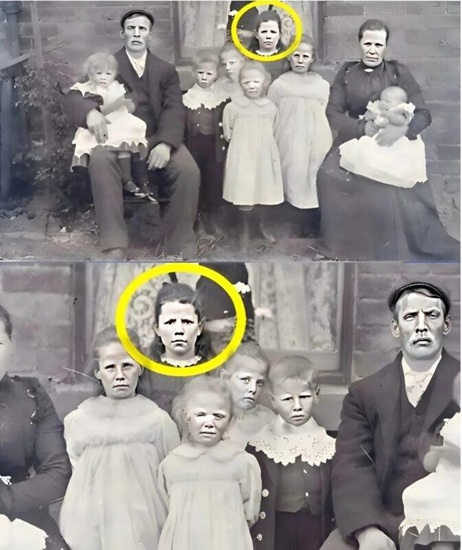
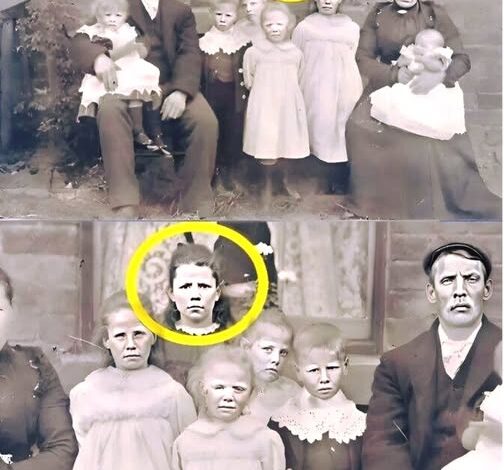
It depicted a family standing formally in front of a red brick house.
The father stood upright near the center wearing dark period clothing and a stern expression common in early portraiture. Beside him stood a woman holding a small child carefully against her chest while several other children arranged themselves in symmetrical formation around them.
Everything about the composition felt eerily deliberate.
Still.
Structured.
Unnaturally motionless.
Like a frozen moment trying too hard to appear ordinary.
At first glance, historians assumed the image must have been misdated.
After all, practical photography did not exist publicly in 1820.
The earliest verified photographic processes emerged later during the late 1820s and early 1830s through experiments by pioneers such as Nicéphore Niépce and Louis Daguerre. Any genuine photograph predating those developments would fundamentally challenge established historical timelines regarding photographic technology itself.
Naturally, skepticism came immediately.
Researchers initially suspected the date attached to the image had simply been recorded incorrectly. Others theorized it might be a later reproduction designed intentionally to imitate older visual aesthetics.
But then people noticed the figure in the background.
And the atmosphere surrounding the discovery changed instantly.
Behind the children, partially obscured near the edge of the house, stood what appeared to be another person.
At first the shape looked almost accidental — a blur created by damage or light distortion. Yet the longer observers stared, the more unsettlingly human it became.
A pale face.
Dark hollow eyes.
An expression impossible to read fully because portions of the figure seemed to dissolve unnaturally into shadow.
Most disturbing of all, the figure did not appear integrated naturally into the composition.
It looked separate somehow.
Watching rather than participating.
The archivists began quietly comparing the image against estate records, trying to identify everyone depicted. That search eventually led them toward fragmented references to a daughter named Maria.
And that was where folklore entered the story completely.
According to surviving family documents, Maria had been the eldest child living at the estate during the early nineteenth century. Yet strangely, her name disappeared abruptly from later records. Census information became inconsistent. Personal correspondence referenced her only indirectly after a certain point.
One damaged journal entry mentioned “the sorrow after Maria.”
Another referred cryptically to “the child no longer spoken of.”
No definitive explanation followed.
No death certificate.
No burial documentation.
No confirmed relocation.
Just absence.
As word of the photograph spread beyond the estate archives, local legends resurfaced almost immediately.
Older villagers spoke about stories passed down through generations involving unexplained sounds within the abandoned mansion, sightings near the property at dusk, and longstanding folklore surrounding what locals called “foundation spirits” — emotional echoes believed to remain tied metaphorically to places where unresolved grief once occurred.
Some versions of the legend claimed Maria disappeared shortly before the family portrait was supposedly taken.
Others suggested she died under mysterious circumstances never publicly acknowledged by the household. A darker variation whispered that her body had never been properly buried at all.
Soon speculation overwhelmed caution.
Popular media outlets seized the story enthusiastically, blending historical uncertainty with supernatural storytelling. Headlines described “the impossible photograph,” “the ghost child of the red estate,” and “the girl trapped behind the family portrait.”
Online discussions exploded.
People zoomed obsessively into the image searching for details.
Some claimed the figure’s face changed between digital scans.
Others insisted shadows near the background resembled grasping hands or distorted facial expressions.
The internet transformed ambiguity into mythology almost overnight.
Meanwhile, actual historians became increasingly frustrated.
Because despite the emotional power of the story, evidence remained deeply unreliable.
Experts pointed out numerous inconsistencies immediately:
the impossible dating,
uncertain provenance,
chemical characteristics inconsistent with confirmed early photographic techniques,
and the likelihood that visual anomalies resulted from degradation or reproduction artifacts rather than supernatural presence.
Old photographs frequently develop distortions over time.
Chemical deterioration,
light exposure,
scratches,
improper restoration methods,
and scanning compression can all create shapes the human brain instinctively interprets as faces or figures. Psychologists refer to this tendency as pareidolia — the mind’s habit of imposing recognizable patterns onto ambiguous imagery.
In emotionally charged contexts, that tendency intensifies dramatically.
People see what stories prepare them to see.
Still, curiosity kept growing.
Eventually, additional investigations focused on the estate grounds themselves. Researchers examined burial records, property maps, and historical references tied to the family. Unverified rumors later circulated claiming excavation work near the house uncovered remains possibly belonging to a young individual.
Yet even those reports remained uncertain.
No formal academic publication confirmed identity.
No verified forensic conclusion established connection to Maria.
No definitive evidence tied the remains directly to the photograph or family legend.
Historians repeatedly emphasized caution.
Human beings naturally hunger for narrative closure, especially when mystery intersects with tragedy. But unresolved historical gaps are not proof of supernatural events. Missing records were common in earlier centuries due to war, disease, poor preservation, illiteracy, and inconsistent bureaucracy.
Yet uncertainty itself often fuels imagination more powerfully than certainty ever could.
That may explain why the photograph continues haunting public fascination years later.
Because beneath the historical debate lies something emotionally universal:
people desperately want forgotten stories to mean something.
A pale figure in the background becomes more than visual ambiguity.
It becomes unresolved grief.
Memory refusing disappearance.
A symbolic representation of lives history failed to preserve clearly.
And perhaps that emotional symbolism matters more to many people than factual verification ever will.
The estate itself remains standing today, though access is heavily restricted.
Researchers continue studying portions of the archive primarily for legitimate historical value rather than paranormal speculation. The mansion offers rare insight into aristocratic family life, regional architecture, and cultural transitions within nineteenth-century Europe.
Still, visitors occasionally gather beyond the gates hoping to glimpse the infamous red house for themselves.
Some come searching for ghosts.
Others for history.
Many simply for the unsettling feeling the story creates.
Because the photograph lingers powerfully in public imagination precisely because it resists certainty.
It sits uneasily between possibilities:
artifact or fabrication,
history or folklore,
evidence or projection.
And ultimately, that ambiguity may be the real reason the story survives.
Not because anyone proved the figure was supernatural.
But because human beings are drawn irresistibly toward mysteries that leave emotional space for imagination to enter.
A faded family portrait.
A missing daughter.
An abandoned mansion swallowing generations of silence.
These elements combine into something larger than documentation alone.
They become modern mythology.
A reminder that history is not always made only from facts preserved cleanly in archives. Sometimes it is shaped equally by what vanished, what remained unexplained, and what people continue searching for inside the shadows of incomplete memory.
Whether Maria truly existed as the legends describe may never be confirmed fully.
Whether the figure in the photograph represents a hidden person, a technical anomaly, or simple visual distortion may also remain unresolved.
But the story endures because it touches something ancient and deeply human:
the need to believe forgotten lives leave traces behind,
the desire to find meaning inside unfinished stories,
and the uneasy feeling that some places continue holding emotional echoes long after the people who created them are gone.
In the end, perhaps the photograph’s greatest power is not proving anything supernatural at all.
It is reminding us how easily mystery grows wherever history leaves empty spaces waiting to be filled by memory, fear, longing, and imagination. :::