At my daughter’s funeral, my son-in-law announced he was sending my three granddaughters away so he could “start over,” never knowing the girls had hidden the notebook, recordings, and secrets that would destr0y him on his wedding day.

“If nobody wants those girls, I’ll leave them with social services on Monday. I’m not wasting my life raising children from a dead woman.”
The words fell across the cemetery like something rotten dropped into holy ground.
Not whispered privately.
Not spoken through grief.
Not even softened by shame.
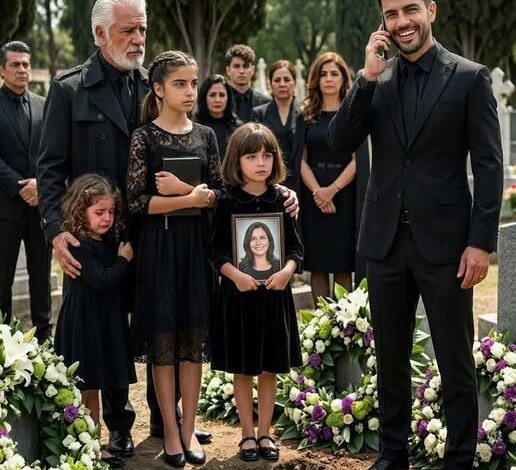
Arturo Medina said them openly beside his wife’s grave while fresh dirt still covered Rosa’s coffin.
For one suspended second, the entire cemetery went silent.
The cheap white lilies surrounding the grave carried their bitter scent through the humid afternoon air while distant church bells echoed softly across Puebla. A light wind moved through the cypress trees lining the cemetery paths, lifting black veils and funeral ribbons gently as mourners froze in stunned disbelief.
My name is Julián Herrera.
And that day, standing beside my daughter’s grave, I learned that cruelty can arrive dressed like composure.
Arturo looked immaculate.
Gray tailored suit.
Polished black shoes.
Silver watch gleaming beneath sunlight.
Not one wrinkle in his clothing.
Not one sign he had buried his wife less than twenty minutes earlier.
Meanwhile, my daughter Rosa lay beneath the earth at thirty-five years old.
And her husband was already discussing how quickly he could abandon their children.
My granddaughters stood beside me.
Twelve-year-old Lucía held Rosa’s framed photograph tightly against her chest, fingers pressed so hard against the frame her knuckles looked white.
Nine-year-old Renata stared ahead without blinking.
And little Abril — only six years old — hid silently behind my black coat, trembling hard enough that I could feel it through the fabric.
“What did you just say?” I asked quietly.
Arturo sighed impatiently, as though I were creating unnecessary drama.
“Don Julián, don’t make this harder than it needs to be,” he said. “Rosa is gone. I deserve to move forward.”
“And your daughters?”
He barely glanced toward them.
“My new partner isn’t raising three girls who don’t even listen to me. If you care so much, take them.”
Several relatives lowered their eyes immediately.
My cousin Elena crossed herself silently.
The priest suddenly became very interested in rearranging papers near the graveside.
Even Arturo’s own aunt looked physically ill.
Humiliation spread through the cemetery heavier than grief itself.
For one terrible second, I wanted to hit him.
Not argue.
Not shout.
Hit him hard enough to erase that smug expression from his face forever.
But then Abril’s tiny fingers wrapped tighter around my hand.
And I stopped myself.
Lucía never cried.
That frightened me more than anything else.
Children should cry at funerals.
Children should collapse beneath grief.
Children should not stand perfectly still studying their father like strangers already preparing for war.
The three girls exchanged a look then.
A silent understanding.
Too old.
Too knowing.
And suddenly I realized something horrifying:
they already knew something I didn’t.
“Come home with me,” I told them softly. “All of you.”
Arturo laughed beneath his breath.
“Perfect,” he muttered. “One less problem.”
He didn’t hug his daughters goodbye.
Didn’t kiss their foreheads.
Didn’t ask whether they had clothes, medication, or school supplies.
He simply turned and walked away toward a white van waiting near the cemetery gates.
Inside sat a younger woman wearing dark sunglasses despite the cloudy afternoon.
Mariela.
Though I did not know her name yet.
That night, I brought my granddaughters home.
The house felt painfully small after the funeral.
Too quiet.
Too aware of absence.
I heated soup.
Made tortillas.
Prepared Rosa’s old bedroom for the girls.
Renata fell asleep wearing one of her mother’s sweaters.
Abril refused to release my hand even while drifting asleep beside me.
Only Lucía stayed awake.
At three in the morning, I found her standing silently in the kitchen doorway.
“Grandpa?” she whispered.
Something inside her voice made my chest tighten instantly.
“Yes, mija?”
She looked toward the dark hallway first, making sure her sisters remained asleep.
Then she placed a small purple cloth bag carefully onto the kitchen table.
“Mom didn’t die just because she was sick.”
The words hollowed the air around us instantly.
“What are you saying?”
Lucía slowly opened the bag.
Inside sat:
an old cellphone,
a spiral notebook,
and a silver USB drive.
“Mom told us if anything happened to her,” Lucía whispered, “we had to give these to somebody who still loved her.”
And in that moment, standing beneath weak kitchen light at three in the morning, I realized my daughter had left behind much more than memories.
She left evidence.
My hands trembled opening Rosa’s notebook.
At first, the pages looked ordinary:
grocery lists,
school reminders,
medical appointments,
budget notes.
Then gradually the handwriting changed.
The letters became smaller.
Tighter.
Uneven.
Like someone writing while afraid of being discovered.
“Arturo says the girls ruined his life.”
“Today he hid my keys so I couldn’t go to the doctor.”
“Human Resources denied my leave request again.”
“Arturo works in Human Resources.”
Cold spread slowly through my body.
Rosa and Arturo worked for the same company.
She handled administration.
He controlled staffing and internal leave approvals.
I remembered every exhausted phone call.
Every moment she insisted she was “just tired.”
Every time I begged her to stay with me awhile.
“I don’t want my daughters growing up without their father,” she always answered.
God forgive me —
I believed him capable of love.
I kept reading.
“Arturo said if I died, he’d finally feel free.”
“Mariela refuses to help with the girls.”
“Arturo promised he’d solve the problem.”
I slowly lifted my eyes.
“Who’s Mariela?”
Renata answered quietly from the doorway.
“The woman in the white van.”
Abril started crying softly.
“Dad called her ‘my love’ even when Mommy was nearby.”
Lucía connected the USB drive to my old computer.
The folders contained:
screenshots,
emails,
voice recordings,
financial documents.
Then we opened the audio files.
Arturo’s voice filled the kitchen cold and irritated.
“Stop acting dramatic, Rosa. If you’re miserable, stop making everyone else miserable too.”
Another recording captured a woman laughing.
“But without the girls, Arturo,” Mariela said. “I’m not becoming somebody’s stepmother.”
Then Arturo answered calmly:
“Relax. First I’ll get rid of Rosa. Then I’ll figure out where to dump the little brats.”
Renata covered her ears instantly.
Abril burst into tears.
I walked outside because I thought I might stop breathing otherwise.
The dawn smelled of wet pavement and fresh bread from nearby bakeries opening for morning business. Somewhere in the neighborhood, dogs barked softly while the city slowly woke around us.
And all I could think about was my daughter suffering alone.
Carrying this terror silently.
Protecting her girls while dying piece by piece beside a man who already planned replacing her.
The next morning, I contacted attorney Beatriz Salgado.
She reviewed every document carefully without interruption.
When she finally closed Rosa’s notebook, her face had changed completely.
“This changes everything,” she said quietly. “Custody. Criminal charges. Workplace misconduct. Coercion.”
“And Arturo?”
Her eyes hardened.
“For now, he must not realize how much evidence exists.”
So we stayed quiet.
Weeks passed carefully.
Social services intervened —
but not the way Arturo expected.
The girls remained with me permanently while investigations quietly expanded around him.
The company launched internal audits.
The prosecutor’s office opened formal inquiries.
Former coworkers slowly began speaking privately.
Meanwhile, Arturo behaved like a man already celebrating freedom.
He posted smiling photographs online beside Mariela:
wine tastings,
romantic dinners,
vacation selfies.
Two months after Rosa’s funeral, he announced their wedding publicly.
“After every storm,” he wrote beneath a photograph of them embracing, “God gives us another chance.”
Lucía stared silently at the screen.
Then she walked toward Rosa’s old purple notebook resting inside the cabinet.
Carefully, she picked it up.
“Then let’s show God the real story.”
And in that moment, I realized my granddaughter planned something far larger than grief.
The wedding took place at a luxurious hacienda outside Cholula.
White roses lined the garden.
String lights glowed warmly across stone archways.
Violins played softly beneath evening sky while wealthy guests drank champagne pretending life was beautiful and uncomplicated.
Arturo stood proudly at the altar in a navy-blue suit smiling like a man reborn.
Mariela floated toward him beneath a cathedral veil looking triumphant.
It looked perfect.
Until we arrived.
I held Abril’s hand.
Renata carried Rosa’s framed photograph.
And Lucía walked ahead of us holding the purple notebook tightly against her chest.
Whispers spread instantly through the guests.
Arturo saw us and lost his smile immediately.
“What are you doing here?” he hissed, rushing toward us. “Leave now before I call security.”
Lucía remained calm.
“We came to say goodbye to Mom properly.”
“Your mother is already dead,” Arturo snapped.
Lucía lifted her chin slightly.
“But the truth isn’t.”
At that exact moment, two investigators entered the hacienda accompanied by Beatriz, a social worker, and one of Arturo’s company executives.
The violin music stopped.
Conversations died instantly.
One investigator approached Arturo directly.
“Arturo Medina,” he said firmly, “you need to come with us regarding an active investigation.”
Arturo laughed nervously.
“You can’t be serious. This is my wedding.”
“The investigation includes evidence of coercion, workplace abuse, denial of medical accommodations, and emotional cruelty toward Rosa Herrera,” Beatriz answered.
Mariela looked stunned.
“What evidence?”
Lucía stepped forward holding the notebook.
Her voice trembled slightly.
But she never broke.
“My mom documented everything,” she said. “Every denied medical request. Every insult. Every time my dad said we ruined his life.”
Arturo exploded instantly.
“Shut up! You’re a child!”
Renata lifted Rosa’s cellphone quietly.
“There are recordings too.”
Beatriz connected the phone to portable speakers.
Then Arturo’s voice echoed across the wedding garden:
“When Rosa dies, I’ll finally be free. Then I’ll dump those girls somewhere they stop ruining my life.”
Silence crushed the hacienda completely.
Nobody moved.
Nobody breathed.
Mariela slowly stepped backward staring at Arturo like she no longer recognized him.
“You actually said that?”
Arturo looked around wildly.
“They manipulated it—”
Then little Abril spoke softly.
“I heard you tell Mommy nobody would miss her.”
The silence afterward felt unbearable.
Mariela slowly removed her veil.
“I’m not marrying a man who speaks about his children that way.”
Arturo reached for her arm desperately, but officers stepped between them immediately.
Guests pulled out phones.
Some cried quietly.
Others turned away ashamed.
As officers escorted him toward the exit, Arturo looked back toward Lucía desperately.
“I’m still your father.”
Tears filled her eyes.
But her voice stayed steady.
“Mom was our home,” she whispered. “You were just the noise hurting it.”
For the first time in his life, Arturo had no answer.
The legal process lasted months.
Investigations uncovered:
medical neglect,
coercive workplace abuse,
financial manipulation,
psychological cruelty.
Former coworkers testified.
Managers admitted pressure existed around Rosa’s leave requests.
Additional recordings surfaced.
Arturo lost:
his job,
his reputation,
custody rights,
and eventually most of the life he believed he controlled.
Mariela vanished quietly afterward.
But the greatest victory never happened inside courtrooms.
It happened at home.
Abril finally slept peacefully.
Renata started singing while doing homework.
And one evening, Lucía placed Rosa’s purple notebook inside a wooden memory box beside her photograph.
“She only wanted somebody to hear her,” Lucía whispered.
I hugged her tightly.
“And you became her voice.”
Now my house feels alive again.
Backpacks scatter across hallways.
Soup boils constantly in the kitchen.
Cartoons echo through living rooms.
Laughter fills spaces grief once emptied.
Rosa is gone.
But her daughters survived.
Arturo believed he could bury my child and erase those girls from his future.
He was wrong.
Because some truths refuse to stay underground.
And sometimes, when frightened children finally stop being afraid, even a wedding altar covered in white roses can become the exact place where a cruel man’s entire world collapses.