My Neighbor Said My 13-Year-Old Daughter Was Sneaking Kids Into Our House During School—So I Hid Under Her Bed and Waited

My neighbor stopped me in the driveway one Thursday morning and asked a question that made my stomach drop.
“Sarah… is Maya skipping school again?”
Again.
That word followed me all the way to work.
My daughter was thirteen. Quiet. Responsible. The kind of child teachers described as dependable.
Every morning she left our Savannah house in the same school uniform, pastel-pink backpack over one shoulder.
“I love you, Mom.”
“I love you more.”
Nothing about her looked like a child secretly disappearing from school.
But once Mrs. Gable planted the doubt, details I had been dismissing began lining up.
Maya barely ate dinner anymore.
She washed her uniform late at night.
Her phone made her jump.
She looked exhausted.
That evening, I asked directly.
“Mrs. Gable says she’s seen you coming home during school hours.”
Maya’s fork paused.
Then she laughed.
“She probably saw somebody else.”
“You’re sure?”
“Mom, I’m at school. I promise.”
The word promise came too quickly.
That night I barely slept.
By two in the morning, I had made a plan so ridiculous I almost abandoned it.
The next morning I acted normal.
Pancakes.
Bus money.
Goodbye kiss.
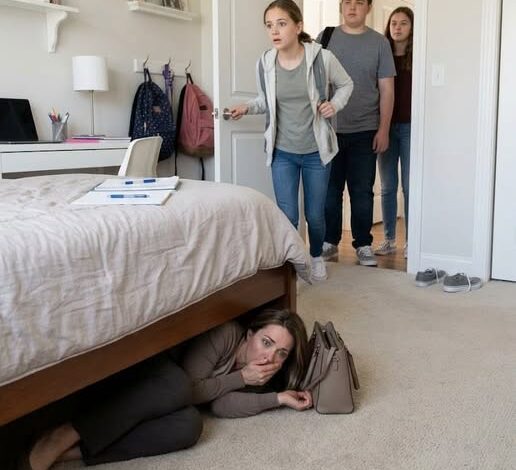
Then I drove away, circled back, parked where Maya couldn’t see my car, slipped through the side door, and crawled beneath her bed.
By 9:20, my legs were numb and I was convinced I had lost my mind.
Then the front door opened.
Footsteps rushed through the house.
Several sets.
Someone whispered, “Quiet.”
Maya.
Her bedroom door opened.
From beneath the bed, I saw four pairs of shoes.
Maya’s flats.
Two dirty pairs of sneakers.
And one tiny pair that looked like they belonged to a much younger child.
Then a black suitcase rolled across the carpet.
My heart slammed against my ribs.
I thought they were running away.
Then Maya knelt.
“You can wear my sweatshirt,” she whispered. “There’s food in the side pocket.”
A younger girl began crying.
That was when I came out.
Maya screamed.
One boy jumped into the desk.
Another moved instantly between me and the younger girl.
“Mom?”
Maya stared at me.
“You were under my bed?”
“Yes.”
“That’s insane.”
“I know.”
I pointed at the suitcase.
“Tell me what is happening.”
Her face collapsed.
“I was going to tell you.”
“When?”
“When I knew she was safe.”
The girl looked terrified.
Then I noticed everything I should have noticed immediately.
Her sleeve pulled over one wrist.
The boy checking the hallway every few seconds.
Maya’s backpack stuffed with granola bars, water bottles, socks, and toiletries.
My anger changed shape.
“My God,” I whispered. “You’ve been hiding them.”
I sat on the carpet.
“Start from the beginning.”
The younger girl was Evelyn.
The older boy was her brother, Benjamin.
The third child was a friend helping them watch for adults.
Benjamin explained that home had become frightening.
Their father controlled their phones.
Blocked doors during arguments.
Punched walls.
Told them nobody outside the family needed to know what happened inside the house.
Two nights earlier, Evelyn had been hurt while trying to leave during an argument.
I didn’t demand details.
Three children whispering in a locked bedroom during school hours told me enough.
“How long?”
Maya stared at the floor.
“Almost three weeks.”
I felt sick.
They hadn’t come every day.
Only when Benjamin sent a certain message before school.
Sometimes they returned to class.
Sometimes they stayed hidden in my empty house all day.
It was dangerous.
Reckless.
And unmistakably the work of scared children trying to solve an adult crisis with snacks, secrecy, and an unlocked side door.
I looked at the suitcase.
“What’s that?”
Evelyn whispered, “I’m not going home tonight.”
Maya rushed to explain.
“I told her she can’t just disappear. I told her we need an adult.”
I stared at my daughter.
“You have an adult.”
Her eyes filled.
“I didn’t know if you’d listen first.”
That hurt more than the lies.
Then Benjamin’s phone buzzed.
His face changed.
Maya stood.
“He knows.”
The message said their father wanted to know where they were.
Then another appeared.
I’M COMING TO GET YOU.
I locked every door.
Then I called for help.
The dispatcher stayed calm while I explained that children inside my house were afraid to leave with a parent who might already be on the way.
A car door slammed outside.
Every child froze.
Three hard knocks followed.
Benjamin whispered, “That’s him.”
Evelyn backed against the wall.
Maya stepped in front of her.
I pulled Maya aside.
“No. You do not stand between someone and danger. That is my job.”
Another knock.
Then a man called both children’s names.
His voice was controlled.
Almost pleasant.
That frightened me more than yelling.
I stayed behind the locked door.
“The children are safe. Help is coming. Nobody is leaving until this is handled properly.”
“You have my children in your house.”
“I have children telling me they’re afraid.”
“They’re kids. Kids lie.”
That sentence explained why they had hidden.
He started describing everything they had done wrong.
They skipped school.
Maya lied.
They entered my house secretly.
All true.
And completely useless without the reason.
Then he tried the doorknob.
Evelyn gasped.
“Do not touch my door again.”
Across the street, Mrs. Gable stood on her porch with her phone.
The father noticed her.
His voice immediately softened.
“Evelyn, sweetheart. Come outside.”
She began shaking.
“Don’t make this worse.”
Benjamin stepped forward.
“We’re not coming out.”
“You’re embarrassing your family.”
Benjamin suddenly shouted through the door.
“Maya didn’t make us do anything! I asked her for help!”
Everything I had imagined the night before disappeared.
Parties.
Older teenagers.
Smoking.
Ordinary bad behavior.
My daughter had become the person frightened children ran to.
She simply had no idea what to do after they arrived.
When responders came, nobody immediately handed anyone over.
Adults were separated.
The children were interviewed individually.
Messages were reviewed.
Dates matched Mrs. Gable’s observations.
Benjamin and Evelyn each gave their own accounts.
I wasn’t told every detail, and I didn’t ask.
They weren’t my children.
What mattered was that they were not simply forced back into the situation they had been trying to escape.
A temporary safe arrangement was made while responsible adults investigated properly.
Before leaving, Evelyn picked up her suitcase.
“Are you mad at Maya?”
I looked at my daughter.
“No.”
Maya blinked.
Then I added, “But she is absolutely grounded.”
Evelyn looked alarmed.
“Helping you isn’t what she did wrong.”
Maya understood.
After everyone left, the house felt enormous.
Four glasses remained on the counter.
A torn bandage wrapper sat near the sink.
A crushed granola-bar crumb was ground into the hallway rug.
Maya stood in the kitchen.
“Am I really grounded?”
“Yes.”
“For helping?”
“For skipping school, lying for three weeks, secretly bringing people into our house, and trying to manage a dangerous situation without an adult.”
She sighed.
“That’s a lot.”
“It is.”
Then I hugged her.
She lasted one second.
Then she collapsed against me, sobbing.
Suddenly she was thirteen again.
Not a protector.
Not an escape coordinator.
My daughter.
“I thought you’d call their dad.”
“I know.”
“I didn’t know what else to do.”
“I know.”
That became the part I could not stop thinking about.
She had made dangerous decisions for reasons I understood.
Both things could be true.
The school still addressed the absences.
I didn’t excuse them.
But I refused to let anyone reduce the entire situation to one word.
Truancy.
Yes, Maya had broken rules.
She had also been responding to fear she did not create.
A week later, we made a new agreement.
“If a friend ever tells you they’re unsafe, you do not have to give me every private detail immediately.”
Maya looked suspicious.
“What do I say?”
“Say, ‘Mom, listen before you act.’”
“And then?”
“I listen.”
“No calling somebody right away?”
“Not unless there’s an immediate emergency.”
She thought.
“Deal.”
The second rule was simpler.
No secret hiding.
No leaving school to become somebody’s private rescue team.
Children were not going to solve dangerous adult problems alone in my empty house ever again.
Weeks passed.
Maya began sleeping normally.
Her appetite returned.
She complained about homework and argued about bedtime.
I had never been so grateful for ordinary teenage irritation.
Months later, Evelyn visited again.
This time she came through the front door.
In daylight.
With an adult who knew exactly where she was.
No suitcase.
No whispered instructions.
No jumping whenever a car passed.
She and Maya ate pizza at the kitchen table.
Then Evelyn laughed.
It was the first time I had heard her laugh.
Afterward, Maya found me.
“Mom?”
“Yeah?”
“Were you seriously under my bed for almost two hours?”
“Unfortunately.”
She burst out laughing.
“You are completely insane.”
“I was investigating.”
“You were spying.”
“I was conducting surveillance from beneath furniture.”
She laughed harder.
Then her expression softened.
“I’m glad you were there.”
“I wish you had told me.”
“I know.”
One Monday morning, Maya came downstairs wearing her uniform.
Pink backpack.
Two pancakes.
Forgotten bus money.
Complaints about being late.
At the front door, she turned.
“I love you, Mom.”
“I love you more.”
She rolled her eyes.
“You always say that.”
“I always mean it.”
Across the street, Mrs. Gable waved.
Maya waved back and walked toward the bus.
I stayed in the doorway until she climbed aboard.
Months earlier, I thought the terrifying discovery would be that my daughter had been living some secret teenage life.
What I actually learned was harder.
Sometimes children keep secrets because they’re afraid adults will react before they listen.
Maya needed consequences.
But she also needed to know she could come to me before she had solved everything, explained everything, or found the perfect words.
And I needed to understand that protecting my daughter did not mean preventing every mistake.
Sometimes it meant making sure she never again believed she had to carry somebody else’s emergency alone.
The bus disappeared around the corner.
For the first time in weeks, I didn’t wonder where Maya was really going.
I knew.
More importantly, she finally knew something too.
Whatever happened out there, she could always come home.