The night I came home early from a business trip and found my pregnant wife lying in the dark, her silk nightgown on backward and the floor marked with a damp towel and dark stains, something icy passed through my chest before I even understood what I was looking at.

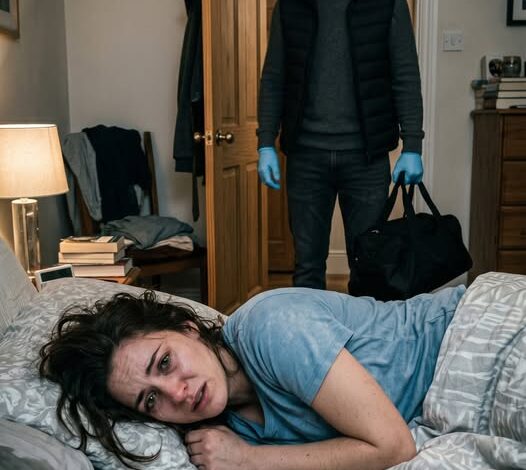
The room tilted beneath my feet the moment I stepped into the bedroom.
Not dramatically.
Not all at once.
Slowly.
Like the hardwood floor had softened into deep water, leaving me unable to trust my own balance.
Two days earlier, I had boarded a flight home grinning like an idiot, thrilled by the idea of surprising my pregnant wife. I imagined Clara laughing when she opened the apartment door. I imagined flowers on the kitchen counter, her arms around my neck, maybe even tears because I’d returned earlier than expected.
I had rehearsed the moment the entire flight home.
Now, standing frozen in the doorway of our bedroom, the bouquet slipped from my hand and hit the floor with a dull, useless thud.
The apartment was silent.
Too silent.
Clara sat curled on the edge of the bed, one trembling hand pressed desperately over her stomach. Her silk nightgown hung backward on her body, seams awkwardly visible at the collar like she’d dressed in darkness or panic. A glass of water lay shattered beside the bed, soaking the rug beneath it.
And there, staining the hardwood floorboards beside the damp towel, sat something dark enough to stop my breathing.
Fear should have reached me first.
Love should have reached me first.
Instead, something uglier arrived before either of them.
My mother’s voice.
Are you sure about her, Ethan?
The memory surfaced instantly.
Three weeks earlier.
A café.
Bitter coffee cooling between us while my mother leaned closer pretending concern.
Women keep secrets, sweetheart. Don’t become a fool raising another man’s child.
For one horrifying second, I looked around the room searching not for danger —
but for betrayal.
The backward nightgown.
The knocked-over glass.
The panic.
My poisoned mind built a phantom man before it recognized a medical emergency.
Then I saw Clara’s phone lying face down on the mattress, charger half-ripped from the wall.
“Clara…” My voice barely sounded human. “How long?”
She blinked slowly through pain and cold sweat.
“Since ten,” she whispered. “Maybe earlier. I thought it was cramps at first. Then it got worse. I tried calling you.”
I picked up her phone mechanically.
The screen lit my face like judgment.
Twenty missed calls.
All from her.
My stomach dropped violently.
But below those calls sat something even worse:
Two attempts to dial emergency services.
Both disconnected after only seconds.
“I couldn’t breathe enough to speak,” Clara murmured weakly. “The pain kept taking my breath away. I thought maybe I was overreacting.”
That sentence split me open.
While my wife lay terrified and bleeding, convinced she might be exaggerating her own suffering, I had stood in the doorway suspecting infidelity.
I rushed toward her immediately then, finally seeing reality clearly.
Her skin looked gray beneath the bedroom light.
Her lips trembled.
Her fingers clawed at the blankets every few seconds when waves of pain hit.
“We need the hospital now.”
She nodded faintly, then pointed weakly toward the dresser.
“The blue folder,” she whispered. “Bottom drawer.”
I yanked the drawer open too quickly, spilling vitamins, receipts, and paperwork across the floor. Finally I found the prenatal folder she’d assembled weeks earlier with obsessive care.
I remembered teasing her gently about labeling every section perfectly.
Now my hands shook so badly I could barely hold it.
When I turned back toward the bed, Clara was staring at me.
Not angrily.
Not even fearfully.
What I saw in her expression was worse.
Recognition.
She had seen my face when I walked in.
She knew exactly what I thought before I touched her.
“Ethan,” she asked softly, “did you think I was with someone else?”
The question landed gently.
That gentleness destroyed me more completely than screaming would have.
I opened my mouth automatically to deny it.
But no lie could survive what she had already witnessed in my eyes.
Outside somewhere below our apartment, a police siren wailed through the city before fading into distance.
Clara closed her eyes briefly against another sharp pain.
“I saw your face,” she whispered. “You looked at the room. Then at my clothes. I knew immediately.”
God.
I wanted to tear the moment apart and rebuild it correctly.
I wanted fear to have reached me first.
Love.
Instinct.
Anything except suspicion.
But the truth stood between us now.
And the truth was this:
my mother planted poison in my mind —
and I let it grow there.
“I don’t know what I thought,” I whispered finally.
It sounded pathetic even to me.
Clara looked away slowly.
The silence afterward felt unbearable.
I wrapped her winter coat around her shoulders carefully, trying not to stare at the backward seams of her nightgown.
But she noticed anyway.
“I put it on after the shower,” she explained quietly. “The pain hit me so hard I got dizzy. I couldn’t tell front from back.”
Such a small explanation.
So innocent.
So ordinary.
And somehow it became unbearable to hear.
No hidden affair.
No secret lover fleeing the apartment.
Only a pregnant woman alone and terrified, too weak to dress herself properly.
I knelt to tie her shoes because she physically could not bend over.
She watched my shaking hands silently.
Not forgiving.
Not accusing.
Just exhausted.
I practically carried her to the elevator.
The fluorescent lights turned her skin pale gray while she leaned against the metal wall clutching the blue medical folder tightly against her chest.
I stood inches away terrified to touch her.
Because suddenly I didn’t know whether my hands represented comfort —
or betrayal.
The elevator descended agonizingly slowly.
Four.
Three.
Two.
Every floor felt like punishment.
Outside, freezing night air slapped against us as I helped her toward the car.
I opened the passenger door carefully.
But before climbing inside, Clara stopped.
She looked at me beneath the weak yellow glow of the streetlamp.
And quietly asked the question that would haunt me forever.
“Were you afraid for me first, Ethan?” she whispered. “Or were you angry first?”
I could have lied.
God knows I wanted to.
I could have built some softer version of events where confusion briefly overwhelmed love.
But she had already seen my face.
And I had already seen the twenty missed calls.
“I was angry first,” I admitted.
Her eyes closed slowly.
Not dramatically.
Not tearfully.
Just the tiny movement of someone receiving confirmation of something they desperately hoped wasn’t true.
The drive to the hospital blurred around me.
Red lights.
Traffic horns.
Rain beginning against the windshield.
Clara sat rigid beside me breathing through pain while both hands covered her stomach protectively.
Then my phone buzzed violently in my pocket.
I ignored it at first.
It buzzed again.
And again.
At the next red light, I pulled it out.
My mother.
Three unread messages.
Are you home yet?
Call me before you speak to Clara.
There are things you need to know about her.
The words made me physically nauseous.
Clara glanced toward the screen.
“Who is it?”
“My mother.”
Something shifted across her face immediately.
Not surprise.
Recognition.
“She called me tonight,” Clara whispered.
My grip tightened painfully around the steering wheel.
“When?”
“Around nine. Right before everything got worse.”
The hospital sign glowed faintly ahead through rain and traffic.
“She told me,” Clara continued hollowly, “that men deserve scientific proof before trusting a pregnancy.”
My chest tightened violently.
Because I recognized the exact sentence.
My mother said nearly the same thing to me weeks earlier over coffee.
I remembered every detail suddenly:
her careful tone,
the fake concern,
the suggestion of a paternity test “just to protect yourself.”
I told her she was ridiculous.
But I never told Clara.
I kept my mother’s poison hidden because confronting her felt uncomfortable.
And now that silence sat between us like a loaded weapon.
I pulled beneath the emergency room awning so fast the tires screeched.
Nurses rushed outside immediately with a wheelchair the moment they saw Clara.
Questions exploded around us:
“How many weeks?”
“Any bleeding?”
“Previous complications?”
I stood there clutching the blue folder like an idiot while Clara answered through pain.
Then the intake nurse glanced toward me.
“And you’re the father?”
Clara hesitated.
Only half a second.
But it destroyed me.
“Yes,” she answered quietly.
Not because she doubted the baby.
Because I had made my doubt visible enough to wound her.
They rushed her toward trauma evaluation while I followed helplessly behind until a nurse stopped me at the doorway.
“Give us one minute, sir.”
I paced outside Trauma Bay Four drowning in bleach smell and panic.
When they finally let me inside, Clara looked impossibly small beneath fluorescent light and hospital blankets.
The doctor ordered bloodwork and an emergency ultrasound immediately.
As the technician wheeled equipment toward the bed, Clara turned toward me weakly.
“Don’t call your mother.”
Not a request.
A boundary.
The first real boundary she’d ever drawn between herself and my family.
“I won’t,” I promised immediately.
Then my phone vibrated again.
The sound echoed through the room.
I pulled it out instinctively.
Incoming Call: Mom.
For years, I answered automatically.
My father died five years earlier, and afterward my mother transformed grief into entitlement. She criticized our apartment. Our finances. Clara’s job. Baby names. Furniture choices.
And I spent years convincing myself her interference was manageable.
Standing beside Clara’s hospital bed, I finally understood something brutal:
I had never protected my wife.
I only protected myself from conflict.
The phone kept vibrating in my hand.
Clara watched me silently.
And suddenly the choice became crystal clear.
Not between answering or ignoring a call.
Between cowardice and responsibility.
I rejected the call.
Then powered the phone completely off.
The technician spread cold gel across Clara’s stomach while the room fell silent except for machinery humming softly.
The doctor moved the ultrasound wand carefully.
Gray static flickered across the screen.
Then suddenly —
movement.
Tiny.
Rapid.
Fragile.
“There’s cardiac activity,” the doctor said carefully.
The heartbeat flickered like distant lightning.
Alive.
Clara gasped sharply beside me.
I nearly collapsed from relief.
But the doctor continued speaking:
threatened miscarriage,
bleeding,
strict monitoring,
possible complications.
Nothing was safe yet.
Only possible.
Afterward, they moved Clara into overnight observation.
Morning light slowly crept across the hospital room while she rested pale and exhausted beneath thin blankets.
When she finally opened her eyes again, she studied my face carefully.
“If your mother asks for proof,” she whispered, “will you ask too?”
The question cut deeper than anything else.
Because if I were brutally honest with myself, some frightened part of me had already imagined it:
DNA tests.
Reassurance.
Evidence.
Not because Clara gave me reason —
but because doubt had been allowed to survive inside me too long.
Outside the room, nurses laughed softly at their station while wheels squeaked along polished floors.
Ordinary sounds.
Ordinary life.
Meanwhile my marriage balanced on a knife’s edge.
“No,” I answered finally.
Clara kept watching.
So I repeated it stronger.
“No. I won’t ask for any test. And I should’ve stopped her long before tonight.”
Tears filled Clara’s eyes slowly.
Not relief.
Grief.
Because the correct answer delivered too late still arrives carrying damage.
“I let my mother poison this marriage because confronting her made me uncomfortable,” I admitted. “And tonight I hurt you when you needed me most.”
Clara looked toward the window.
“I don’t know what this makes us now.”
Neither did I.
We weren’t destroyed completely.
But innocence was gone.
Then my phone buzzed faintly inside my pocket despite being powered down earlier and restarted for hospital calls.
I placed it face down on the tray table without checking it.
Clara noticed.
“When we leave this hospital,” she whispered after a long silence, “I refuse to return home to her voice waiting for me.”
I understood exactly what she meant.
Not voicemails.
Not text messages.
Protection.
A wall between her and the woman poisoning our lives.
I picked up the phone.
“I’ll handle it now.”
The moment the device fully connected again, messages flooded the screen.
A mother has the right to protect her son from mistakes.
A paternity test protects everyone involved.
You deserve certainty before committing forever.
Each message looked calm.
Reasonable.
Almost loving.
But now I could finally see them clearly for what they were:
control disguised as concern.
I pressed call.
Speakerphone.
My mother answered instantly.
“Ethan! Finally. Listen before Clara manipulates you—”
“No,” I interrupted quietly.
The line fell silent immediately.
“You are going to listen to me.”
My voice sounded different even to myself.
Steady.
Cold.
Certain.
“Clara is lying in a hospital bed because she nearly lost our baby tonight,” I said. “And your poison helped put her here.”
“How dare you!” my mother snapped instantly. “I was protecting you! You don’t even know if that child is—”
“If you finish that sentence,” I said evenly, “you will never see me or my child again.”
Silence.
Heavy.
Absolute.
“You planted doubt in my head,” I continued. “And because I was too weak to stop you, I brought that poison home. That ends now.”
“Ethan, please—”
“No. Listen carefully. Clara is my family. My child is my family. You will not contact her again. You will not mention paternity again. And if you cannot treat my wife with absolute respect, you are no longer part of our lives.”
“You’re choosing her over your mother?”
“I’m choosing my family.”
Then I ended the call.
No explanations.
No apologies.
No negotiation.
Just silence.
Real silence for the first time in years.
I placed the phone down slowly.
Clara was crying openly now.
Not because everything was fixed.
Not because trust magically returned.
But because finally —
finally —
I had stopped asking her to survive my cowardice.
She held out her hand toward me.
I crossed the room instantly and dropped to my knees beside the bed, gripping her fingers carefully while tears finally broke loose from somewhere deep inside me.
I cried for the fear.
For the doubt.
For almost failing her completely.
And maybe most of all, I cried because the version of me desperate to keep everyone comfortable had finally died inside that hospital room.
Morning sunlight slowly flooded the window behind us.
The world outside kept moving:
nurses changing shifts,
coffee carts rattling down hallways,
machines beeping softly somewhere nearby.
But inside that little room, something enormous had shifted permanently.
Not repaired.
Not forgiven completely.
But finally honest.
Clara’s fingers moved slowly through my hair while I rested my forehead against the hospital blanket beside her stomach.
And beneath my hand, faint but stubborn and alive, our child’s tiny heartbeat continued fighting forward into the light.