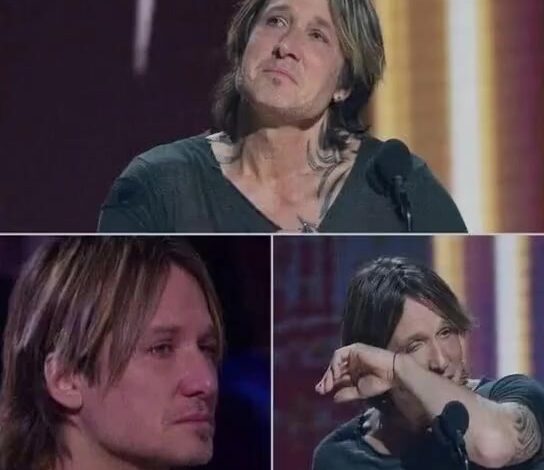
Keith Urban’s life has always carried the tension of someone running from one thing while reaching desperately toward another.
From the outside, the story appears polished enough to fit neatly inside celebrity mythology:
the Grammy-winning country star,
the sold-out arenas,
the marriage to an Oscar-winning actress,
the photographs glowing beneath red carpets and camera flashes.
But beneath the success lies something more fragile and far more human:
a man repeatedly rebuilding himself before the collapse could finish defining him.
Long before fame hardened into identity, Urban was simply a boy watching his father believe in him fiercely enough to rearrange an entire family’s life around possibility.
Born in New Zealand and raised largely in Australia, Keith grew up inside a household where music occupied daily space naturally. His father, Robert Urban, loved American country music deeply and recognized his son’s unusual talent early. Talent alone, however, rarely changes lives without sacrifice attached to it.
So the family sacrificed.
Hours spent driving to competitions.
Money stretched thin for instruments and lessons.
Dreams treated not as fantasy but labor.
Keith absorbed all of it:
the discipline,
the pressure,
the unspoken understanding that music might become both escape and survival simultaneously.
And perhaps that intensity planted the seeds of future instability too.
Because people who learn young that performance earns love sometimes struggle later separating achievement from worth.
By adulthood, Urban possessed extraordinary musical instincts but increasingly fragile personal foundations. Addiction crept through the spaces success could not stabilize. Alcohol and cocaine became companions during years when fame accelerated faster than emotional grounding could keep pace.
To audiences, he looked like a rising star.
Privately, he was unraveling.
Then came Nicole Kidman.
Their first meeting at the 2005 “G’Day LA” event has since entered celebrity folklore partly because it sounds almost improbable in hindsight. Two globally recognizable people crossing paths briefly beneath the strange artificial intimacy of Hollywood events.
Urban later admitted he assumed Kidman would never call him afterward.
She did.
And suddenly both their lives tilted unexpectedly.
The speed of their connection startled even them. They became engaged quickly despite still knowing relatively little about one another in practical terms. To outsiders, it looked reckless — two famous people moving too fast inside industries already notorious for short-lived romance.
But perhaps what bound them together was not certainty.
Recognition.
Kidman had already survived public heartbreak beneath worldwide scrutiny after her marriage to Tom Cruise ended. Urban carried his own instability quietly behind fame and charm. Both understood what it meant to live publicly while feeling emotionally unsafe privately.
Sometimes intimacy forms fastest between people exhausted by performance.
Still, love alone could not save Urban from himself.
Just months after their wedding in 2006, he entered rehab for substance abuse.
That decision became one of the defining pivots of his life.
Because entering treatment so early in a marriage requires terrifying vulnerability. Addiction often thrives through secrecy and compartmentalization. Marriage destroys compartments quickly. Urban later spoke openly about how deeply ashamed he felt — not simply for relapsing into destructive behavior, but for risking the relationship itself before it had fully begun.
Nicole stayed.
Not blindly.
Not passively.
But faithfully.
And perhaps that is what made the marriage durable where many celebrity relationships fracture under pressure. They stopped treating love as performance and began treating it as sustained work:
rehabilitation,
honesty,
parenthood,
rebuilding trust repeatedly instead of assuming it arrives permanently.
Over time, their marriage evolved into something quieter and more resilient than public fascination initially expected.
Two daughters followed:
Sunday Rose and Faith Margaret.
Fatherhood softened Urban visibly.
Friends and interviewers began noticing how often he redirected conversations away from fame and toward ordinary domestic details:
school schedules,
bedtime routines,
family dinners squeezed between tours.
That shift mattered because celebrity culture frequently rewards emotional fragmentation. Public figures learn to exist partly detached from normal life rhythms. Constant travel, adoration, and pressure distort intimacy easily.
Urban seemed increasingly determined not to lose himself completely inside that machinery.
Yet grief remained woven through everything.
His father’s death from prostate cancer in 2015 marked another permanent turning point.
By then, Robert Urban had already witnessed his son become internationally successful. But success does not lessen the devastation of losing the person who believed first.
Keith rarely speaks about his father without visible emotion.
Because beneath all the awards and sold-out concerts still lives the boy whose dad drove him to music competitions believing possibility outweighed exhaustion.
When cancer took him, Urban transformed grief into movement rather than retreat.
That transformation became especially visible during the 2018 It’s A Bloke Thing luncheon in Australia. Instead of treating the charity appearance as obligation or publicity opportunity, Urban performed entirely free of charge to support prostate cancer awareness and research.
The event raised more than two million dollars.
But the emotional significance ran deeper than fundraising totals.
This was not celebrity philanthropy detached from lived experience.
It was mourning redirected toward purpose.
Urban understood intimately what cancer steals:
not only lives,
but conversations,
future milestones,
the ordinary comfort of knowing someone remains reachable by phone call.
Performing that day became less entertainment than offering.
A son using music to answer grief publicly because private grief alone no longer felt sufficient.
That pattern repeats throughout much of Urban’s life now.
Again and again, he converts personal pain into connection.
Songs about loneliness become communal anthems.
Addiction recovery becomes openness instead of secrecy.
Loss becomes advocacy.
Perhaps because he understands fame eventually feels hollow unless attached to something capable of outliving applause.
And applause fades quickly.
Healing does not.
What makes Urban compelling to many fans is not perfection but visible reconstruction. Audiences sense instinctively when public figures understand suffering firsthand rather than merely discussing it abstractly. Urban carries the emotional texture of someone who has repeatedly come close to losing important things:
sobriety,
love,
stability,
himself.
That awareness softens people.
It deepens gratitude.
Even now, balancing international tours with family life requires constant negotiation. One night he stands beneath stadium lights before tens of thousands of screaming fans. Days later he may sit helping with homework or making breakfast quietly while his daughters prepare for school.
Those transitions matter psychologically.
They keep fame from becoming total identity.
And perhaps that balance explains why Urban’s public image feels unusually grounded despite decades inside celebrity culture. He appears less interested in mythology than maintenance:
maintaining sobriety,
maintaining family,
maintaining enough emotional honesty to keep success from hollowing him out entirely.
The story, then, is not really about stardom.
Not ultimately.
It is about rebuilding.
A man repeatedly forced to confront versions of himself capable of self-destruction — and choosing, over and over again, to construct something steadier from the wreckage.
A husband learning love requires vulnerability stronger than charm.
A father discovering ordinary moments matter more than ovations.
A son carrying grief into public action so other families might suffer less.
That is why Keith Urban resonates beyond music itself.
Because his life reflects a truth many people recognize privately:
sometimes survival is not a single triumph.
It is a series of decisions made repeatedly after pain,
after failure,
after loss —
until eventually the life you rebuild becomes more meaningful than the one that first collapsed.
And somewhere between stadium lights and bedtime stories, charity stages and quiet kitchens, Keith Urban seems to have found exactly that kind of life:
not flawless,
not untouched by grief,
but deeply, stubbornly alive.