The workers would remember the sound for the rest of their lives.
Not the shouting.
Not the sirens.
Not even the panic.
It was the crack.
A sharp, violent crack that sliced through the morning air and froze every person on the construction site where they stood.
For a fraction of a second, nobody moved.
Nobody understood.
Then came the second sound.
A deep metallic groan.
The kind of sound that shouldn’t exist.
The kind that seems to come from the bones of something enormous.
Every head turned upward.
And suddenly everyone realized the same terrifying truth.
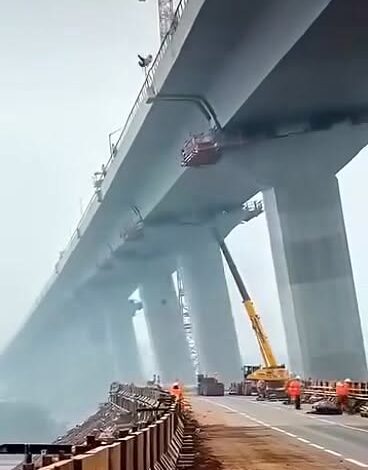
The bridge was moving.
At first, it was subtle.
A slight sway.
A vibration beneath steel beams.
Something easy to dismiss under normal circumstances.
But this wasn’t normal.
The movement grew stronger.
Faster.
The massive structure shuddered.
Bolts rattled.
Cables strained.
Concrete dust drifted through the air like gray snow.
“Get out!”
The scream erupted from somewhere high above the deck.
Then another voice joined it.
“Run!”
Within seconds, the construction site transformed from an ordinary workday into chaos.
Workers dropped tools where they stood.
Welders abandoned equipment.
Engine operators jumped from machinery.
Foremen shouted warnings through radios that crackled with overlapping voices.
Training disappeared.
Instinct took over.
Everyone understood one thing.
They had to get off the bridge.
Now.
Carlos Ramirez had spent twenty-three years working construction.
He had experienced storms, equipment failures, electrical fires, and dangerous accidents.
Nothing compared to this.
As he sprinted across the unfinished section of roadway, the surface beneath him trembled.
The sensation sent ice through his veins.
Structures weren’t supposed to move like that.
Not bridges.
Not something designed to carry thousands of tons every day.
Around him, dozens of workers rushed toward safety.
Some scrambled down temporary stair towers.
Others raced across access platforms.
One man lost his footing and nearly fell before a coworker grabbed his vest and pulled him upright.
Nobody stopped moving.
Nobody looked back.
Another crack exploded through the air.
Louder this time.
Closer.
The sound echoed across the river below.
Concrete fractured.
Steel twisted.
The bridge lurched violently.
Several workers screamed.
Carlos reached the end of an access ramp and jumped the final few feet onto solid ground.
The moment his boots hit dirt, he spun around.
What he saw would haunt him forever.
The center section of the bridge was sagging.
Not much.
Only a few inches.
But enough.
Enough to tell every engineer, inspector, and worker present that disaster was no longer a possibility.
It was approaching.
Fast.
“Everybody clear?” someone shouted.
Voices answered from every direction.
Some calm.
Some panicked.
Some barely audible.
The count began.
Crew leaders checked names.
Supervisors searched for missing workers.
Every second felt endless.
Then another sound rolled across the site.
A low rumble.
Deep.
Unnatural.
Like thunder trapped inside concrete.
The bridge shifted again.
This time everyone saw it.
Nobody spoke.
Fear spread through the crowd.
Pure.
Raw.
Immediate.
Because now there was no denying reality.
The structure was failing.
Emergency crews arrived within minutes.
Police blocked nearby roads.
Firefighters established safety zones.
Engineers stood staring at the bridge with expressions that revealed everything.
Something had gone catastrophically wrong.
As workers gathered behind barriers, many struggled to process what had happened.
Minutes earlier, they had been performing routine tasks.
Checking measurements.
Operating machinery.
Following schedules.
Now they stood watching a structure that seemed ready to collapse beneath its own weight.
For some, another memory surfaced.
A memory that never truly disappeared.
The Minneapolis bridge disaster.
August 1, 2007.
Rush hour.
Hundreds of vehicles.
Then sudden collapse.
Lives lost.
Families destroyed.
An entire nation shocked.
Many of the older workers remembered watching the footage on television.
The falling concrete.
The twisted steel.
The desperate rescue efforts.
The realization that a bridge people trusted every day could simply vanish beneath them.
Now, standing beside another failing structure, those memories returned with terrifying clarity.
Carlos thought about it too.
He remembered the images.
The interviews.
The grief.
And he remembered asking himself a question all those years ago.
How could nobody see it coming?
Standing there now, he understood something difficult.
Sometimes people do see warning signs.
The problem is whether anyone listens.
Over the following hours, investigators began gathering information.
Workers exchanged stories.
Several reported hearing unusual noises during previous days.
Others described vibrations that felt different from normal construction activity.
A few recalled concerns raised during inspections.
Nothing dramatic.
Nothing that seemed urgent at the time.
Small warnings.
Tiny signals.
Pieces of a puzzle that suddenly looked far more important.
As engineers examined the structure, one reality became impossible to ignore.
Bridges do not fail without reason.
Somewhere, something had been missed.
A defect.
A weakness.
A warning.
An assumption.
Whatever the cause, the consequences had come dangerously close to becoming catastrophic.
Had the cracking started an hour later, hundreds of workers might have been positioned across the structure.
Had the failure occurred after opening, motorists could have been involved.
Had evacuation been delayed by even a few minutes, lives might have been lost.
That truth settled heavily over everyone present.
Because survival often creates its own kind of shock.
The realization of what almost happened.
The understanding of how narrowly disaster was avoided.
As evening approached, the construction site stood silent.
Machinery sat abandoned.
Tools remained where they had been dropped.
Emergency lights flashed across the darkening landscape.
Workers slowly headed home to families who would hug them a little tighter that night.
Many struggled to sleep.
The sounds remained trapped in their minds.
The crack.
The groan.
The rumble.
The bridge moving beneath their feet.
For days afterward, investigators worked to determine exactly what had happened.
Questions demanded answers.
Could the failure have been prevented?
Were warning signs overlooked?
Did inspections reveal problems that were never fully addressed?
The investigation would eventually provide technical explanations.
Numbers.
Reports.
Engineering conclusions.
But for the workers who stood there that day, the lesson was simpler.
Structures speak before they fail.
Sometimes through cracks.
Sometimes through vibrations.
Sometimes through subtle warnings that seem insignificant until it’s too late.
Every ignored concern carries a cost.
Every delayed inspection creates risk.
Every shortcut becomes a gamble.
And the currency being wagered is never concrete or steel.
It’s human life.
That morning, disaster came close enough for everyone to hear its voice.
Close enough to feel it beneath their feet.
Close enough to remind them of a truth written into every bridge, every building, and every piece of infrastructure ever constructed:
Safety is not a formality.
It is the thin line separating an ordinary day from a tragedy people will remember forever.
This time, the workers reached solid ground before that line disappeared.
This time, they got lucky.
And sometimes, luck is all that stands between a warning and a memorial.