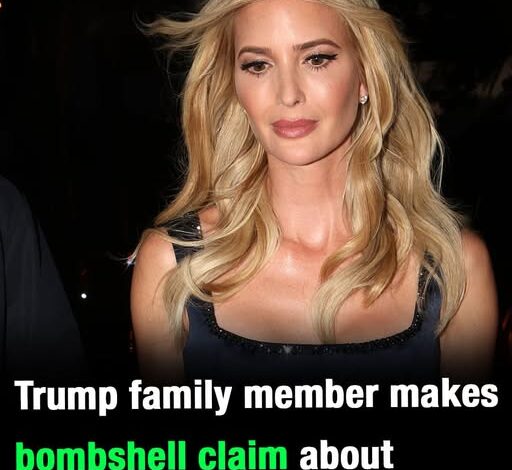
Away from Washington and the relentless chaos of her father’s presidency, Ivanka Trump has carefully rebuilt a quieter, more insulated life. Indian Creek Island offers privacy, but it hasn’t severed her emotional ties to the Trump orbit. When she appeared beside her towering younger brother Barron at Donald Trump’s State of the Union address, their easy rapport and whispered exchanges suggested a new internal alliance, a softer, more personal power base within a famously combative family.
Yet the latest revelation about Ivanka didn’t come from a political rival, but from inside the clan. Lara Trump, married to Eric Trump, described Ivanka as the one who gives the most unsolicited advice—always well-meaning, always trying to help, even when no one asked. In the same breath, she admitted Ivanka is also the most thoughtful gift-giver, the only one who never forgets a birthday. It paints a striking picture: a woman who stepped away from the stage, but still can’t stop caring, guiding, and quietly shaping the family from just beyond the spotlight.
For years, Ivanka Trump occupied one of the most complicated positions in modern American public life. To critics, she symbolized privilege wrapped in careful branding: polished, measured, and perpetually navigating the tension between personal image and political loyalty. To supporters, she represented composure within chaos, the calm daughter trying to soften the harsher edges of an administration built on confrontation.
But regardless of perspective, one thing became undeniable during Donald Trump’s presidency:
Ivanka understood proximity to power better than almost anyone around him.
She knew when to speak.
When to stay silent.
When to stand beside her father publicly.
And when to create strategic distance.
That balancing act defined much of her political identity.
Unlike many figures within Trump-world who thrived on aggression and media warfare, Ivanka cultivated an image built around restraint. Her tone remained softer, her language more measured, her presentation carefully controlled even while operating inside one of the most turbulent political environments in recent memory.
Yet that restraint came at a cost.
Public life during the Trump years consumed nearly everyone attached to the administration emotionally. Endless investigations, media cycles, protests, legal battles, internal feuds, and political polarization turned even ordinary appearances into emotionally loaded spectacles. Families connected to the White House found themselves transformed into symbols larger than themselves almost overnight.
Ivanka became one of the central symbols.
Every outfit was analyzed.
Every facial expression interpreted.
Every statement dissected for hidden meaning.
People projected enormous expectations onto her from opposite directions simultaneously. Some wanted her to restrain her father publicly. Others expected unwavering loyalty. Many believed she possessed more influence than she admitted, while others argued her power was mostly symbolic.
Living under that level of scrutiny changes people.
Which is why her withdrawal from frontline politics after leaving Washington felt so intentional.
Indian Creek Island—the ultra-private, heavily secured Florida enclave often nicknamed the “Billionaire Bunker”—offered more than luxury. It offered insulation. Distance. A chance to reconstruct daily life outside the nonstop pressure cooker of national politics.
Yet physical distance never fully erased emotional connection.
Families like the Trumps operate partly as political dynasties and partly as deeply intertwined emotional systems. Public disagreements, strategic distancing, and shifting alliances may occur constantly, but the gravitational pull of family remains powerful underneath everything.
That is partly why Ivanka’s recent appearances beside Barron Trump drew such attention.
Barron himself has become a strangely fascinating figure publicly precisely because so little is known about him emotionally. Towering physically now, older and more visibly self-possessed, he carries the mystery of someone raised inside extraordinary visibility while remaining almost completely shielded from public overexposure.
Watching him beside Ivanka created an unexpectedly human moment.
Their whispered conversations and relaxed body language contrasted sharply with the often rigid, performative atmosphere surrounding political events. Instead of calculated messaging, audiences briefly glimpsed something simpler:
siblings interacting naturally.
That subtle warmth mattered because the Trump family is so often portrayed publicly through conflict, ambition, and dominance. Seeing ease between family members offered a softer image rarely emphasized within narratives surrounding them.
And perhaps that softness increasingly defines Ivanka’s role specifically.
No longer visibly driving policy discussions or serving as a formal White House advisor, she now appears positioned differently within the family structure:
less warrior,
more stabilizer.
Lara Trump’s comments reinforced that impression powerfully.
Calling Ivanka the family’s biggest giver of unsolicited advice sounds humorous on the surface, but psychologically it reveals something deeper. People who constantly advise, guide, organize, and emotionally manage others often occupy caretaker roles inside families whether officially acknowledged or not.
Especially in high-pressure families, someone frequently emerges as the “emotional administrator”:
the one remembering birthdays,
checking on people,
offering solutions,
managing emotional temperature quietly behind the scenes.
According to Lara’s description, Ivanka seems to occupy that role increasingly.
The detail about birthdays feels especially revealing.
In large, public, achievement-driven families, emotional maintenance can easily disappear beneath ambition and logistics. Remembering birthdays sounds small, but small acts often carry disproportionate emotional meaning because they signal attention rather than obligation.
A thoughtful gift says:
I noticed you.
I remembered.
You exist beyond headlines and strategy.
That emotional attentiveness contrasts sharply with the harsher public image surrounding the Trump family historically. Outsiders often imagine wealthy political dynasties functioning purely through transaction, competition, and image management. Lara’s comments instead paint a portrait of someone trying actively to preserve intimacy and connection inside an unusually intense environment.
Of course, even affection within powerful families can become complicated.
Ivanka’s instinct to advise constantly likely reflects both personality and survival. Growing up around Donald Trump required navigating a world where strength, perception, and strategic thinking mattered enormously. Children raised inside highly competitive or high-profile families often become hyper-attuned to managing outcomes emotionally.
Advice becomes a form of care.
Sometimes also a form of control.
Often both simultaneously.
Lara’s phrasing—that Ivanka means well “even when nobody asked”—captures that tension perfectly. It suggests someone who cannot entirely stop trying to help, organize, refine, or improve situations around her.
That instinct likely served Ivanka politically too.
During her White House years, she often appeared to function partly as translator between worlds:
between her father’s blunt instincts and more polished institutional expectations,
between populist politics and elite social circles,
between emotional loyalty and public image preservation.
Those skills do not simply disappear after leaving Washington.
They reshape themselves into quieter forms.
Which may explain why Ivanka’s current influence feels subtler but still significant. Publicly, she appears removed from direct political combat. Privately, however, she likely remains emotionally central inside family dynamics simply because families continue operating long after headlines move on.
There is also something deeply recognizable about her transition specifically as a woman.
Women in powerful families are often expected to perform impossible balancing acts:
supportive but independent,
ambitious but nurturing,
visible but not overpowering,
helpful without seeming controlling.
Ivanka has navigated those contradictory expectations for years under extraordinary scrutiny. Every move carried symbolic meaning larger than itself because audiences projected broader cultural debates onto her constantly:
feminism,
privilege,
loyalty,
complicity,
motherhood,
ambition.
Stepping away from public politics may therefore represent not only strategic distancing, but emotional exhaustion too.
Constant visibility extracts psychological cost eventually.
And perhaps that is why viewers now respond differently to glimpses of Ivanka. Removed from official power structures, she appears less like a political operator and more like a complicated human being trying to maintain family relationships inside extraordinary circumstances.
The image emerging is unexpectedly domestic beneath the glamour:
the sister whispering beside her brother,
the aunt remembering birthdays,
the family member texting advice nobody requested,
the thoughtful gift-giver trying to maintain emotional connection quietly.
That humanity does not erase political criticism or public controversy surrounding the Trump years. But it complicates the image in ways audiences increasingly recognize instinctively.
Because no matter how public families become, private emotional ecosystems continue underneath the spectacle.
People still seek approval.
Still carry sibling dynamics.
Still play emotional roles assigned decades earlier.
Still try to care for each other imperfectly through stress, conflict, and public pressure.
The Trumps may live under levels of visibility most families cannot imagine, but they remain vulnerable to those same emotional patterns too.
And perhaps Ivanka’s current chapter reveals something universal hidden beneath wealth and politics:
Sometimes stepping away from the spotlight does not mean stepping away from influence entirely.
Sometimes influence simply changes form.
Less visible.
More personal.
Measured not through speeches or titles anymore, but through quieter acts:
phone calls,
birthday gifts,
advice over dinner,
a reassuring conversation beside a younger sibling while cameras flash nearby.
In that sense, Ivanka may no longer stand at the center of the political stage.
But according to those closest to her, she never truly stopped trying to hold pieces of the family together behind the curtain.