At first, it looked almost beautiful.
That was what made it so unsettling later.
If it had appeared obviously dangerous from the beginning, perhaps none of us would have hesitated. We would have recognized the threat immediately, called for help, and moved on with our lives. But the strange object attached to the wall possessed a deceptive elegance that made certainty impossible.
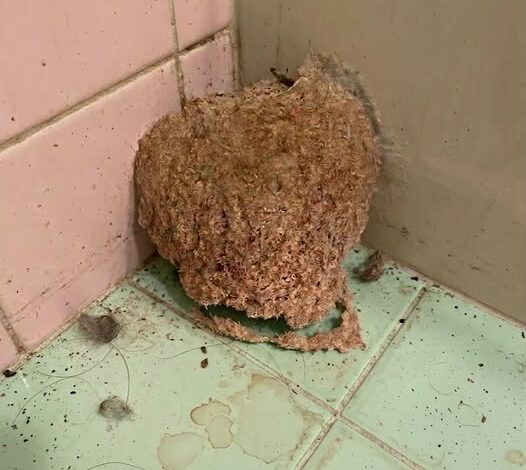
From across the room, it resembled some kind of natural sculpture.
Layer upon layer curved outward in careful formation. The surface looked textured but deliberate, almost artistic. The pale gray and brown tones blended together in a way that reminded us of weathered paper, driftwood, or something handmade. It seemed too organized to be random and too unusual to ignore.
For several long moments, we simply stood there staring.
Nobody spoke.
The silence itself felt significant.
Because we were all thinking the same thing.
Something had put it there.
The longer we looked, the stranger it became.
What initially appeared delicate slowly transformed into something unsettling. The shape seemed too intentional. The structure too precise. Tiny repeating patterns appeared along the surface, each one fitting neatly beside the next. It looked engineered rather than accidental, as though some unseen architect had been working quietly inside our home while we carried on with our ordinary lives.
That realization triggered the first wave of anxiety.
Homes are supposed to feel understandable.
We expect to know what belongs there and what does not. We recognize familiar objects instantly: a towel draped over a chair, a basket on a shelf, a crack in the paint that has been there for years. Familiarity creates safety.
This thing was not familiar.
And unfamiliar objects have a way of expanding in the imagination.
Theories emerged immediately.
Maybe it was mold.
Someone suggested a fungal growth.
Another person wondered whether something inside the wall had begun decaying.
The more possibilities we invented, the worse the atmosphere became.
Fear thrives inside uncertainty.
When people lack information, the mind begins constructing explanations automatically. Rarely does it choose comforting ones. Instead, it gravitates toward worst-case scenarios because caution once helped humans survive. Evolution rewards people who assume danger before assuming safety.
So we did what everyone does now.
We pulled out our phones.
Within minutes, multiple screens glowed around the room as we searched frantically.
“Strange papery formation on wall.”
“Brown cone structure indoors.”
“Layered growth bathroom wall.”
“Honeycomb-looking thing inside house.”
Search results only deepened the mystery.
Some images looked vaguely similar but not enough to provide confidence. Others appeared disturbingly close, only to reveal completely different explanations when examined more carefully.
The internet excels at providing possibilities.
It is less useful at delivering certainty.
We zoomed into photographs.
Compared textures.
Read forums.
Sent pictures to friends.
Each response introduced new speculation.
Every guess felt plausible.
Every explanation felt incomplete.
And as the minutes passed, the room itself seemed to change.
The object remained motionless.
Yet somehow it felt increasingly alive.
Perhaps that was because uncertainty alters perception. Once the possibility of danger enters a space, ordinary details begin rearranging themselves emotionally.
Shadows appear darker.
Corners feel deeper.
Silence becomes suspicious.
Even familiar rooms start feeling slightly foreign.
Then someone mentioned the buzzing.
The entire room went quiet again.
Because suddenly we remembered.
There had been a faint sound.
Not constant.
Not loud.
Just occasional.
A soft vibration that seemed to appear and disappear without obvious source.
We had dismissed it repeatedly.
Old houses make noises.
Pipes vibrate.
Ventilation systems hum.
Windows rattle.
Life inside a home produces countless small sounds that rarely deserve investigation.
Except now those sounds seemed different.
Now they felt connected.
The buzzing was no longer background noise.
It was evidence.
And once that realization arrived, other details surfaced too.
Tiny fragments on the floor.
Small pieces of debris we had swept away absentmindedly days earlier.
At the time they looked insignificant.
Dust.
Paint chips.
Bits of plaster.
Nothing worth thinking about.
But viewed through a new lens, they became clues.
The house had been communicating with us long before we understood the language.
That thought was strangely unsettling.
Because warning signs often appear ordinary until hindsight transforms them into patterns.
The object on the wall.
The debris beneath it.
The faint buzzing.
The uneasy feeling nobody could quite explain.
Each piece meant little individually.
Together they told a story.
We just had not recognized it yet.
The answer arrived suddenly.
A photograph.
A professional pest-control website.
A single image nearly identical to what we were seeing.
Hornets.
The structure was a hornets’ nest.
And the moment we understood that fact, everything changed.
Fear became specific.
Specific fear is strangely easier to manage than uncertainty because at least it provides direction.
The papery layers suddenly made sense.
The organized cells.
The texture.
The debris.
The buzzing.
Every confusing detail clicked into place simultaneously.
Yet understanding did not make the situation less alarming.
If anything, it intensified it.
Only moments earlier, the object had existed as mystery.
Now it existed as threat.
The bathroom that had felt familiar for years instantly became hostile territory. Every step toward the wall suddenly felt reckless. Every movement carried new risk.
How many hornets were inside?
Were they active?
Could they enter other parts of the house?
Had they already?
Questions multiplied faster than answers.
But one thing became clear immediately:
This was not a problem for curiosity.
It was a problem for caution.
So we backed away.
Slowly.
Carefully.
Nobody wanted to test the colony’s temperament.
Nobody wanted to discover whether disturbing the nest would trigger a defensive response.
We closed the bathroom door.
Sealed gaps as best we could.
Warned everyone in the house.
Then called professionals.
There was something humbling about that decision.
Modern culture often encourages people to solve everything themselves. Home improvement videos, online tutorials, and endless internet advice create the illusion that nearly any problem can be fixed with enough confidence and determination.
Sometimes that is true.
Sometimes it is not.
Some situations demand expertise rather than courage.
This was one of them.
When the pest-control specialists arrived, their calmness was reassuring and unsettling at the same time.
Reassuring because they recognized the situation immediately.
Unsettling because their professionalism confirmed our concerns were legitimate.
They did not laugh.
They did not dismiss our fears.
They inspected carefully.
Asked questions.
Prepared equipment.
Explained procedures.
Everything about their behavior communicated that the nest represented a genuine hazard requiring deliberate handling.
Watching professionals work often reveals the difference between confidence and competence.
Confidence assumes control.
Competence understands risk.
The specialists approached the nest methodically, minimizing disturbance while assessing colony activity. Protective equipment covered every exposed surface. Tools appeared designed specifically for scenarios we had never imagined encountering.
The process felt strangely surreal.
Something that had seemed almost decorative from a distance now required specialized removal techniques and protective gear.
Reality had finally caught up with imagination.
Piece by piece, the structure came down.
The mystery disappeared.
The danger followed.
And yet the emotional impact lingered.
Because removing the nest did not immediately restore normality.
The room felt different afterward.
Safer, certainly.
But different.
We continued glancing toward the wall automatically.
Listening for sounds no longer present.
Checking corners.
Watching for movement.
Fear leaves echoes behind even after the source disappears.
The nervous system remembers.
That reaction frustrated us initially.
We knew the danger was gone.
Professionals had confirmed it.
Yet part of the brain continued scanning for threat anyway.
This is one of fear’s most fascinating characteristics.
It is designed to keep us alive, not comfortable.
Once it learns a lesson, it repeats it.
Again and again.
Until safety slowly reestablishes itself through repetition.
Still, gratitude eventually replaced anxiety.
Gratitude that we noticed the nest before touching it.
Gratitude that no child discovered it first.
Gratitude that no pet investigated out of curiosity.
Gratitude that nobody attempted a heroic do-it-yourself removal.
Because alternative outcomes were easy to imagine.
A broom handle striking the nest.
A spray can used incorrectly.
A sudden disturbance triggering defensive behavior.
Within seconds, a routine household discovery could have become a medical emergency.
Instead, caution prevailed.
And perhaps that became the most valuable lesson hidden inside the experience.
Not every problem requires immediate action.
Not every mystery demands direct investigation.
Sometimes wisdom means stepping back rather than stepping forward.
Modern life often celebrates boldness, initiative, and decisive action. Yet many dangerous situations are resolved not through bravery but through restraint.
Knowing when not to touch something.
Knowing when not to interfere.
Knowing when expertise matters more than pride.
The hornets had been constructing their nest quietly while life continued around them.
While we brushed our teeth.
While we checked messages.
While we hurried through morning routines and evening rituals.
Danger rarely announces itself dramatically at first.
Sometimes it arrives gradually, hidden beneath appearances, building itself layer by layer until one day someone finally notices.
And perhaps that is why the experience remained memorable long after the nest disappeared.
It was not simply about hornets.
It was about awareness.
About the gap between what we see and what actually exists.
About how easily ordinary environments can conceal extraordinary realities.
Most importantly, it was a reminder that certainty is often less valuable than caution.
Because when confronted with something strange, unexplained, and potentially dangerous, the smartest decision is not always to investigate further.
Sometimes the wisest thing a person can do is exactly what we did that day:
Step back.
Close the door.
And call someone who already knows what they are looking at.