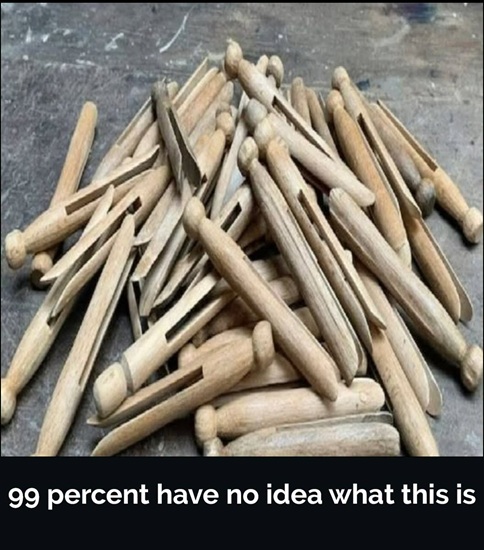
Most people have one somewhere in their home.
Tucked inside a laundry basket.
Forgotten in a kitchen drawer.
Clipped to a bag of chips.
Used in a craft project.
Or hanging quietly on a clothesline, doing the same job it has done for generations.
The wooden clothespin is so common that few people stop to think about it.
It is small.
Simple.
Inexpensive.
Almost invisible.
Yet this humble object carries a remarkable history—one that stretches back centuries and reflects the evolution of domestic life, industrial innovation, and humanity’s endless search for practical solutions to everyday problems.
Long before modern washing machines, electric dryers, and climate-controlled homes, laundry was one of the most demanding household chores a family faced.
Today, washing clothes requires little more than pressing a few buttons.
In earlier centuries, it could consume an entire day.
Sometimes more.
Clothes were washed by hand in tubs, streams, or large basins. Water had to be carried, heated, and reused carefully. Soap was often homemade. Every garment required scrubbing, rinsing, wringing, and hanging.
Once the washing was complete, another challenge remained.
Drying.
Without dryers, families relied entirely on nature.
The sun.
The wind.
The open air.
Clotheslines stretched across backyards, between buildings, over courtyards, and across open fields. Entire communities often displayed rows of freshly washed garments fluttering in the breeze.
It was effective.
But it wasn’t perfect.
A strong gust of wind could send clothing tumbling into dirt, mud, or neighboring properties.
Storms could arrive unexpectedly.
Heavy blankets and sheets could slip loose and fall.
Valuable clothing items could disappear altogether.
People needed a way to secure their laundry.
The solution seems obvious today.
At the time, it was not.
Before clothespins existed in their modern form, people improvised.
Some used small carved pieces of wood.
Others relied on bent twigs, pegs, bone fragments, or simple weighted objects.
These early methods varied from region to region.
Whatever materials were available often became the tools of necessity.
The results were mixed.
Some worked reasonably well.
Many did not.
Clothing slipped.
Wood cracked.
Materials deteriorated quickly.
Households constantly searched for better options.
As populations grew and domestic responsibilities increased, the need for a reliable fastening device became increasingly clear.
The earliest clothespins were little more than wooden pegs.
Simple.
Functional.
Crude.
They resembled oversized nails carved from wood and were inserted through fabric to secure garments to a line.
While effective under certain conditions, they had obvious limitations.
They could damage delicate fabrics.
They required careful placement.
And they often loosened during periods of strong wind.
Still, they represented progress.
For the first time, families had a purpose-built tool specifically designed for drying clothes outdoors.
As centuries passed, inventors and craftsmen continued experimenting with improvements.
Then came the Industrial Revolution.
And everything changed.
The nineteenth century transformed ordinary household life in ways people could scarcely imagine.
Factories began producing goods on a massive scale.
Machines replaced much of the labor once performed by hand.
Inventors focused not only on grand technologies but also on improving everyday objects.
Even something as simple as a clothespin attracted attention.
People recognized that small innovations could have a large impact when multiplied across millions of households.
One of the most important breakthroughs came with the development of the spring-loaded clothespin.
The design was elegantly simple.
Two wooden arms.
A coiled metal spring.
Balanced pressure.
Reliable grip.
Instead of relying solely on friction or weight, the new mechanism actively clamped onto fabric.
This seemingly minor improvement dramatically increased effectiveness.
Garments stayed in place.
Wind became less problematic.
Laundry became easier.
For families who spent hours each week washing and drying clothing, the difference was significant.
The redesigned clothespin quickly gained popularity.
Its effectiveness was obvious.
Its construction was inexpensive.
Its operation required no training.
People simply squeezed, clipped, and moved on.
Sometimes the most successful inventions are not the most complicated.
They are the ones that solve a problem so well that eventually nobody questions their existence.
The clothespin became one of those inventions.
As industrial manufacturing expanded across Europe and North America, production increased rapidly.
Factories standardized sizes.
Improved materials.
Refined designs.
Maple and birch became popular choices because of their strength, durability, and resistance to weather.
Millions of clothespins rolled off assembly lines.
They were affordable enough for nearly every household.
Reliable enough to use daily.
Simple enough to last for years.
By the early twentieth century, wooden clothespins had become fixtures of domestic life.
Laundry day was still labor-intensive.
But it was becoming more manageable.
Rows of clothing stretched across neighborhoods.
White sheets billowed in summer breezes.
Children ran beneath clotheslines while parents worked nearby.
The sight became a familiar part of everyday life.
In many communities, laundry hanging outdoors was almost a form of communication.
People could tell who was home.
Who had a large family.
Who was preparing for guests.
The clothesline became part of the social landscape.
And the clothespin was its silent partner.
Its usefulness extended beyond laundry.
Teachers used clothespins in classrooms.
Families used them to organize household items.
Farmers adapted them for countless practical tasks.
Creative individuals discovered dozens of unexpected uses.
Even then, people recognized something important about the design.
Its simplicity made it endlessly adaptable.
As decades passed, new materials emerged.
Plastic entered the marketplace.
Manufacturers promoted plastic clothespins as lighter, cheaper, and easier to mass-produce.
Many households embraced the change.
Plastic versions became common.
Stores stocked them in bright colors.
Advertising presented them as modern improvements.
For a time, it seemed as though wooden clothespins might disappear entirely.
But they never did.
In fact, they survived for a very simple reason.
They worked.
Wood remained durable.
Wood remained reliable.
Wood remained familiar.
Many people preferred the traditional feel and strength of wooden designs.
Others appreciated their environmental advantages.
Unlike plastic, wood naturally decomposes.
It can be sourced sustainably.
It produces less long-term waste.
As environmental awareness increased in recent decades, interest in traditional wooden household items began to grow again.
The clothespin found new life.
Not only as a laundry tool.
But as a symbol.
Today, wooden clothespins appear in arts and crafts projects around the world.
They become photo holders.
Holiday decorations.
Educational tools.
Wedding decorations.
DIY furniture accents.
Children’s toys.
Creative minds continue discovering new uses for an invention originally designed to hold wet socks on a line.
Few household objects have demonstrated such versatility.
Yet perhaps the clothespin’s greatest significance lies in what it represents.
It serves as a reminder of a slower era.
A time when household tasks required more effort.
When convenience could not be purchased at the push of a button.
When people repaired rather than replaced.
Adapted rather than discarded.
Created solutions from simple materials and practical thinking.
For many older generations, the sight of wooden clothespins evokes powerful memories.
Summer mornings.
Laundry fluttering in the breeze.
Conversations across backyard fences.
Children helping parents with chores.
The smell of sun-dried sheets.
Moments that feel increasingly distant in a fast-moving world.
The clothespin connects those memories to the present.
Its history also tells a broader story about innovation itself.
Many people imagine progress as dramatic breakthroughs and revolutionary technologies.
But history is often shaped by smaller improvements.
A better tool.
A stronger design.
A simpler solution.
The spring-loaded clothespin may never appear in history books alongside steam engines or computers.
Yet it improved daily life for millions of people.
That matters.
Human progress is not measured only by extraordinary inventions.
It is measured by countless small improvements that make ordinary life easier.
The clothespin is one of those improvements.
A tiny object.
A simple mechanism.
A surprisingly profound impact.
Even today, after centuries of technological advancement, the basic design remains largely unchanged.
Two wooden arms.
One spring.
One purpose.
That longevity speaks for itself.
Good ideas endure.
And few household inventions have endured as quietly—and as effectively—as the wooden clothespin.
So the next time you spot one clipped to a clothesline or tucked away in a drawer, take a moment to appreciate what you’re holding.
Not just a piece of wood.
Not just a household tool.
But a small piece of history.
A symbol of ingenuity.
A survivor of changing times.
And proof that sometimes the simplest inventions leave the longest legacy.