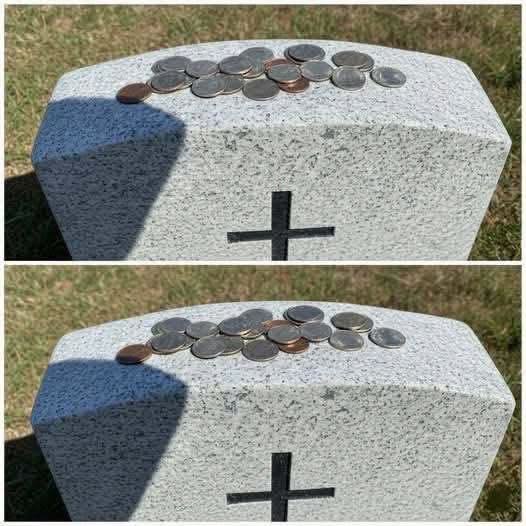
At first, the coins are easy to miss.
A penny resting near a name.
A nickel balanced on the edge of a headstone.
A dime catching the sunlight beside a small American flag.
A quarter placed carefully where someone grieving might notice it later.
To a passerby, they may look like loose change left behind by accident. But in many military cemeteries across the United States, those coins carry a meaning far greater than their value.
They are not random.
They are messages.
Quiet ones.
The kind left by people who understand that some bonds do not end when a life does.
For the families of fallen service members, a coin on a gravestone can say what words often cannot:
Someone came.
Someone remembered.
Someone still carries your loved one’s name.
This tradition is most often associated with the graves of soldiers, Marines, sailors, airmen, and other members of the armed forces who gave part—or all—of themselves in service. It is not an official requirement. No rule demands it. No ceremony announces it.
That is part of what makes it powerful.
It is personal.
Private.
A silent language shared among veterans, families, and those who know the meaning behind the gesture.
The idea of leaving something for the dead is ancient. Long before modern cemeteries, people placed objects with loved ones as signs of care, passage, and remembrance. In ancient Greek mythology, a coin was placed with the deceased so they could pay Charon, the ferryman, to cross the river Styx into the afterlife. Other cultures also left offerings, believing they could protect, guide, or honor the dead on their journey beyond this world.
The modern military coin tradition is different in belief, but similar in emotion.
It is rooted in remembrance.
And in the military community, each coin tells a different story.
A penny is the simplest message.
It means someone visited.
Someone stopped, looked at the name, and took a moment to honor the person buried there. It may have been a stranger, a friend, a fellow veteran, or someone whose life was touched by service. The penny says, quietly and clearly, “You are not forgotten.”
A nickel carries a deeper connection.
It means the visitor trained with the deceased. They may have gone through boot camp together, shared the same difficult early days, learned discipline side by side, and begun their military journey at the same time. A nickel represents a bond formed before deployment, before combat, before the full weight of service had settled in.
A dime means the visitor served with the fallen.
This coin speaks of shared duty. Shared missions. Shared danger. It may represent long nights, difficult assignments, deployments, or moments when trust was not optional but necessary. To leave a dime is to say, “I stood beside you. I remember what we carried together.”
A quarter is often considered the most emotional of all.
It means the person who left it was there when the service member died.
That small coin carries the weight of witness. It speaks of a final moment, a loss seen firsthand, and a memory that likely never faded. For families, finding a quarter can be deeply moving because it suggests that someone who was present at the end came back to honor the person who did not return.
These meanings are not formally regulated, but they are widely understood within veteran communities. Together, they form a quiet code of respect.
No speeches are needed.
No explanation is required.
The coin says enough.
For families, these small objects can bring unexpected comfort. Grief often carries a terrible fear—that the world will move on, that names will fade, that the person loved so deeply will become only a photograph or a record in an archive.
Then a family member visits the grave and finds a coin.
Maybe one.
Maybe several.
And suddenly, they know someone else remembers too.
That knowledge matters.
It reminds them that their loved one’s service still echoes in the lives of others. It tells them that even after years have passed, someone made the effort to come, stand in silence, and leave behind a symbol of respect.
For veterans, leaving a coin can be just as meaningful.
Not everyone can speak easily about grief, combat, or loss. Some memories are too heavy. Some names still hurt to say out loud. Standing before a grave may bring back moments that words cannot carry.
A coin gives them another way.
A way to say goodbye.
A way to keep faith.
A way to honor a bond that civilians may never fully understand.
Military service often creates relationships that go beyond ordinary friendship. Training, hardship, danger, and shared sacrifice can bind people together in ways that last a lifetime. When one of them is lost, that connection does not simply disappear.
The coin becomes proof of that connection.
Small.
Simple.
Permanent, at least for a while.
In many national cemeteries and military burial grounds, coins collect slowly over time. They sit beside flags and flowers, gathering quietly across seasons. Some are eventually collected by cemetery staff, sometimes used to help maintain the grounds or support burial-related efforts, depending on local practice.
But before they are removed, they tell a story.
A story of visitors who came and left something behind.
A story of loyalty.
A story of grief carried with dignity.
What makes the tradition so moving is its simplicity.
A coin has little monetary value.
A penny is almost nothing in everyday life.
But placed on the gravestone of a fallen service member, it becomes something else entirely.
It becomes memory.
It becomes gratitude.
It becomes a promise.
That promise says sacrifice will not be ignored just because time has passed. It says a name carved in stone still belongs to someone who mattered. It says the living still feel connected to the dead.
For people unfamiliar with the tradition, learning its meaning can change the way they see military cemeteries. Those small pieces of metal are not clutter. They are not decoration. They are messages left in a language of honor.
Each coin says someone paused.
Someone remembered.
Someone cared enough to leave a sign.
And sometimes, that is the most powerful tribute of all.
Not grand.
Not loud.
Not public.
Just a small coin resting on cold stone, carrying the weight of loyalty, loss, and respect.
A reminder that even the smallest gesture can hold extraordinary meaning when it is left with love.