My Daughter, 8, Found a Newborn Baby near Our Barn – When My Husband Asked, ‘Who Would Do This?’ She Looked at Him and Said, ‘Daddy… I Saw You’

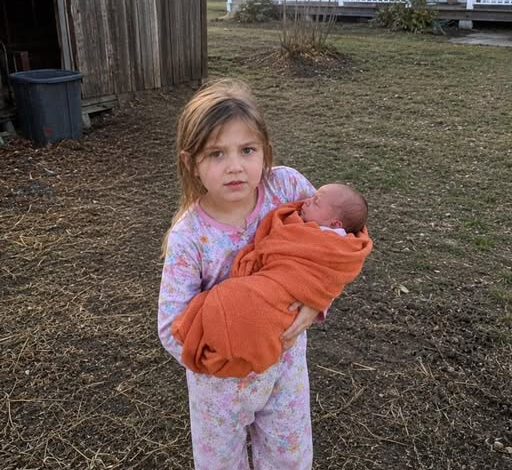
In the weeks after Daniel left, the house felt both quieter and more honest.
The silence was different now.
Not the tense silence that settles over a home when everyone is pretending. Not the silence of secrets pressed beneath everyday routines.
This silence could breathe.
Saturday mornings still smelled like cinnamon and butter. Sunlight still spilled across the kitchen floor in long golden rectangles. Talia still padded downstairs in oversized pajamas, rubbing sleep from her eyes before climbing onto her usual stool beside the counter.
Some things, thankfully, survived.
Together we measured flour and sugar. We argued over how many chocolate chips counted as “too many.” We licked frosting from spoons and laughed when batter somehow ended up on the tip of her nose.
Children have a remarkable ability to keep living.
Even when adults make a mess of everything.
Especially then.
Sometimes, while stirring a bowl or waiting for cookies to cool, Talia would ask about Benjamin.
The questions always arrived unexpectedly.
“Is he okay?”
“Does he cry a lot?”
“Does he know us?”
“Will I ever see him again?”
I answered carefully.
Not because I wanted to hide the truth.
Because children deserve truths they can carry.
“He’s safe.”
“He’s loved.”
“He has people taking care of him.”
And the answer she seemed to need most:
“None of this is your fault.”
Every time I said it, she nodded.
Every time, I wondered if she believed me yet.
At the hospital, things were more complicated.
Gwen and I occupied the same rooms with the awkwardness of people who shared a wound but not forgiveness.
There were no dramatic confrontations.
No screaming matches.
No satisfying speeches.
Just paperwork, appointments, and long stretches of uncomfortable reality.
Benjamin slept through most of it.
Tiny.
Oblivious.
Innocent.
A child who had inherited consequences he never created.
Watching him changed something in me.
Not my anger.
That remained.
Not my disappointment.
That remained too.
But I stopped seeing him as evidence of betrayal.
He wasn’t proof of Daniel’s choices.
He was a baby.
Nothing more.
Nothing less.
And babies deserve better than becoming symbols in adult wars.
So I made a decision.
One that surprised even me.
I would not allow Benjamin to become collateral damage.
Not for my sake.
Not for Gwen’s.
And certainly not for Daniel’s.
The legal processes moved forward.
Custody agreements.
Financial obligations.
Housing arrangements.
The tedious machinery of untangling lives.
Each document felt like another brick placed between the past and whatever came next.
Necessary.
Heavy.
Permanent.
Daniel tried reaching out several times.
Sometimes through messages.
Sometimes through lawyers.
Sometimes through mutual friends who clearly regretted getting involved.
I answered only when required.
Nothing more.
Nothing less.
There comes a point when explanations stop mattering.
The facts remain unchanged no matter how many times someone retells them.
Cora called too.
The first time, I stared at the screen until it stopped ringing.
The second time, I sent it to voicemail.
The third time, I blocked the number.
Not because I hated her.
Hatred requires energy.
I simply no longer had room in my life for people who confused secrecy with loyalty.
The hardest lesson wasn’t learning who betrayed me.
It was learning who expected me to absorb the betrayal quietly.
Who expected understanding without accountability.
Compassion without boundaries.
Grace without change.
I discovered those things are not the same.
You can wish someone well without reopening your door.
You can refuse revenge without offering access.
You can move forward without pretending nothing happened.
Months passed.
The sharpest pain began to dull.
Not disappear.
Just soften around the edges.
One evening, I found Talia sitting on the back porch watching fireflies blink across the yard.
I sat beside her.
For several minutes neither of us spoke.
Then she leaned against my shoulder.
“You know what?” she said.
“What?”
“We’re okay.”
The simplicity of it nearly broke me.
Because she was right.
Not perfect.
Not healed.
Not unchanged.
But okay.
The house was smaller now.
The future looked different.
Some relationships had ended forever.
Others had been rebuilt into unfamiliar shapes.
Yet somehow, despite everything, we were still standing.
That night, after she went to bed, I walked through the quiet house.
Past the kitchen.
Past the hallway.
Past the rooms where so much of our old life had unfolded.
For the first time, I didn’t see what had been destroyed.
I saw what remained.
The laughter.
The honesty.
The safety.
The chance to begin again.
Betrayal had rewritten my life.
There was no denying that.
But it had also revealed something important.
Love is not proven by what people say in comfortable moments.
It is proven by what they refuse to ask of others when things become difficult.
And the moment you ask a child to carry your secret, protect your lie, or absorb the consequences of your choices, you have crossed a line no apology can fully erase.
That realization cost me a marriage.
It cost me friendships.
It cost me the future I thought I was building.
But it gave me something too.
Clarity.
The kind that arrives only after everything false falls away.
And standing in that quiet house, listening to the steady rhythm of my daughter’s breathing from down the hall, I understood something I hadn’t known when all of this began.
Home is not the place that survives betrayal.
Home is the place that refuses to pass it on.
And finally, after all the damage, that was exactly what we had become.