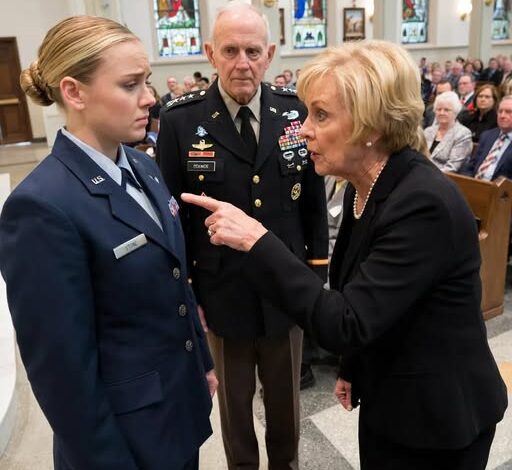
I knew my mother would hate the uniform.
I knew it before I pulled into the church parking lot, before the gravel cracked beneath the tires of my rental car, before I saw the American flags snapping hard in the cold November wind.
I knew it that morning in the hotel room, standing barefoot on thin carpet, staring at myself in the mirror while my dress blues lay across the bed like a promise I had made too late.
The woman looking back at me was thirty-four years old.
Not old.
But worn.
Worn in the eyes.
Worn in the shoulders.
Worn in the places no medal could cover and no uniform could straighten.
My name is Hannah Mercer.
For twelve years, my hometown believed I had abandoned my family.
For twelve years, my mother let them believe it.
And that morning, as I buttoned my jacket and pinned the small rows of ribbons above my heart, I told myself I was not going to Briar Glen to fight.
I was going to say goodbye to my father.
That was all.
At least, that was what I wanted to believe.
The First Baptist Church of Briar Glen, Tennessee, sat on the same hill where it had stood since before my grandmother was born. White steeple. Red doors. Bell tower rising above bare-limbed trees. Stained glass windows showing Jesus with lambs, fishermen, and a lost son returning home.
I almost laughed when I saw that last window.
Lost sons got parades.
Lost daughters got whispers.
The parking lot was already full. Pickup trucks with Marine Corps stickers. Sedans with church magnets. Motorcycles with folded flags tied to the handlebars. People had come from three counties to honor my father, Colonel Robert Mercer, United States Army, retired.
To Briar Glen, he was a hero.
To me, he was Dad.
The man who taught me to change a tire before I was tall enough to see over the hood. The man who put cinnamon in pancake batter. The man who sat on the back porch at dawn drinking coffee so black it looked like ink. The man who wrote me letters by hand even when he couldn’t say where I was, what I was doing, or whether he was scared.
He was also the man whose funeral I had missed because I was unconscious in a military hospital in Germany, shrapnel buried in my side, while a surgeon told my commanding officer I might not wake up.
My mother never told anyone that part.
She told them I chose not to come.
That I was too proud.
That the Army had turned me into someone who forgot where she came from.
I stepped out of the rental car, and one by one, conversations died.
A woman near the church steps lifted a gloved hand to her mouth. Two men stopped mid-sentence. A teenage boy stared openly at my uniform until his grandmother pulled him back by the sleeve.
I kept walking.
The medal on my chest caught the gray morning light.
I had not worn it for attention.
I had worn it because my father asked me to.
In one of his last letters, written in the shaky hand he tried to hide from me, he had said:
Hannah, when they put my name on that wall, wear what you earned. Not for them. For me.
This wasn’t the funeral. Dad had died six weeks earlier, and the burial had already happened while I was overseas, still recovering and trapped in the slow cruelty of military paperwork.
This was the county memorial.
His name had been added to the Veterans Memorial Wall outside the courthouse, and the church was hosting the ceremony because Dad had been a deacon there for nearly thirty years.
My younger sister, Lauren, stood just inside the red doors.
Her blond hair was shorter than I remembered, cut to her shoulders. There were careful lines around her eyes now, the kind that came from smiling when people expected it.
When she saw me, she froze.
“Hannah.”
“Hi, Laur.”
Her eyes moved over my uniform, my medals, my polished shoes.
“You came.”
“I said I would.”
Before she could answer, I heard my mother.
“No.”
One word.
Sharp enough to cut through the lobby.
I turned.
Elaine Mercer stood near the sanctuary doors in a black dress and pearl earrings, every silver strand of her hair pinned neatly into place. She looked elegant. Heartbroken. Furious.
People moved aside without being asked.
She had always had that effect.
She walked toward me slowly, her heels tapping against the polished church floor.
Her eyes did not go to my face.
They went straight to my uniform.
Then to my medals.
Then back to my face.
“You don’t get to wear that here,” she said.
The lobby went silent.
Even the old church doors seemed to stop creaking.
“Mom.”
“Don’t you Mom me. Not today.”
Her voice trembled, but not with weakness.
“This is your father’s memorial. This is not a stage for you.”
“I didn’t come for a stage.”
“Then take it off.”
A few people gasped.
My hands stayed at my sides.
“I’m not taking off my uniform.”
Her face hardened.
“You have no right to stand here dressed like that, pretending you honored him.”
“I did honor him,” I said quietly.
“You left him.”
The words landed like a slap.
“You left this family,” she said. “You left your father when he was sick. You left your sister to help me carry everything. And now you walk in here like some decorated hero?”
I felt every eye on me.
Neighbors.
Church ladies.
Dad’s old friends.
Men who had saluted him graveside.
Women who had brought casseroles and sympathy cards and whispered stories about the daughter who couldn’t be bothered to come home.
“I was deployed,” I said.
She laughed once.
Bitterly.
“You always have an excuse.”
“It isn’t an excuse.”
“No. It’s a uniform. That’s what you hide behind.”
I looked past her into the sanctuary.
Rows of people sat beneath the stained glass. At the front, beside Dad’s photograph and a folded flag, was an empty chair with a small card on it.
Major Hannah Mercer.
Lauren had told me about the chair.
I also knew my mother had argued against it.
“Mom,” I said. “Not here.”
Her eyes flashed.
“Exactly. Not here. You do not get to come into this church wearing those medals, acting like you loved him better than the rest of us.”
“I loved him.”
“You broke his heart.”
For one second, I was twenty-two again, standing in our kitchen with enlistment papers folded inside my bag, my mother staring at me as if I had betrayed the blood in my veins.
You’re just like him, she had said.
Always running toward wars that have nothing to do with you.
Dad had followed me out to the driveway that night. He placed both hands on my shoulders and looked me directly in the eyes.
Go become who you are, baby girl. Don’t you dare shrink just to make the world comfortable.
I held onto that memory as my mother glared at me in the church lobby.
“I’m going inside,” I said.
She stepped in front of me.
“No.”
An usher shifted uncomfortably.
“Elaine, maybe we should—”
“This is family business.”
“It became public when you made it public,” I said.
Her mouth tightened.
Then her fingers closed around the edge of my ribbon rack.
At first, I didn’t understand what she was doing.
Then I felt the pull.
Hard enough for the metal backing to bite through the fabric.
“Don’t,” I said.
“You don’t get to wear these in front of his casket,” she hissed.
“There is no casket today.”
“You know what I mean.”
Then a voice came from inside the sanctuary.
“Ma’am.”
Not loud.
It did not need to be.
The word carried through the church like a command.
Everyone turned.
In the front row, an old man rose slowly with the help of a cane. He wore a dark suit, a black tie, and a row of military medals across his breast pocket. His hair was white. His shoulders stooped slightly. But there was nothing weak in the way he looked at my mother.
Sergeant Major Thomas Callahan.
Retired.
Most people in Briar Glen knew him as Tommy, the quiet Vietnam veteran who sat alone at the diner every Tuesday morning and left a twenty-dollar tip on a six-dollar breakfast.
I knew him as the man my father had served with.
And as the man I had dragged behind a burned-out truck while bullets tore through the road around us in Kandahar.
My mother’s fingers slipped from my uniform.
Sergeant Major Callahan stepped into the aisle.
“Elaine,” he said. “Take your hand off that soldier.”
My mother blinked as if he had struck her.
“Tommy, you don’t understand.”
“I understand more than you think.”
“She abandoned Robert.”
“No.”
One word.
Calm.
Unmovable.
My mother stiffened.
“This is not your place.”
“It became my place the moment you put your hands on a uniform you don’t understand.”
He walked toward us slowly.
Painfully.
His cane tapped against the floor like a judge’s gavel.
When he reached the lobby, he looked at me.
For one second, the old man disappeared, and the soldier from Kandahar looked back at me through smoke and sand.
“Major Mercer,” he said.
A ripple moved through the crowd.
Major.
My mother stared at me.
Lauren’s mouth parted.
I gave him a small nod.
“Sergeant Major.”
His eyes dropped to the medal on my chest, then rose again.
“You wore it.”
“Dad asked me to.”
His jaw tightened.
Then he turned to my mother.
“Elaine, you need to sit down. Because what I’m about to say should have been said years ago.”
The church doors remained open behind me.
Cold air moved into the lobby.
No one closed them.
My mother looked around, searching for support.
Some women avoided her eyes.
Some men stared at the floor.
No one defended her.
Callahan faced the crowd.
“Robert Mercer was my brother,” he said. “Not by blood. By war. By years. By every promise one soldier makes to another when both of them are too scared to admit they might not see sunrise.”
His voice filled the church.
“Most of you knew Robert as a good man. A deacon. A father. A colonel. But you did not know everything.”
My mother went pale.
“Tommy,” she warned.
He ignored her.
“You did not know that Robert spent the last years of his life carrying two griefs. One was his illness. The other was the lie that his oldest daughter had turned her back on him.”
My throat tightened.
“That is not true,” my mother whispered.
“It is true,” Callahan said. “And you know it.”
Lauren turned slowly toward our mother.
“Mama?”
My mother did not look at her.
Callahan reached into the inside pocket of his jacket and pulled out a worn envelope.
My breath caught.
Dad’s handwriting.
My name.
Hannah Grace Mercer.
The letters were slightly crooked because his hands had trembled near the end.
“I was asked to bring this today,” Callahan said. “Robert gave it to me three months before he passed. He said if Hannah came, I was to give it to her. And if anyone tried to shame her, I was to read it aloud.”
My mother took one step back.
Callahan looked at me.
The choice was mine.
That was the first kindness anyone had offered me that day.
I looked at my mother.
At Lauren.
At my father’s photograph near the altar.
Then I nodded.
Callahan opened the envelope.
The paper trembled slightly in his hand.
His voice did not.
“To whoever needs to hear the truth: my daughter Hannah did not abandon me.”
A sob broke from somewhere in the sanctuary.
“She served this country in places I was not allowed to know, under circumstances she was not allowed to explain. She missed birthdays, holidays, and finally my burial, not because she did not love me, but because she was wounded in service and nearly died before anyone in this town knew enough to pray for her.”
My mother closed her eyes.
“I was proud of her from the day she left home. I was proud when she became a medic. I was proud when she became an officer. I was proud when she saved men who would never know her name. I was proud when she wrote me letters from deserts and hospitals and airports at three in the morning.”
The church blurred.
I blinked hard.
“She sent money when I was too proud to ask. She paid the property taxes the year I could not. She covered the part of my treatment insurance refused. She begged me not to tell because she knew Elaine would turn it into another reason to hate what Hannah had become.”
Lauren gasped sharply.
She turned toward our mother.
“You knew?”
My mother’s lips parted.
No sound came.
Callahan’s voice grew rough.
“Do not let anyone tell my daughter she has no right to stand at my memorial. If she comes in uniform, let her stand tall. If she comes broken, let her sit beside me in spirit. If she comes angry, let her be angry. She owes this town nothing. She owes her mother no apology for surviving. She owes me nothing but to keep living.”
I pressed my lips together until they hurt.
“Hannah, if you are hearing this, forgive me for not fixing what I should have fixed while I was alive. I loved you in every season. I loved you when you were near, and I loved you when you were somewhere under foreign stars. Wear what you earned. Come home only if home learns how to hold you. Love, Dad.”
A holy silence followed.
The kind that presses on the chest.
The kind that makes even people who do not believe in God look toward the ceiling.
My mother stood frozen.
Her makeup had begun to crack beneath her eyes.
For years, I had imagined this moment.
The truth revealed.
My mother exposed.
The town forced to look at me differently.
I had thought it would feel like victory.
It did not.
It felt like standing in the wreckage after a tornado, realizing that even if the storm was over, the house was still gone.
Lauren spoke first.
“Mama. Is that true?”
My mother’s face twisted.
“I was protecting this family.”
“From what?” Lauren asked.
“From her choices.”
“My choices kept Dad in his house,” I said quietly.
She looked at me then.
Really looked.
Not at the uniform.
At me.
For one second, I saw something almost like fear.
Then pride rose inside her like a shield.
“You were not here when he forgot where the bathroom was,” she said. “You were not here when he fell in the kitchen. You were not here when I had to lift him from the floor.”
“I know.”
“You were not here when he asked for you.”
That one cut deep.
Because it was true.
Lauren stepped between us.
“She was in a hospital, Mama.”
My mother turned on her.
“Stay out of this.”
“No,” Lauren said, voice shaking. “You let me hate her. You let me think she just didn’t care.”
My mother flinched.
“I never told you to hate your sister.”
“You didn’t have to. You fed it to me one sentence at a time.”
I went inside.
Not dramatically.
Not like a movie.
The crowd parted slowly and shamefully.
People who had whispered about me for years now stepped aside with lowered eyes.
Mrs. Henderson, who had once told Lauren I was too good for Briar Glen now, touched my sleeve as I passed.
“Hannah,” she whispered. “I didn’t know.”
I looked at her hand until she removed it.
“No,” I said. “You didn’t.”
I walked to the front.
Dad’s photograph stood beside a wreath of white flowers.
He was younger in the picture. Maybe fifty. Broad shoulders. Gray at the temples. Dress uniform perfect. Smile crooked.
The same smile he wore when he caught me stealing cookie dough from the fridge.
I sat in the chair reserved for me.
Callahan took his place beside me.
Lauren sat on my other side.
My mother remained at the back for a long time.
Then, finally, she walked down the aisle and sat across from us in the pew reserved for immediate family.
She did not look at me.
That was fine.
I did not look at her either.
The ceremony went on.
The mayor spoke.
Dad’s old soldiers spoke.
A choir sang “It Is Well With My Soul.”
The American Legion honor guard stood at the front with flags.
Then Callahan rose again.
“I was supposed to talk today about Robert,” he said. “But the truth is, you already know the polished parts. So I’m going to tell you about the real man.”
Soft laughter moved through the room when he described Dad cheating at horseshoes with the confidence of a senator.
More laughter came when he described Dad trying to fix Callahan’s truck with duct tape and prayer, only to make the engine smoke worse.
Then his voice settled.
“He loved his wife, even when they hurt each other. He loved his daughters, even when he did not know how to stand between them and pain. And that was his regret.”
My mother lowered her head.
“He told me near the end that courage in war came easier to him than courage at the dinner table. A lot of us are like that. We can face bullets and still be cowards in our own kitchens. He wished he had defended Hannah sooner. Not because she needed defending as a soldier, but because every child deserves to know their father is proud of them out loud.”
I stared at Dad’s photograph.
“So let me say what Robert asked me to say,” Callahan continued. “Hannah, your father was proud of you. Not secretly. Not quietly. Proud in the way men like him sometimes fail to show until paper and death make them braver than life ever did.”
He looked across the sanctuary.
“If any person here believes she does not belong at this memorial, they can come tell me outside after the service.”
No one moved.
Callahan nodded once.
“That’s what I thought.”
For the first time that day, a small laugh broke through the tears.
Even I laughed, though it sounded more like a sob.
When the honor guard played taps, I stood.
I had heard taps too many times.
On bases.
At burials.
Across dusty airfields when no body came home, only boots, a rifle, and a helmet.
But this time was Dad.
The final note faded.
I saluted.
I kept my hand raised until the silence settled.
When I lowered it, I felt something inside me lower too.
Not disappear.
Just rest.
After the ceremony, in the fellowship hall with its casseroles, ham biscuits, and sweet tea in plastic cups, my mother asked me to speak privately.
She led me into a small classroom off the hall.
Paper autumn leaves were taped to the walls.
Tiny chairs sat around a table.
“I did not know you were wounded,” she said.
Not I’m sorry.
Not I lied.
Not forgive me.
“I called,” I said. “A chaplain called. My commander called Lauren’s number because yours went straight to voicemail.”
“I changed numbers.”
“I know.”
She looked away.
“You have to understand what it was like. Your father came home from war, but part of him never came back. The nightmares. The silence. The anger he swallowed until it poisoned him. Then you left in the same uniform. You walked right into the thing that had taken my husband from me long before he died.”
I softened despite myself.
Because that was true too.
“I understand that you were afraid,” I said.
“I thought if I shut the door first, it wouldn’t hurt when you didn’t walk through it.”
The sentence was so honest it stunned us both.
“I was here,” she continued, voice cracking. “I was the one changing sheets, driving him to appointments, watching him disappear. And still, when the mail came, it was your letters that made him sit up.”
There it was.
Not only anger.
Jealousy.
Loneliness.
A wife exhausted by caregiving, resenting a daughter who had become a symbol of everything she feared and everything her husband admired.
“I didn’t know,” I said.
“No,” she replied. “You were busy being brave.”
“I was scared every day,” I said. “I cried in bathrooms. I slept with my boots on because alarms kept going off. I held pressure on wounds with both hands and prayed to a God I wasn’t sure was listening. I missed home so badly sometimes I hated everyone in it for going on without me.”
My mother’s face changed.
Just slightly.
“I wanted to come home when Dad got worse,” I said. “He told me not to. He said my unit needed me. He said he didn’t raise me to abandon people depending on me. We fought about it.”
“You never told me.”
“You stopped taking my calls.”
She closed her eyes.
“I shouldn’t have touched your uniform.”
“No.”
“I shouldn’t have said what I said.”
“No.”
“I shouldn’t have let Lauren think…”
Her voice broke.
“I know,” I said.
She looked at me.
“I’m sorry.”
The words were small.
Not enough.
But real.
At least in that moment.
“I don’t know what to do with that yet,” I said.
Her eyes closed.
“That’s fair.”
“I’m not staying in Briar Glen.”
“I know.”
“I’m not pretending this fixed us.”
“I know.”
“But I won’t stop Lauren from calling me. And I won’t ignore you if you call.”
She looked up quickly.
Her lips trembled.
“It’s more than I deserve.”
I did not argue.
The courthouse dedication came an hour later.
The sky had cleared, but the wind remained sharp.
When it was time to unveil Dad’s plaque, the mayor asked my mother to pull the cloth away.
She looked at it.
Then at me.
“Hannah,” she said.
The crowd went quiet.
“You should do it.”
I stared at her.
So did everyone else.
I walked forward.
Lauren joined me without being asked.
After a hesitation, my mother did too.
Together, the three of us pulled the cloth away.
COLONEL ROBERT JAMES MERCER
UNITED STATES ARMY
HUSBAND. FATHER. SOLDIER. SERVANT.
HE BELIEVED COURAGE MEANT COMING HOME WITH HONOR.
I touched the carved letters of his name.
Cold stone beneath my fingers.
For years, I had thought coming home meant returning to a place.
Standing there in my uniform, beside a sister I was learning again and a mother I was not ready to forgive, I understood that coming home was not about geography.
It was about truth.
Truth had come home that day.
Late.
Bruised.
Unwelcome at first.
But it came.
That evening at Ray’s Diner, five of us crowded into a booth: me, Lauren, Callahan, and eventually, to my surprise, my mother.
She arrived fifteen minutes late and stood beside the table like she expected to be turned away.
I moved my bag from the empty seat.
Mom sat.
Dinner was awkward.
Painfully awkward.
But it was real.
Callahan told stories about Dad that made Lauren laugh until she cried. Mom corrected details with the reflex of a woman who had spent forty years hearing those stories. I learned Dad had once tried to build a backyard smoker and nearly burned down the shed.
Lauren told me she was a school counselor now.
I told her about Colorado, where I was stationed, and the dog I planned to adopt when my medical leave ended.
Mom listened more than she spoke.
Near the end of the meal, she said, “Your father kept your room the same.”
I looked at her.
“I changed the sheets,” she added quickly. “But the books and things are still there.”
Lauren kicked me gently under the table.
“I’ll think about it,” I said.
Mom nodded.
“That’s fair.”
The next morning, I went to the house.
Not for my mother.
For Dad.
The Mercer house sat at the end of Sycamore Road.
Wraparound porch.
Blue shutters.
Bare oak tree in the front yard.
Mom opened the door before I knocked.
“Coffee?” she asked.
“Is it Dad’s recipe?”
A faint smile.
“Undrinkable?”
“Then yes.”
Inside, the house smelled like lemon polish, old wood, and memory.
Dad’s boots were no longer by the door.
His chair still sat near the fireplace.
His Bible rested on the side table.
I walked down the hallway to my old room.
Blue walls.
High school track ribbons.
A shelf of paperbacks.
On the desk sat a wooden box I had never seen before.
“He kept your letters there,” Mom said from the doorway.
I opened it.
Dozens of envelopes.
Some stained.
Some worn at the folds.
All addressed in my handwriting.
Under them were photographs I had sent.
At the bottom was a small notebook.
Dad’s handwriting filled the pages.
Hannah deployed again. Lord, keep her steady.
Hannah called from Germany. Tried to sound cheerful. Was not cheerful.
My girl thinks distance means failure. Need to tell her it doesn’t.
I sat down hard.
Mom came closer, then stopped, unsure.
“He also wanted you to have this,” she said.
She returned with the folded flag case.
“Mom. That’s yours.”
“He wanted you to have it eventually.”
Her hands tightened around the case.
“I don’t know how to do this,” she admitted.
“I don’t either,” I said.
She looked at the flag.
“I spent so long being angry at the uniform that I forgot there were people inside it.”
“I can’t take the flag,” I said. “Not today.”
She nodded, wounded but accepting.
“But maybe,” I added, “we can put it somewhere we both can see it.”
Her eyes lifted.
“In the living room,” I said. “By his chair.”
So we did.
Together.
My mother held one side.
I held the other.
Neither of us let go.
Before I left, I stood on the porch with my bag over my shoulder.
“Will you call when you land?” she asked.
Not a demand.
Not a guilt trip.
Just a question.
“Yes,” I said.
Her eyes filled.
“Okay.”
I walked toward the driveway.
Then stopped.
“Mom.”
“Yes?”
“When you tell people about Dad, don’t leave me out anymore.”
She gripped the doorframe.
“I won’t.”
“And when you tell people about me, tell the truth.”
She nodded slowly.
“I will.”
Lauren honked from the driveway, then immediately looked embarrassed for ruining the moment.
Mom and I both almost laughed.
It was small.
But it was something.
At the airport, Lauren hugged me so tightly I had to remind her about my healing ribs.
“Sorry,” she said, pulling back. “I forgot you’re breakable.”
“I am not breakable.”
She gave me a look.
I sighed.
“Fine. Slightly dentable.”
She smiled, then grew serious.
“Don’t disappear again.”
“I didn’t disappear.”
“I know. But don’t let us lose you again.”
“I’ll call,” I said. “And you can visit Colorado.”
Her face lit up.
“Do they have cowboys?”
“Some.”
“Do they have emotionally unavailable military sisters?”
“At least one.”
She hugged me again, gentler this time.
As I walked toward security, I looked back.
Lauren stood waving with both hands like we were kids again.
I waved back.
On the plane, I took Dad’s letter from my bag and read it again.
Then I held his pocketknife, which Callahan had pressed into my hand at the courthouse, until the flight attendant told me to put my tray table up.
I realized I was smiling.
Not because everything was fixed.
My father was still gone.
My mother had still hurt me.
Years had still been lost.
But the truth had been spoken in a room full of people who needed to hear it.
My sister knew I had loved her all along.
My mother had apologized, imperfectly but honestly.
And I had worn the uniform.
For Dad.
For myself.
For every version of me that once believed coming home meant begging people to understand.
Two weeks later, a package arrived at my apartment in Colorado.
Inside was a framed photograph of Dad in uniform on the porch of our house.
Beside it was a second frame.
Me standing at the Veterans Wall, my hand against his name, my uniform sharp, my face turned slightly toward the sky.
On the back, in my mother’s handwriting, were seven words:
He would have been so proud.
I sat on my kitchen floor and cried.
Then I placed both photographs on the mantel.
Side by side.
Father and daughter.
Soldier and soldier.
Home and away.
A few minutes later, my phone rang.
Mom.
I stared at the screen for a long time.
Then I answered.
“Hi,” I said.
Her voice was soft.
“Hi, Hannah.”
A pause.
Not empty.
Not cold.
Just new.
“I wanted to make sure the package arrived.”
“It did.”
“Good.”
Then she said, “Tell me about Colorado.”
So I did.
I told her about the mountains, the snow, the physical therapy clinic, and the dog I had met at the shelter—a three-legged mutt named Captain who looked at me like we had both survived things and were tired of explaining them.
Mom laughed at that.
A real laugh.
Small, but real.
And for the first time in twelve years, I did not feel like a ghost calling from a country no one could pronounce.
I felt like a daughter on the phone with her mother.
Not healed.
Not whole.
But heard.
That was enough for one day.
Months later, Lauren sent me a video from Briar Glen’s Memorial Day ceremony.
In it, my mother stood at the podium in front of the courthouse wall, wearing a navy dress and Dad’s old flag pin.
“My husband, Colonel Robert Mercer, served this country with honor,” she began. “But today, I also want to honor someone I failed to honor for too long.”
In the crowd, Sergeant Major Callahan stood leaning on his cane.
He nodded once.
“My daughter, Major Hannah Mercer, could not be here today. But her service, her sacrifice, and her love for her father are part of this family’s story. I once let grief make me cruel. I once mistook distance for abandonment. I was wrong.”
She paused.
“So today, when we speak of those who serve, let us remember not only the ones we understand. Not only the ones who come home unchanged. Not only the ones whose pain is easy for us to accept. Let us remember all of them. Including the daughters.”
The crowd applauded.
Not wildly.
Respectfully.
Strongly.
Lauren’s camera shook because she was crying.
So was I.
I watched the video three times.
Then I called Mom.
When she answered, I said, “Dad would have liked your speech.”
She was quiet for a moment.
“Do you think so?”
“I know so.”
Her breath caught.
“Thank you.”
“No,” I said. “Thank you.”
That summer, I went home again.
Not for a funeral.
Not for a memorial.
Just for Sunday dinner.
Mom burned the rolls.
Lauren brought a boyfriend we all pretended not to interrogate.
Callahan arrived with a peach pie and insulted the boyfriend’s truck.
Captain chased squirrels in the yard with the confidence of a four-legged animal and the balance of a shopping cart.
After dinner, I sat on the porch swing with Mom while fireflies blinked over the grass.
For a while, neither of us spoke.
Then she looked at me and asked, “Do you still hate me?”
I watched the fireflies.
“No.”
Her shoulders sagged.
“But I’m still hurt,” I said.
“I know.”
“And I may be hurt for a long time.”
“I know.”
I looked at her.
“But I don’t want to be only hurt.”
Her eyes filled.
“Me neither.”
The porch swing creaked softly beneath us.
Inside, Lauren laughed at something Callahan said.
Captain barked at absolutely nothing.
The Tennessee evening settled warm around the house.
My mother reached for my hand.
This time, I let her take it.
The girl I had been might have wanted a perfect ending.
An apology big enough to erase everything.
A family made whole overnight because the truth had come out in public.
But real life is not that generous.
Real life gives you a cracked door.
A phone call.
A burned pan of rolls.
A hand reaching across a porch swing.
A chance to decide whether the next chapter has to look exactly like the last one.
I thought about Dad.
His letters.
His pocketknife.
His impossible coffee.
His last request.
Wear what you earned.
I had thought he meant the uniform.
Maybe he did.
But sitting beside my mother, with my sister’s laughter floating through the screen door and Dad’s flag visible through the living room window, I understood he might have meant something more.
Wear the scars.
Wear the truth.
Wear the love that survived misunderstanding.
Wear the grief without letting it become cruelty.
Wear the name Mercer not as a chain, but as a history still being written.
The next morning, before I left, Mom walked me to the car.
This time, she did not look at my uniform.
I was not wearing it.
Just jeans, boots, and one of Dad’s old flannel shirts.
She touched the sleeve gently.
“You look like him,” she said.
I smiled.
“I know.”
She laughed through tears.
Then she hugged me.
Not carefully.
Not politely.
Like a mother hugging a daughter who had finally come home and might still leave, but would no longer vanish.
As I drove away from Briar Glen, I passed the courthouse.
The Veterans Wall caught the morning sun.
Dad’s name shone in the light.
For once, I did not feel the need to stop and prove I belonged there.
I knew I did.
And somewhere, I hoped, Dad knew too.