For most of my life, I thought I knew exactly who my father was.
He was predictable.
Reliable.
The kind of man whose routine never seemed to change.
Every weekday morning, he left the house at 6:45 sharp carrying the same faded lunchbox. He wore nearly identical work shirts, came home at the same time every evening, and settled into the same chair after dinner.
If you asked what he did for a living, the answer was always simple.
“I’m a manager at a parts distributor.”
That was it.
No dramatic stories.
No big accomplishments.
No lengthy explanations.
Just a mid-level management job at a warehouse supply company.
As kids, my siblings and I never questioned it.
Why would we?
Parents seem larger than life when you’re young, but their jobs often don’t. Dad wasn’t a firefighter, a doctor, or a CEO. He wasn’t someone who made headlines or gave speeches.
He was just Dad.
The guy who fixed squeaky doors before breakfast.
The guy who coached little league games.
The guy who fell asleep halfway through movies and claimed he was “just resting his eyes.”
He complained occasionally about office politics and paperwork.
Sometimes he rubbed his lower back and joked about spending too many hours sitting at a desk.
Everything about the story felt ordinary.
So we believed it.
For decades.
Then he died.
Even now, writing those words feels strange.
Because no matter how old you become, part of you never imagines a world without your parents in it.
Dad’s passing wasn’t sudden, but it still felt impossible.
The funeral took place on a gray autumn afternoon.
Family filled the chapel.
Neighbors stopped by to share condolences.
Former coworkers arrived wearing dark suits and solemn expressions.
Everyone seemed eager to tell stories about him.
Stories about his kindness.
His patience.
His sense of humor.
Listening to them brought comfort.
But it was one conversation that changed everything.
The service had ended, and people were beginning to leave.
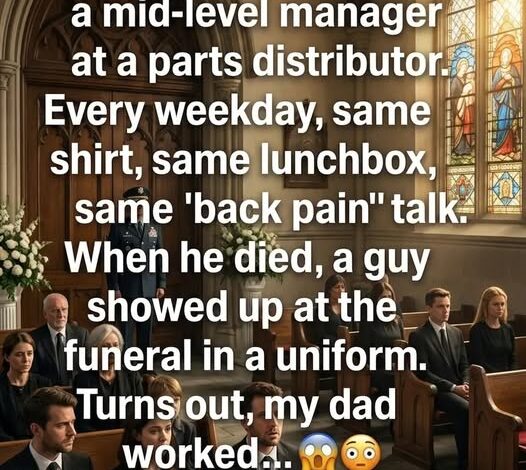
My siblings and I stood near the entrance thanking guests for coming when a man in a maintenance uniform approached us.
He looked nervous.
As though he wasn’t sure whether he belonged there.
When he reached us, he removed his cap and held it against his chest.
“Your father was one of the best men I’ve ever known.”
We thanked him politely.
Then he said something that made us pause.
“He kept that place running.”
I smiled politely.
“You worked with him at the distribution company?”
The man nodded.
“For twenty-two years.”
Then his expression shifted.
Almost confused.
“You know he wasn’t a manager, right?”
The world seemed to stop.
My brother blinked.
My sister frowned.
I laughed awkwardly.
“What do you mean?”
The man stared at us.
Then realization slowly crossed his face.
“He never told you.”
Suddenly, none of us were breathing normally.
The man looked genuinely saddened.
“Your father was head maintenance.”
Silence.
Not ordinary silence.
The kind that arrives when reality suddenly changes shape.
“Maintenance?” my sister whispered.
He nodded.
“Best maintenance worker we ever had.”
The words hung in the air.
My father wasn’t a manager.
Not even close.
The man continued speaking.
“He could fix anything. Electrical systems. Conveyors. Heating units. Loading equipment. If something broke, people called your father.”
He smiled softly.
“Honestly, half that facility would’ve shut down without him.”
I didn’t know what to say.
For thirty years, we believed one story.
Now another stood directly in front of us.
The man seemed to sense our confusion.
“He never wanted recognition.”
Then he laughed quietly.
“We used to joke that if the building caught fire, your father would somehow repair it before the firefighters arrived.”
For the first time all day, someone smiled.
Then another worker joined the conversation.
Then another.
And another.
Each brought stories.
Stories we had never heard.
Stories that painted a picture of a man we suddenly realized we barely understood.
One supervisor told us about a snowstorm that shut down most of the city.
Nearly everyone stayed home.
Dad drove through dangerous roads and spent sixteen straight hours keeping emergency systems operational.
Another employee described how Dad stayed late almost every evening.
Not because anyone asked him to.
Because he wanted to make sure the night crew wouldn’t walk into problems the next morning.
A warehouse worker told us about his first week on the job.
He’d accidentally damaged expensive equipment and expected to be fired.
Instead, Dad quietly helped him repair it and never mentioned the mistake to management.
“He saved my job,” the man said.
“Probably changed my life.”
The stories kept coming.
Each one revealing another piece of someone we thought we knew.
By the time the funeral ended, I felt overwhelmed.
Not because Dad had lied.
Because I was beginning to understand why.
That evening, my siblings and I gathered at our parents’ house.
The rooms felt strange without him.
Every chair.
Every photograph.
Every familiar object seemed to carry a different weight.
As we sorted through old belongings, my brother opened a dusty storage box from the garage.
Inside were tools.
Old manuals.
Work gloves.
And beneath them, something unexpected.
A heavy blue work jacket.
We all stared at it.
The fabric was faded.
Oil stains marked the sleeves.
Several patches covered worn areas near the elbows.
Embroidered above the pocket was my father’s name.
Not Manager.
Not Supervisor.
Just his name.
The jacket looked exhausted.
Like it had lived a thousand difficult days.
I ran my fingers across the fabric and imagined him wearing it.
Working.
Fixing.
Helping.
Doing the things he never talked about at home.
Then my sister reached into one of the pockets.
“There’s something here.”
She unfolded a small piece of paper.
The note was written in Dad’s handwriting.
Simple.
Direct.
Exactly like him.
It said:
Do good work.
Leave things better than you found them.
That’s enough.
For a long moment, nobody spoke.
My eyes filled with tears.
Not because the message was profound.
Because it was.
But also because it explained everything.
His job title never mattered to him.
The status never mattered.
Recognition never mattered.
What mattered was usefulness.
Showing up.
Solving problems.
Helping people.
Leaving things better than he found them.
That was the life he chose.
And suddenly I understood why he hid the truth.
It wasn’t shame exactly.
It was protection.
He grew up in a generation where certain jobs carried unfair judgments.
He worried we might see him differently.
That we’d compare him to fathers with executive titles or corner offices.
So he gave us a version of the story he thought we’d respect.
Never realizing the truth was far more impressive.
Because leadership isn’t always found in boardrooms.
Sometimes it’s found on concrete floors at six in the morning.
Sometimes it’s wearing work boots instead of dress shoes.
Sometimes it looks like staying late to help someone who doesn’t know how to ask.
As children, we believed success meant promotions.
Titles.
Money.
Prestige.
My father spent his entire life teaching a different lesson without ever saying it aloud.
Character matters more than status.
Kindness matters more than recognition.
And the most important people in a community are often the ones nobody notices until they’re gone.
That night, I carefully folded his jacket and placed the note back inside the pocket.
Not because I wanted to hide it.
Because it belonged there.
Together.
A lifetime of hard work and the simple philosophy that guided it.
I used to think legacy was measured by achievements listed on a résumé.
Now I know better.
My father’s legacy isn’t a title.
It’s every machine he repaired.
Every person he helped.
Every problem he solved without seeking credit.
It’s the respect in the voices of people who worked beside him.
The gratitude of strangers who came to his funeral.
The example he left behind.
He never managed a company.
He never sat in a corner office.
He never had the title he wanted us to believe he had.
But in the end, none of that mattered.
Because the truth was far greater.
My father spent his life quietly making the world around him work better.
And there may not be a more honorable legacy than that.