The Hidden Risk in Your Passenger Seat: How a Simple Water Bottle Could Become a Serious Safety Concern

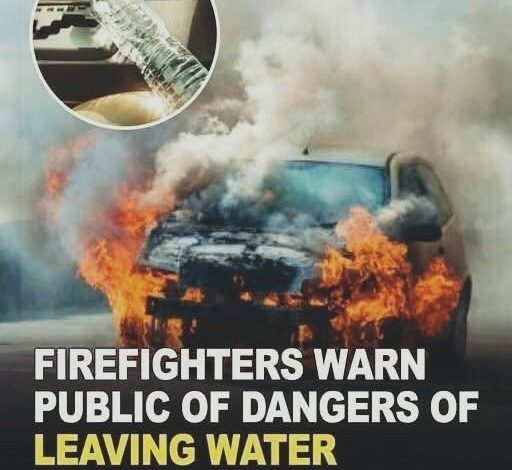
The Truth About Leaving Water Bottles in Hot Cars
Most people don’t think twice about leaving a half-empty water bottle in their car.
It sits in a cup holder, on a seat, or tucked into a door compartment while the vehicle bakes under the summer sun. Over the years, however, alarming warnings have spread online claiming that a simple plastic water bottle can start a car fire.
The images are dramatic.
The headlines are frightening.
And the message is always the same:
Leave a water bottle in your car, and you could be creating a serious fire hazard.
But how much of that claim is actually true?
Where the Warning Comes From
The concern is based on a real scientific principle.
A clear plastic bottle filled with water can act like a lens. Under the right conditions, it can bend and focus sunlight into a concentrated beam, much like a magnifying glass.
In controlled demonstrations, that focused light can become hot enough to scorch certain surfaces.
Because of this, photos and videos showing burned materials beneath water bottles have circulated widely online, leading many people to believe that water bottles are a common cause of vehicle fires.
What Happens in the Real World?
The reality is much less dramatic.
For a water bottle to create enough concentrated heat to ignite materials, several factors must align perfectly:
- The bottle must be positioned at a precise angle.
- Direct sunlight must hit it continuously.
- The focused beam must remain fixed on a flammable surface.
- The conditions must remain stable long enough for ignition to occur.
Inside a parked vehicle, those conditions rarely exist.
The sun moves.
Shadows shift.
Bottles roll or get bumped.
The focused beam is usually unstable and short-lived.
As a result, fire investigators and safety experts generally do not consider water bottles to be a common cause of vehicle fires.
The Real Danger Inside Hot Cars
While the water bottle warning may be exaggerated, the extreme heat inside parked vehicles is very real.
On hot summer days, temperatures inside a closed vehicle can rise rapidly, often reaching dangerous levels within a short period.
Interior surfaces such as:
- Dashboards
- Steering wheels
- Seats
- Seat belts
- Electronics
can become extremely hot.
Heat-related damage is far more common than water-bottle-related fire risks.
Items That Deserve More Attention
Certain objects are far more vulnerable to high temperatures than a bottle of water.
These include:
- Aerosol cans
- Disposable lighters
- Lithium-ion batteries
- Power banks
- Smartphones
- Laptops
- Electronic accessories
Extreme heat can cause batteries to degrade, swell, leak, or fail. Pressurized containers may rupture or leak, while electronics can suffer permanent damage.
Food, beverages, medications, and cosmetics can also deteriorate when left inside hot vehicles.
Practical Summer Safety Tips
Instead of worrying about unlikely fire scenarios, focus on reducing heat exposure inside your vehicle.
Helpful precautions include:
- Parking in shaded areas whenever possible
- Using reflective windshield shades
- Removing electronics when not needed
- Avoiding storage of pressurized containers in hot vehicles
- Keeping the interior free of unnecessary clutter
- Cracking windows slightly when safe and appropriate
These simple habits address genuine risks and help protect both your vehicle and its contents.
The Bottom Line
The viral warnings about water bottles starting car fires contain a small kernel of truth.
Under highly specific conditions, a bottle can focus sunlight and generate heat.
However, the leap from “possible lens effect” to “common fire hazard” is not supported by evidence.
Most vehicle fires are caused by electrical failures, fuel-related issues, mechanical defects, or other well-documented problems—not by water bottles sitting in cup holders.
The real lesson is not to fear every bottle of water left in your car.
It’s to respect the extreme heat that builds inside vehicles during summer months.
That heat is real.
That heat can cause damage.
And managing it is far more important than worrying about an unlikely fire caused by a forgotten water bottle.