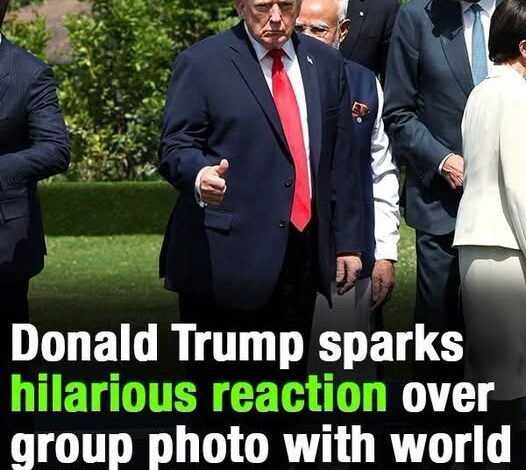
During a major international summit in Évian-les-Bains, world leaders gathered to discuss critical global issues, including ongoing tensions involving Iran and the conflict in Ukraine. Organizers hoped to present a message of unity and cooperation among some of the world’s largest economies. However, much of the public conversation that followed focused not on policy discussions or diplomatic agreements, but on a brief and unexpected moment captured during a group photo session.
As cameras recorded the event, former President Donald Trump appeared to step away from the group momentarily while leaders were assembling for the photograph. The brief clip quickly spread across television broadcasts, news websites, and social media platforms. Within hours, the footage was being replayed, analyzed, and discussed by commentators from a wide range of political perspectives.
Reactions to the video varied considerably depending on viewers’ interpretations. Critics viewed the moment as symbolic, suggesting it reflected disorganization or distraction during an important diplomatic gathering. Supporters, however, argued that the clip was being exaggerated and taken out of context, pointing out that a few seconds of video reveal little about the substance of a complex international summit.
The differing reactions highlight a broader reality of modern political communication. In an era dominated by social media and instant sharing, brief visual moments often attract more attention than lengthy policy discussions. A single image, gesture, or unexpected movement can quickly become the focal point of public debate, sometimes overshadowing the issues leaders gathered to address.
This phenomenon is not limited to any one politician or political party. Public figures around the world increasingly operate in an environment where every appearance is recorded from multiple angles and distributed globally within minutes. Small moments that might once have gone unnoticed can now become viral content, generating headlines and shaping public perception.
Meanwhile, the summit itself focused on significant international challenges. Leaders discussed regional security concerns, diplomatic strategies, economic cooperation, and efforts to address ongoing conflicts. These discussions involved complex negotiations and policy considerations that typically receive far less public attention than highly visible moments captured on camera.
Media analysts often note that visual content tends to spread more rapidly than detailed policy reporting because it is easier to consume, share, and interpret. Short video clips can evoke immediate reactions, while understanding diplomatic agreements or international negotiations often requires more time and context. As a result, public attention frequently gravitates toward memorable images rather than substantive discussions.
The incident also illustrates how modern political narratives are often shaped by competing interpretations. Supporters and critics may view the same footage and reach entirely different conclusions based on their existing perspectives. In many cases, the debate surrounding a viral moment becomes less about what objectively occurred and more about what individuals believe the moment represents.
As technology continues to accelerate the flow of information, political leaders face the challenge of balancing substantive governance with the realities of constant public scrutiny. Every appearance has the potential to generate instant reactions, and even minor moments can become subjects of widespread discussion.
Ultimately, the attention surrounding the brief summit video serves as a reminder of how political communication has evolved. While major international meetings are intended to address complex global issues, public conversation is often shaped by short visual moments that capture attention far more quickly than policy statements or diplomatic agreements.
In today’s media environment, a few seconds of footage can become a defining story, demonstrating how modern politics increasingly unfolds not only through negotiations and decisions, but also through the images and clips that circulate around the world in real time.