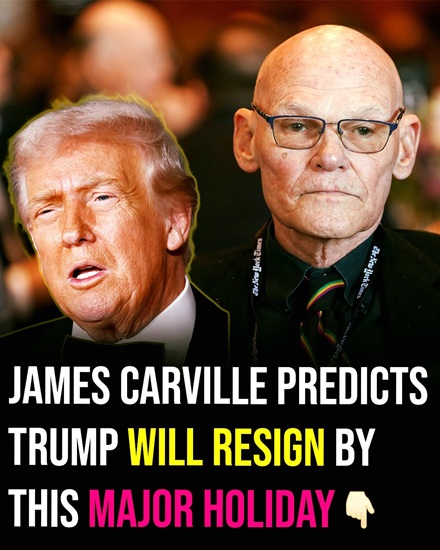
James Carville has made a prediction about Donald Trump’s possible resignation timeline ahead of a major holiday.

The appearance of “Trump 2028” merchandise has recently sparked widespread discussion about Donald Trump’s political future, presidential term limits, and the role of political branding in shaping public debate. While campaign-themed merchandise is a common feature of American politics, the slogan has drawn particular attention because it references a year that would fall beyond the traditional two-term presidential framework established by the United States Constitution.
The merchandise began appearing online through outlets associated with Trump supporters and quickly generated discussion across news media, social media platforms, and political commentary programs. For supporters, the slogan has been viewed by some as a symbol of continued political influence and enthusiasm surrounding Trump’s leadership. For critics, however, it has raised questions about constitutional norms and the implications of promoting a potential future candidacy that would face significant legal barriers.
Under the 22nd Amendment to the U.S. Constitution, presidents are limited to serving two elected terms in office. The amendment was ratified in 1951 following Franklin D. Roosevelt’s unprecedented four-term presidency and has remained a cornerstone of presidential term-limit law ever since. As a result, any discussion of a third elected term is generally viewed as highly speculative and would require extraordinary constitutional changes that are not currently under consideration.
Despite these legal realities, political merchandise often serves purposes beyond literal campaign announcements. Slogans, hats, apparel, and promotional items are frequently used to energize supporters, generate media attention, and reinforce political identity. In this case, the “Trump 2028” branding has succeeded in doing exactly that, placing Trump once again at the center of national political conversation.
At the same time, broader discussions about Trump’s political future have been fueled by commentary from political analysts and strategists across the ideological spectrum.
Among those weighing in recently is longtime Democratic strategist James Carville, who has publicly offered his views regarding the future trajectory of Trump’s presidency. During appearances on political podcasts and commentary programs, Carville argued that political challenges, electoral dynamics, and potential investigations could significantly affect the administration’s long-term stability.
Carville’s comments reflected his personal political analysis rather than any verified prediction. He suggested that future election outcomes and shifts in congressional power could create substantial pressure on the administration. According to his assessment, changing political conditions may influence the direction of national leadership over the coming years.
During discussions on the podcast Politics War Room, Carville and journalist Al Hunt examined various scenarios regarding the future political landscape. Hunt expressed skepticism about the likelihood of Trump voluntarily stepping away from office, noting that maintaining political influence and institutional support would remain important priorities for any administration facing opposition scrutiny.
Carville, however, maintained a more dramatic outlook, arguing that political backlash and electoral shifts could create increasingly difficult governing conditions. His remarks were framed as political forecasting based on current trends rather than statements of fact.
Political forecasting remains an inherently uncertain exercise.
American political history is filled with examples of unexpected election outcomes, shifting public opinion, and unforeseen events that dramatically altered political trajectories. Economic conditions, international developments, legislative battles, and social issues all have the potential to reshape the political landscape in ways that are difficult to predict years in advance.
As a result, claims regarding future resignations, electoral outcomes, or political exits remain speculative unless supported by concrete evidence.
Representatives aligned with the administration have dismissed such predictions, characterizing them as partisan commentary rather than objective analysis. This response reflects the broader pattern of political debate in the United States, where competing narratives often emerge around the same set of events.
The discussion surrounding “Trump 2028” merchandise also highlights the increasing importance of branding in modern politics.
Political figures today often operate within media environments that reward attention, symbolism, and constant engagement. Merchandise can function as a communication tool, helping politicians maintain visibility and reinforce loyalty among supporters long after traditional campaign cycles have ended.
For supporters, such branding may represent confidence, continuity, and enthusiasm for a political movement. For opponents, it may serve as a reminder of ongoing concerns about democratic norms, constitutional limits, or political polarization.
Regardless of interpretation, the slogan has succeeded in generating exactly what modern political branding often seeks: attention.
The broader conversation reflects the deeply divided nature of contemporary American politics. Supporters and critics frequently view the same developments through entirely different lenses, leading to contrasting interpretations of political motives, leadership qualities, and future ambitions.
This polarization is amplified by social media, television commentary, podcasts, and digital news platforms, where political narratives evolve rapidly and often compete for public attention.
As discussions continue, one fact remains unchanged: the constitutional framework governing presidential term limits has not been altered. Any speculation regarding future candidacies beyond existing limits remains hypothetical and subject to significant legal and constitutional barriers.
What is clear, however, is that Donald Trump continues to occupy a central position in American political discourse.
Whether through campaign messaging, media appearances, merchandise, or commentary from political allies and opponents alike, his influence on national conversations remains substantial. As future elections approach and political debates intensify, discussions surrounding his role in American politics are likely to continue attracting significant public interest.
For now, the “Trump 2028” slogan remains primarily a political symbol—one interpreted differently depending on perspective, but undeniably successful in generating conversation. In a political environment increasingly shaped by messaging and visibility, that alone makes it a noteworthy development.
Ultimately, the debate surrounding the merchandise says as much about the current state of American politics as it does about Donald Trump himself. It reflects a nation where symbolism, speculation, and political identity often drive public discussion, and where even a simple slogan can become the center of a much larger conversation about leadership, power, and the future of American democracy.