Donald Trump has telling response after being booed during national anthem at Knicks NBA Finals game

For a few unforgettable seconds, a basketball game stopped being just a basketball game.
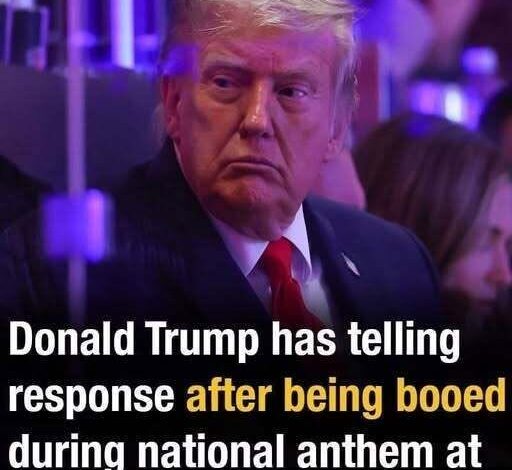
The lights of Madison Square Garden were bright as ever. Fans filled the seats. Cameras swept across the arena. The atmosphere carried the familiar electricity of a major sporting event. Yet when the national anthem began and the broadcast focused on Donald Trump, something shifted.
The building seemed to hold its breath.
Trump stood beneath the lights with a fixed smile and a steady salute. It was a familiar image—one that millions of Americans had seen in countless forms over the years. Whether admired or criticized, he remained a figure capable of commanding attention the moment a camera found him.
Then the sound began.
At first, it was subtle. A scattering of boos emerged from different corners of the arena. Within moments, they became impossible to ignore. They did not completely overpower the anthem, nor did they dominate every voice in the crowd. But they were loud enough to cut through the ceremony and transform the moment into something far larger than sports.
Suddenly, Madison Square Garden was no longer just an arena.
It had become a stage.
And the country was watching.
For some viewers, the reaction felt inappropriate. The national anthem has long been treated as one of the few remaining rituals meant to stand above politics. To them, the boos represented another example of division reaching places where unity was once expected. What should have been a shared moment of respect had become yet another battlefield in America’s endless political struggle.
Others saw something entirely different.
To them, the crowd was exercising a fundamental right. Public figures, especially presidents and former presidents, do not become immune to criticism simply because music is playing or cameras are rolling. The boos were not an attack on the anthem, they argued. They were a reflection of public opinion—a spontaneous expression from people unwilling to separate politics from the politician standing before them.
The disagreement began almost instantly.
Not in the arena.
Across the country.
Because with Donald Trump, the same image often produces two completely different realities.
Yet amid the noise, one thing stood out.
Trump did not react.
His smile remained unchanged.
His posture never shifted.
There was no visible frustration, no acknowledgment of the criticism, no sign that the reaction had affected him at all. He stood motionless while the crowd revealed itself around him.
That stillness became its own story.
Some interpreted it as strength. They saw a man accustomed to hostility, refusing to be rattled by public opposition.
Others saw calculation. Trump has spent years understanding the value of optics and performance. Remaining calm in a hostile environment can communicate confidence more effectively than any speech.
And others viewed it as something else entirely—a refusal to confront the reality that significant portions of the public remain deeply opposed to him.
The image itself offered no answers.
It simply sat there, allowing every viewer to project their own conclusions onto it.
Then came the moment that changed the entire atmosphere.
The Jumbotron cut away.
Within seconds, the giant screen landed on Knicks star Jalen Brunson.
The reaction was immediate.
The boos vanished beneath a thunderous wave of cheers.
The contrast felt almost startling.
One moment, the arena sounded divided.
The next, it sounded united.
Fans leaped to their feet. Applause erupted throughout the building. Energy surged through the crowd in a way that felt effortless and natural.
Brunson had not delivered a speech.
He had not taken a political position.
He had not asked for approval.
Yet he received something increasingly rare in modern public life: uncomplicated admiration.
That sudden shift revealed something deeper than either reaction alone.
On one side stood a former president whose presence instantly triggered debates about power, loyalty, resentment, patriotism, accountability, and identity. His image carried years of political conflict into the building before he ever appeared on screen.
On the other side stood a basketball player.
A hometown hero.
A symbol of hope for fans who wanted their team to win.
For a brief moment, the crowd found something they could agree on.
Not because the nation’s divisions had disappeared.
But because sports still possess a unique ability to create shared emotions without requiring shared politics.
The contrast was impossible to miss.
One figure divided the room.
The other united it.
Outside the arena, that same tension could be felt in different ways.
Security measures had intensified throughout the area. Barricades, police presence, restricted access points, and altered traffic patterns reminded everyone that presidential appearances no longer arrive quietly. They reshape the environment around them.
Entire sections of normal city life bend to accommodate the political spotlight.
People adjust routes.
Events change plans.
Crowds move differently.
Even those with little interest in politics find themselves affected by its presence.
Inside Madison Square Garden, however, the game continued.
Fans cheered.
Players competed.
The night moved forward.
Yet the earlier moment lingered because it seemed to capture so much of modern America within a matter of seconds.
The anthem.
The salute.
The boos.
The cheers.
The camera cut.
The unchanged smile.
Each piece felt symbolic.
Together, they formed a snapshot of a nation wrestling with itself.
Trump has long understood the power of attention. Few public figures have demonstrated a greater ability to remain at the center of national conversation. Supporters often view attacks against him as evidence of his importance. Critics view those same moments as proof of public rejection.
Either way, the spotlight rarely leaves him for long.
That reality was visible once again inside the Garden.
Even a basketball game could not fully escape his gravitational pull.
Yet perhaps the most revealing moment was not the boos themselves.
Nor was it Trump’s reaction.
It was what happened when the camera found someone else.
The eruption for Brunson reminded everyone that unity still exists, even if only in brief flashes.
It exists when people rally around talent.
Around shared pride.
Around a common goal.
Those cheers did not solve America’s divisions. They did not erase political disagreements or heal cultural wounds.
But they offered a glimpse of something increasingly rare—a crowd moving together rather than apart.
By the time the game continued, the moment had already escaped the arena.
Videos spread across social media.
Commentators weighed in.
Supporters and critics interpreted the scene through familiar lenses.
Some focused on the boos.
Others focused on the anthem.
Some saw disrespect.
Others saw accountability.
The same few seconds became evidence for entirely different arguments.
And perhaps that was the most powerful message of all.
In modern America, almost nothing remains purely symbolic anymore.
A salute becomes a political statement.
A crowd becomes a jury.
A basketball arena becomes a reflection of the national mood.
Even silence becomes open to interpretation.
As the lights continued to shine over Madison Square Garden, one question remained suspended in the air: What had people actually witnessed?
Strength?
Defiance?
Denial?
Protest?
Patriotism?
The answer depended largely on who was watching.
But regardless of interpretation, the moment revealed something undeniable.
America is still arguing with itself.
And sometimes, all it takes is a camera, a crowd, and a few seconds beneath the bright lights of an arena to remind everyone just how loud that argument has become.