When deputies arrived at Friendship Elementary that night, they expected to investigate a break-in.
What they found instead looked like the aftermath of a storm.
Glass covered the floor near the entrance. A shattered door marked the point where someone had forced their way inside. Hallways that normally echoed with the sounds of children learning sat silent beneath flashing police lights. And deeper inside the building, investigators discovered the heart of the damage.
The school’s media center had been devastated.
Bookshelves were overturned.
Computers had been damaged.
Furniture had been broken.
Supplies were scattered across the room.
What should have been a safe place for students to read, learn, and explore had been transformed into a scene of destruction.
As deputies documented the damage, the estimated cost continued to climb.
Ten thousand dollars.
Twenty thousand.
Thirty thousand.
By the time officials finished their initial assessment, the total exceeded $50,000.
For a community school, it was a painful loss.
For teachers and students, it felt personal.
But the most heartbreaking part of the story had not yet unfolded.
Investigators worked quickly.
Security footage captured the break-in.
The suspects had covered portions of their faces, believing the masks would protect their identities.
At first, the images seemed frustratingly unclear.
The figures moved through shadows.
The footage was grainy.
The angles were imperfect.
Still, detectives released portions of the video, hoping someone would recognize something.
A walk.
A gesture.
A piece of clothing.
Anything.
What happened next surprised everyone.
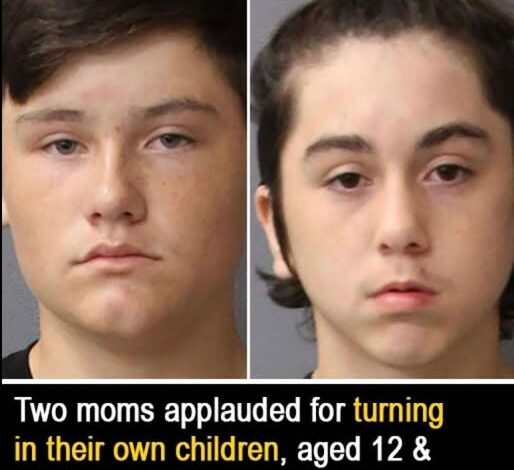
In two different homes, two mothers sat down to watch the footage.
Like countless parents across the community, they wanted answers.
They wanted to know who could have done something like this.
Who would target an elementary school?
Who would destroy a place built for children?
Then came the moment every parent fears.
Recognition.
Not certainty at first.
Just a feeling.
A shape.
A movement.
Something familiar.
One mother leaned closer to the screen.
Her stomach tightened.
The boy on the video moved a certain way.
The way her son moved.
The way he carried his shoulders.
The way he walked.
The way he turned his head.
A second mother experienced the same horrifying realization.
Neither wanted to believe it.
Neither wanted to be right.
But deep down, both already knew.
Denial would have been easy.
Perhaps easier than anything that followed.
They could have convinced themselves the footage was unclear.
They could have waited.
Ignored the suspicion.
Told themselves investigators would figure it out.
After all, these were their children.
Children they had raised.
Protected.
Loved.
Children who still needed rides to school and reminders to clean their rooms.
Children who were years away from adulthood.
The idea that they could be responsible for thousands of dollars in destruction felt impossible.
Yet the evidence remained.
And so did the truth.
The mothers faced a choice.
Protect their sons.
Or protect their future.
Sometimes those are not the same thing.
The phone calls came shortly afterward.
Two mothers contacted the sheriff’s office.
Their voices reportedly shook as they spoke.
No parent dreams of making that call.
No parent imagines voluntarily bringing law enforcement to their own child.
But they did it anyway.
Because they believed something even harder than punishment.
Accountability.
The calls changed everything.
Investigators followed up.
Interviews were conducted.
Evidence was reviewed.
And eventually, the boys admitted what they had done.
The confessions confirmed the nightmare.
The children seen on surveillance footage were indeed the ones responsible.
News spread quickly through the community.
Reactions were immediate.
Some people focused entirely on the damage.
The broken property.
The taxpayer expense.
The violation of a school that belonged to everyone.
Parents expressed anger.
Teachers expressed frustration.
Residents demanded consequences.
Others looked beyond the destruction and focused on the mothers.
Their decision became almost as widely discussed as the crime itself.
Many praised them.
Not because anyone celebrated what happened.
But because they had chosen honesty over avoidance.
Truth over excuses.
Responsibility over denial.
People often say parents should hold their children accountable.
Far fewer understand what that actually requires when the child involved is their own.
These mothers did.
And it cost them.
The case occupies an uncomfortable space.
A place where childhood and accountability collide.
The boys were young.
Young enough that some people immediately wanted to dismiss the incident as a foolish mistake.
But the consequences were real.
Broken windows are real.
Destroyed equipment is real.
Lost educational resources are real.
Fifty thousand dollars is real.
Age explains poor decisions.
It does not erase their impact.
That reality makes the situation difficult.
Compassion matters.
So does accountability.
Neither cancels the other.
Both can exist at the same time.
For the mothers, the emotional burden may have been heavier than any public criticism.
They were not simply watching a news story.
They were watching their children become part of one.
Every parent wants to protect their child from pain.
That instinct is powerful.
Natural.
Almost impossible to ignore.
But good parenting sometimes demands something harder.
The willingness to let consequences teach lessons that protection cannot.
Shielding a child from every mistake may feel loving in the moment.
Yet avoiding accountability can create far greater damage later.
The mothers understood that.
Even if understanding it broke their hearts.
Some lessons arrive through success.
Others arrive through failure.
This lesson arrived through shattered glass and damaged bookshelves.
The boys now face consequences that will likely stay with them for years.
But those consequences may also become a turning point.
A moment remembered not as the day everything ended, but as the day something changed.
Because accountability, when introduced early enough, can redirect a life.
It can teach responsibility before patterns become permanent.
It can create growth where denial would have created repetition.
Painful lessons often become the most valuable ones.
Between the crime scene and the courtroom lies a truth many parents understand but rarely discuss.
Love is not always gentle.
Sometimes love means saying no.
Sometimes love means refusing to make excuses.
Sometimes love means standing beside your child while they face the consequences of their actions instead of helping them avoid them.
And sometimes love means making a phone call you never imagined making.
A phone call that leaves your hands trembling.
A phone call that breaks your heart.
A phone call that may save your child from becoming someone worse in the future.
That was the choice these mothers faced.
And despite the pain, they made it.
Not because it was easy.
Not because they stopped loving their sons.
But because they loved them enough to tell the truth.
In the end, the shattered glass can be replaced.
The damaged shelves can be repaired.
The destroyed equipment can be rebuilt.
What mattered most was ensuring that the boys responsible had the opportunity to learn from what they had done before a terrible decision became a lifelong pattern.
That opportunity began the moment two mothers looked at a surveillance video, recognized their children, and chose courage over comfort.
It was not the easiest act of parenting.
It may have been one of the most important.