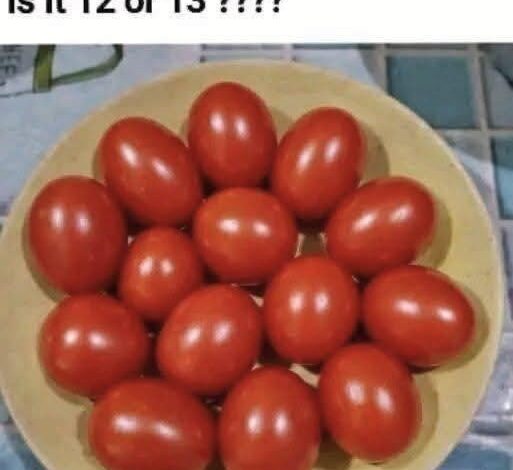
At first glance, the challenge seems almost laughably simple.
A plate of tomatoes.
A straightforward question.
Count them.
That’s it.
No complicated math. No hidden clues. No trick wording. Just a handful of bright red tomatoes arranged on a plate and a debate that has somehow divided thousands of people online.
Are there 12 tomatoes?
Or are there 13?
Most viewers are convinced they know the answer within seconds.
Then something strange happens.
They count again.
And suddenly they’re not so sure.
What should take only a moment begins to feel surprisingly difficult. The eye hesitates. The brain second-guesses itself. One tomato seems to blend into another. A curved edge looks like a separate fruit. A shadow creates uncertainty. Before long, people who were completely confident are staring at the image far longer than they expected.
That confusion is exactly what made the viral tomato puzzle spread across social media.
Because the image is not really testing your ability to count.
It is testing how your brain sees.
The challenge works because it appears easy.
People enjoy puzzles when they believe success should come quickly. A difficult mathematical equation feels intimidating. A complicated riddle requires effort. But a plate of tomatoes feels approachable.
Anyone can participate.
Children.
Parents.
Grandparents.
Friends.
Coworkers.
No special skills are required.
You simply look and answer.
That accessibility is part of the magic.
Within moments, comment sections fill with confident declarations.
“Twelve.”
“No, definitely thirteen.”
“You missed one.”
“Look again.”
“I counted fourteen!”
What begins as a simple image becomes a surprisingly passionate debate.
The real reason people disagree lies in how the tomatoes are arranged.
If every tomato sat neatly in rows, separated by clear spaces, the answer would be obvious. Human beings are remarkably good at counting organized objects.
Our brains love patterns.
Rows.
Columns.
Groups.
Symmetry.
When objects are clearly separated, we process them quickly and accurately.
But the tomatoes in this image are crowded together.
Some overlap.
Some partially hide behind others.
Several occupy positions that make their boundaries difficult to distinguish.
Instead of seeing individual objects immediately, the brain begins grouping them together.
And that is where the confusion begins.
Visual perception is not as simple as most people think.
Many assume the eyes function like cameras, capturing reality exactly as it appears.
But that is not what happens.
Your eyes gather information.
Your brain interprets it.
Those are two very different processes.
The brain constantly organizes, predicts, fills gaps, and simplifies what it sees.
Most of the time, these shortcuts help us.
Without them, everyday life would be overwhelming.
Imagine having to consciously analyze every object, color, shadow, and shape you encounter throughout the day.
You would never get anything done.
Instead, the brain creates efficient shortcuts.
Usually those shortcuts are accurate.
Sometimes they are not.
The tomato puzzle takes advantage of exactly that weakness.
Color plays a major role.
Every tomato is nearly identical.
Bright red.
Rounded.
Shiny.
When many similar objects are clustered together, the eye can struggle to separate them cleanly.
A highlight may appear to belong to one tomato when it actually belongs to another.
A shadow can create the illusion of a gap.
Two touching tomatoes may briefly appear as one larger shape.
Or a single tomato may appear to be two separate objects.
The brain tries to organize the information quickly.
Different people organize it differently.
That is why honest disagreement occurs.
Not because people are careless.
Because perception is interpretation.
The circular arrangement creates another challenge.
Humans generally prefer clear starting points and endpoints.
Rows have beginnings.
Columns have endings.
Circles do not.
When counting objects arranged around a plate, it becomes surprisingly easy to lose track.
You may accidentally skip one.
You may count one twice.
Your eyes may return to a spot you’ve already counted without realizing it.
A small mistake early in the process can completely change the final answer.
That is why some viewers count twelve the first time and thirteen the second.
Nothing in the image changed.
Only their attention did.
Expectation influences perception too.
The moment someone asks whether there are 12 or 13 tomatoes, your brain begins looking for evidence.
You stop observing naturally.
You start investigating.
If you suspect there are 13, you search for a hidden tomato.
If you suspect there are 12, you begin questioning whether one apparent tomato is actually part of another.
The question itself changes how you look.
Psychologists have documented this phenomenon for decades.
Expectation shapes observation.
What we think we might see often influences what we actually notice.
The tomato puzzle demonstrates this beautifully.
Photography introduces another layer of confusion.
A camera captures only one angle.
Real life offers depth.
Movement.
Perspective.
If you stood beside the plate, you could lean closer, change your position, and instantly identify which tomatoes overlap.
A photograph removes those advantages.
Depth becomes flattened.
Objects merge visually.
Partial shapes become ambiguous.
What appears obvious in person may become uncertain in a still image.
This limitation transforms ordinary objects into surprisingly effective puzzles.
Perhaps the most interesting part of the challenge is how confident people become.
Confidence and accuracy are not always connected.
Someone may glance at the image for two seconds and declare the answer with complete certainty.
Then another person provides a different count.
Suddenly doubt appears.
The image is examined again.
The certainty weakens.
A third count begins.
The answer changes.
This experience is surprisingly common.
And surprisingly human.
People often trust their first impression more than they should.
The tomato puzzle exposes that tendency in a harmless, entertaining way.
That may be why the image spread so widely online.
The puzzle is not really about tomatoes.
It is about perception.
Attention.
Assumptions.
And the strange gap between what we believe we see and what is actually there.
Social media thrives on exactly this kind of challenge.
The stakes are low.
The participation is easy.
The disagreement feels meaningful enough to keep people engaged.
Friends compare answers.
Families debate.
Comment sections fill with circles, arrows, and explanations.
For a few minutes, a plate of tomatoes becomes a mystery.
There is also a larger lesson hidden inside the puzzle.
Every day, people make quick judgments based on incomplete information.
We glance.
Assume.
Decide.
Most of the time, we move on without questioning ourselves.
But reality is often more complicated than first impressions suggest.
The tomato puzzle encourages something rare.
It encourages people to pause.
To look again.
To examine details instead of relying entirely on instinct.
That habit extends far beyond visual puzzles.
It applies to conversations.
News.
Relationships.
Opinions.
Life itself.
Sometimes the first answer is correct.
Sometimes it is not.
The only way to know is to slow down and look carefully.
So is the answer 12 or 13?
The only reliable approach is methodical counting.
Choose a starting point.
Move carefully around the plate.
Count each tomato once.
Pay attention to overlaps and partially hidden shapes.
Ignore assumptions.
Focus only on what is actually visible.
Whether you arrive at 12 or 13, the puzzle has already succeeded.
Because its true purpose was never simply finding the number.
Its purpose was creating uncertainty.
Encouraging attention.
Revealing how easily perception can be challenged.
And reminding us that even the simplest image can teach something fascinating about how the human mind works.
A plate of tomatoes should not be difficult.
Yet somehow, for thousands of people online, it became exactly that.
And perhaps that is why the puzzle remains so memorable.
Not because of the answer.
But because it makes us question how confidently we think we see the world around us.