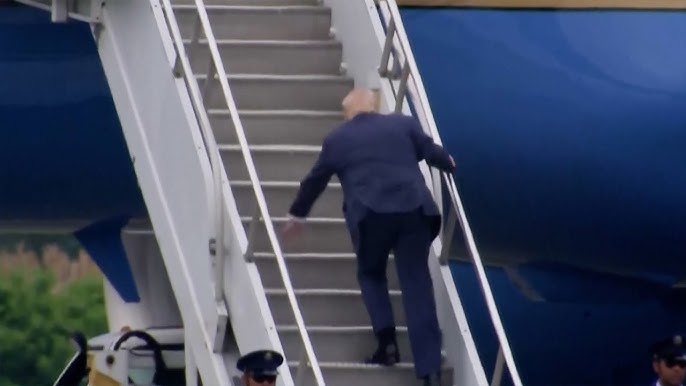
The stumble lasted barely a heartbeat.
One foot caught awkwardly on the Air Force One stairs, Donald Trump lurched slightly forward, steadied himself almost instantly, and continued walking without assistance. Within seconds, the moment was over. Staff kept moving, cameras kept rolling, and the day’s schedule continued exactly as planned.
But in modern politics, moments no longer end when they happen.
They begin again online.
Within minutes, clips of the stumble spread across social media platforms, slowed down, zoomed in, replayed, captioned, mocked, defended, and transformed into whatever viewers already wanted it to mean. For critics, it became comedic material almost immediately — another viral clip added to the endless digital archive of political awkwardness. Supporters pushed back just as quickly, arguing that a brief misstep on stairs was being treated like a national emergency simply because it involved Trump.
The actual incident was ordinary.
The reaction was anything but.
What fascinated people almost as much as the stumble itself was who stood nearby: Senator Marco Rubio. Cameras captured Rubio only steps away as Trump regained balance, and suddenly the internet began dissecting not only the stumble but Rubio’s posture, expression, timing, and reaction. Some viewers interpreted his presence symbolically, searching for signs of political loyalty, succession, weakness, or tension in frames lasting less than a second.
That is how modern political culture operates now.
Nothing remains simply physical anymore.
Every gesture becomes metaphor.
Every expression becomes evidence.
Every stumble becomes narrative.
In reality, politicians are still human beings with aging knees, uneven footing, exhaustion, distractions, and ordinary moments of clumsiness. Air Force One stairs are steep. Wind conditions shift. Shoes catch. People trip. Under normal circumstances, such a moment would barely register in public memory.
But presidents and former presidents no longer live inside normal circumstances.
They exist beneath relentless observation where cameras never fully turn away and where even the smallest unscripted movement can dominate headlines for days. A stumble becomes interpreted not just as a stumble, but as a reflection of strength, stamina, leadership, age, vulnerability, or decline depending entirely on the viewer’s existing political beliefs.
That may be the most revealing part of the incident.
The clip itself proved almost nothing.
The reactions revealed everything.
People saw what they were already prepared to see.
Some viewers mocked Trump’s age and physicality immediately, despite many of those same voices previously criticizing conservative media for obsessing over President Biden’s slips, stumbles, and verbal mistakes. Others defended Trump passionately while dismissing comparisons entirely. The arguments became less about one man missing a step and more about perceived hypocrisy, media standards, and political loyalty.
The internet turned one second of footage into a cultural Rorschach test.
And because social media rewards speed over perspective, nuance disappeared almost instantly. The clip circulated stripped of context, replayed endlessly in loops that made the moment feel larger than it actually was. That repetition creates a strange illusion in digital culture: brief events begin feeling historically significant simply because audiences consume them thousands of times.
In earlier decades, a politician stumbling on stairs might have appeared once on the evening news and vanished by the next morning. Today, algorithms stretch fleeting moments into national obsessions. Commentary channels freeze individual frames. Partisan accounts weaponize them. Memes spread faster than factual reporting. Attention itself becomes amplification.
The result is a political environment where symbolism often overwhelms substance.
And perhaps that is why the incident lingered far longer online than logic suggested it should.
Not because the stumble mattered greatly.
Because the ecosystem surrounding it does.
Modern politics increasingly unfolds through viral fragments rather than sustained discussion. Seconds-long clips now shape public perception more effectively than lengthy speeches or policy papers ever could. People encounter leaders not primarily through legislation or governance, but through curated moments designed for emotional reaction: a pause, a stumble, a facial expression, a shaky handshake, an awkward glance.
The body itself becomes political content.
For older politicians especially, every movement carries added scrutiny. Trump, Biden, and other aging national figures now operate inside a culture intensely fixated on physical vitality as shorthand for competence. Minor slips become interpreted through fears about mortality, decline, and leadership capacity in ways younger politicians rarely experience.
Yet the fixation says as much about the audience as the politicians themselves.
Americans increasingly consume politics less like civic engagement and more like serialized performance, where every clip feeds ongoing storylines audiences emotionally invest in. A stumble fits neatly into narratives people already believe about strength or fragility. Social media accelerates this process because outrage, mockery, and tribal affirmation spread faster than restraint.
So a man briefly losing footing on stairs becomes transformed into a national conversation.
Not because the moment itself deserved such weight, but because the culture surrounding politics now demands constant interpretation of everything leaders do, however trivial.
And perhaps that is the deeper truth hidden beneath the viral clip:
the stumble was ordinary human behavior under extraordinary observation.
What truly mattered was not the misplaced step itself, but the speed with which millions of people rushed to turn it into proof of something larger. In the age of social media, politics no longer pauses between major events. It fills every available second, feeding endlessly on fragments, reactions, and replayed footage until even the smallest moment feels impossible to escape.
The incident faded eventually, as viral moments always do.
But the system that transformed it into national spectacle remains fully intact — watching, recording, replaying, and waiting for the next misplaced step.