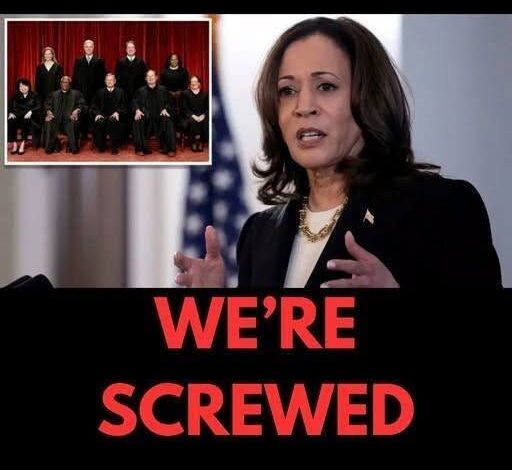
Few political debates ignite emotions in America faster than arguments over the rules of the system itself.
Policy disagreements come and go. Tax rates change. Presidents leave office. Laws are passed and repealed. But when politicians begin questioning the institutions that determine how power is gained, exercised, and preserved, the conversation moves beyond ordinary politics. It becomes a struggle over the foundations of government itself.
That is why Kamala Harris’s comments sparked such an intense reaction.
Her support for proposals such as expanding the Supreme Court, eliminating the Electoral College, and granting statehood to Washington, D.C., and Puerto Rico immediately touched some of the deepest divisions in American political life. To supporters, these ideas represent overdue reforms designed to strengthen democratic representation. To critics, they appear to be attempts to reshape the system in ways that could permanently alter the balance of political power.
The controversy was never just about individual policies.
It was about competing visions of America.
For many conservatives, Harris’s proposals raised alarms because they targeted institutions that have existed for generations and play a central role in the country’s constitutional framework. The Supreme Court, the Electoral College, and the structure of congressional representation are not viewed by many on the right as outdated obstacles. Rather, they are seen as safeguards created to prevent concentrated political power and protect the interests of diverse regions and communities.
From this perspective, changing those institutions carries serious consequences.
Supporters of the current system argue that America was intentionally designed to balance competing interests. Large states and small states, urban centers and rural communities, majorities and minorities were all meant to have protections within the constitutional structure. Removing or weakening those protections, they argue, could allow temporary political majorities to dominate the system in ways the founders specifically sought to prevent.
As a result, many Republicans interpreted Harris’s remarks not as neutral reform proposals but as part of a broader effort to rewrite political rules after years of increasingly contentious electoral and legal battles.
Conservative critics quickly framed the debate in stark terms.
To them, proposals such as expanding the Supreme Court are not merely administrative changes. They are viewed as attempts to influence the ideological balance of the judiciary. Likewise, abolishing the Electoral College is often portrayed as a move that would shift political influence toward heavily populated states while reducing the voice of smaller states.
In their view, the issue is not fairness but power.
And that perception fuels much of the resistance.
Yet progressives see an entirely different reality.
To many on the left, the existing system already contains structural advantages that distort democratic representation. They argue that institutions praised by conservatives as protective safeguards often function in practice as barriers that allow political minorities to maintain influence disproportionate to their share of the population.
For progressive activists and lawmakers, concerns about representation have intensified over the past decade. They point to issues such as gerrymandered legislative districts, voting restrictions, Senate representation disparities, judicial appointments, and Electoral College outcomes that have sometimes produced presidents who did not win the national popular vote.
From their perspective, the problem is not that reforms threaten democracy.
The problem is that democracy itself is not operating as fairly as it should.
This divide becomes especially visible when discussions turn to voting rights and redistricting.
When Harris criticized Republican-led redistricting efforts as discriminatory, she was framing the issue as a question of representation rather than simple political strategy. To her supporters, district maps that dilute the influence of certain communities undermine the principle that every vote should carry equal weight.
Republicans, however, often respond that redistricting battles occur in both parties and are part of the political process rather than evidence of systemic discrimination.
The disagreement highlights a deeper conflict.
Increasingly, both sides view the same institutions through entirely different lenses.
One side sees protections.
The other sees barriers.
One side sees stability.
The other sees inequality.
This growing divide extends beyond elected officials.
Prominent progressive figures such as Alexandria Ocasio-Cortez have used increasingly urgent language when discussing threats to democratic governance. Comparisons to historical periods of national division reflect a belief among some activists that the struggle over voting rights, representation, and political power has reached a critical stage.
Conservatives often reject such characterizations, arguing that this rhetoric exaggerates political disagreements and contributes to polarization. Yet the fact that these comparisons are being made at all demonstrates how intensely many Americans now view debates over institutional reform.
At its core, the controversy surrounding Harris’s remarks is about far more than court expansion or statehood proposals.
It is about whether the American political system should evolve or remain largely unchanged.
Supporters of reform argue that institutions created centuries ago must adapt to modern realities. They point to demographic shifts, population growth, changing political coalitions, and evolving expectations about representation as reasons to reconsider how power is distributed.
Opponents counter that constant institutional changes risk undermining stability and public trust. They argue that constitutional structures are designed to withstand political pressure and should not be altered whenever one side becomes dissatisfied with electoral outcomes.
Both arguments appeal to democratic principles.
Yet they lead to very different conclusions.
What makes the debate particularly significant is that it increasingly revolves around the rules themselves rather than the outcomes those rules produce.
Historically, political parties competed within established structures.
Today, many of the fiercest battles focus on whether those structures should remain in place at all.
As trust in institutions declines, both parties have become more willing to question the legitimacy of systems they believe disadvantage them. Democrats often point to representation disparities and voting access concerns. Republicans frequently raise concerns about judicial activism, election administration, and institutional overreach.
The result is a political environment where each side increasingly believes the system is tilted against them.
That perception may be as important as any specific policy proposal.
Because once citizens begin losing confidence in the fairness of institutions, every election, court ruling, and legislative decision becomes harder to accept. Political disagreements that were once temporary can begin to feel existential.
This is why debates over reforms such as Supreme Court expansion, Electoral College abolition, and statehood proposals generate such strong reactions.
They are not simply arguments about government mechanics.
They are arguments about legitimacy.
They are arguments about representation.
And ultimately, they are arguments about who gets to shape the future of American democracy.
The larger question now facing the country is not merely whether these reforms will happen.
It is whether Americans can continue to trust institutions that an increasing number of people on both sides believe are working against them.
That challenge may prove even more important than any individual proposal.
Because the strength of a democracy depends not only on its rules, but on the public’s willingness to believe those rules remain fair.
And as the battle over political power intensifies, preserving that belief may become one of the most difficult tasks facing the nation.