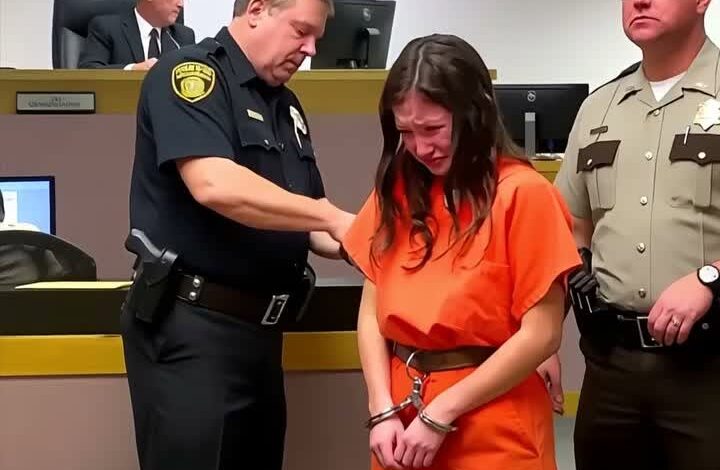
Most people never see these children before the worst day of their lives.
They do not see the neighborhoods they grew up in. They do not see the instability, the fear, the violence, the neglect, or the circumstances that shaped them long before a courtroom ever learned their names. Instead, society often meets them at a single moment—a crime scene, a police report, a trial.
By then, their story has already been reduced to one terrible act.
A judge delivers a sentence.
A courtroom falls silent.
Families leave carrying grief, anger, relief, or heartbreak.
And for some young offenders, the words that follow are among the harshest the legal system can impose:
Life without the possibility of parole.
For an adult, such a sentence is severe.
For a child, it raises a question that continues to divide courts, lawmakers, psychologists, victims’ families, and communities around the world.
Can a society truly know who a child will become decades before that future arrives?
That question sits at the center of one of the most emotionally charged debates in modern criminal justice.
Because when a juvenile receives a sentence without any possibility of release, the punishment extends beyond prison walls. It is not simply a declaration that a crime deserves serious consequences. It is a declaration that no future growth, education, remorse, rehabilitation, or transformation will ever matter enough to reconsider that judgment.
It tells a teenager that the worst thing they have ever done will permanently outweigh everything they might one day become.
For many people, that idea feels deeply unsettling.
Not because they deny the suffering caused by violent crime.
Not because they dismiss the pain of victims and families.
But because it challenges one of the most fundamental truths about childhood itself.
Children are still becoming who they are.
Adolescence is a period of constant change. Young people are often impulsive, emotionally reactive, vulnerable to peer pressure, and prone to decisions they later struggle to understand themselves. Their personalities, values, and judgment are still forming.
Anyone who has ever looked back on their teenage years understands this reality.
The person you were at fifteen is rarely the person you become at twenty-five.
The person you were at sixteen may bear little resemblance to the person you become at forty.
Yet life-without-parole sentences for juveniles are built upon the assumption that one moment in adolescence can permanently define an entire lifetime.
That assumption has become increasingly controversial.
Over the past several decades, advances in neuroscience have transformed how experts understand adolescent development. Researchers studying the brain have found that areas responsible for impulse control, long-term planning, emotional regulation, and risk assessment continue developing well into early adulthood.
This does not mean teenagers cannot distinguish right from wrong.
They can.
Nor does it excuse violent behavior.
But it does suggest that young people process decisions differently than fully mature adults.
Their capacity for judgment is still evolving.
More importantly, so is their capacity for change.
That possibility of change lies at the heart of the debate.
Opponents of juvenile life-without-parole sentences argue that accountability should not require society to abandon hope entirely. They believe serious crimes deserve serious consequences, but they also believe the justice system should leave room to evaluate who a person becomes after years—or decades—of growth.
Their argument is not about avoiding punishment.
It is about refusing to assume that rehabilitation is impossible.
Many of these concerns become even more complex when social circumstances are considered.
A significant number of juveniles facing the harshest punishments come from environments marked by extraordinary hardship.
Some grow up surrounded by violence.
Others experience chronic poverty.
Many endure abuse, neglect, unstable housing, untreated mental health conditions, or educational systems unable to provide adequate support.
By the time some of these children enter a courtroom, multiple institutions have already failed them.
Schools may have missed warning signs.
Social services may have lacked resources.
Communities may have struggled with generations of disadvantage.
Families may have been overwhelmed by circumstances beyond their control.
None of these realities excuse criminal behavior.
But they do raise difficult questions.
Can a child’s actions be understood without understanding the environment that shaped them?
Can justice be fully served if context is ignored?
Critics of juvenile life-without-parole sentences argue that too often, the legal system focuses solely on the crime while overlooking the years that preceded it.
The offense becomes the entire story.
Everything else disappears.
Yet human lives are rarely that simple.
Around the world, many countries have moved toward a different approach.
Rather than permanently eliminating the possibility of release, these systems often combine accountability with rehabilitation. Education programs, psychological treatment, vocational training, counseling, mentorship, and periodic sentence reviews allow authorities to assess whether meaningful change has occurred over time.
Such systems do not guarantee freedom.
Nor do they erase responsibility.
Instead, they create opportunities to ask an important question years later:
Is this still the same person?
Supporters of these approaches argue that justice should be capable of recognizing transformation when it genuinely occurs.
After all, if rehabilitation is impossible, what purpose do correctional systems ultimately serve?
If society believes some children can never change, then punishment becomes not a pathway toward accountability but a declaration of permanent hopelessness.
For many reform advocates, that is a moral line they are unwilling to cross.
Yet the debate remains deeply painful because victims’ families often carry wounds that never fully heal.
For those who have lost loved ones to violence, discussions about second chances can feel profoundly difficult. The person they lost will never receive another opportunity. Their future was taken from them forever.
That reality deserves acknowledgment.
Any meaningful conversation about juvenile sentencing must recognize both truths simultaneously: the immense suffering caused by violent crime and the possibility that young offenders are capable of becoming different people over time.
Balancing those truths is extraordinarily difficult.
Perhaps that is why the debate persists.
At its core, this issue is about far more than sentencing guidelines or legal policy.
It is about how society understands childhood.
It is about whether human beings should be permanently defined by the worst decision they made before reaching adulthood.
It is about whether justice is measured solely through punishment or whether redemption can have a place within it.
And ultimately, it is about what we believe regarding human potential.
Every juvenile serving a life-without-parole sentence represents a question that remains unanswered.
Not whether they committed harm.
Not whether accountability matters.
But whether the person they were at sixteen should determine who they are allowed to be at sixty.
That question extends beyond prisons and courtrooms.
It reaches into schools, neighborhoods, families, and communities.
It forces society to confront its own beliefs about responsibility, mercy, growth, and change.
Because children are not finished becoming who they are.
They are still learning.
Still developing.
Still evolving in ways that even experts struggle to predict.
Their actions may demand accountability.
Some may require lengthy punishment.
Some may deserve decades of consequences.
But many people argue that accountability should not require declaring a child beyond hope forever.
As courts, lawmakers, and communities continue wrestling with these questions, one truth remains difficult to ignore:
A sentence can determine where a person spends their life.
But it also reflects what a society believes about the possibility of transformation.
And perhaps the hardest question of all is not whether justice should exist.
It is whether justice can truly fulfill its purpose if it leaves no room for the possibility that even after great harm, a human being can still change.