Most passengers boarded the overnight flight expecting nothing more than a long journey and a few hours of restless sleep.
Some settled into movies. Others opened books or adjusted neck pillows before dimming the cabin lights. The steady hum of the engines soon blended with the quiet routines of air travel, creating the familiar atmosphere of another ordinary flight.
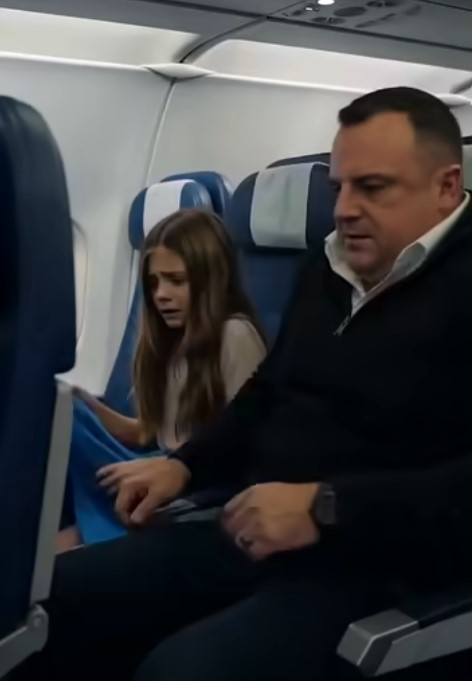
At first glance, there was nothing remarkable about the man and teenage girl seated several rows behind the wing.
The man, identified as Raymond, appeared calm and attentive. Beside him sat fourteen-year-old Maya, who seemed quiet and withdrawn. To everyone around them, they looked like family members traveling together.
No one gave them a second thought.
At least not initially.
One passenger, however, couldn’t ignore the uneasy feeling growing inside him.
Julian Ross had spent most of his life relying on observation in ways others rarely considered. Because of profound hearing loss, he had become exceptionally skilled at reading facial expressions, body language, and subtle changes in behavior. Years of depending on visual cues had taught him that people often reveal far more through actions than words.
As the flight progressed, something about the pair continued to catch his attention.
Maya rarely spoke.
When she did, her responses appeared brief and hesitant.
She avoided eye contact not only with other passengers but often with Raymond himself. Her shoulders remained tense, and she seemed unusually nervous whenever he leaned toward her.
Julian initially questioned his own instincts.
Travel was exhausting.
People flew while stressed, grieving, ill, or simply tired.
There were countless reasons someone might appear uncomfortable.
Still, he couldn’t shake the feeling that something wasn’t right.
A short time later, a flight attendant stopped by their row.
Julian watched as Raymond spoke confidently, explaining that Maya had recently gone through a difficult emotional period and wasn’t feeling particularly social. The explanation seemed reasonable enough, and the flight attendant moved on without concern.
But Maya’s expression lingered in Julian’s mind.
It wasn’t sadness he thought he saw.
It looked more like fear.
The hours passed slowly.
Cabin lights dimmed.
Many passengers drifted to sleep.
Julian remained awake.
Every time he glanced toward the pair, he noticed the same pattern. Maya remained quiet. Raymond remained watchful.
Then another passenger began paying attention.
Sarah Jenkins, a healthcare professional traveling home after a conference, happened to notice Maya as she walked back from the restroom.
Years of working with patients had taught Sarah to recognize signs of anxiety and emotional distress. While she knew appearances alone could be misleading, something about the teenager’s behavior concerned her.
She noticed how tightly Maya clasped her hands.
How her breathing seemed shallow.
How her eyes darted nervously whenever Raymond shifted in his seat.
Later, Sarah happened to exchange a brief glance with Julian.
Neither spoke.
Neither needed to.
Both seemed to recognize the same concern.
As the flight continued, another moment intensified their unease.
Raymond retrieved a prescription bottle and handed Maya medication.
The action itself wasn’t unusual. Thousands of travelers carried legitimate prescriptions.
What caught their attention was Maya’s reaction.
She hesitated.
Only briefly.
But long enough to notice.
Eventually, she took the medication.
Over the next hour, she appeared increasingly drowsy.
Her head drooped repeatedly before jerking awake again.
Julian found himself wrestling with uncertainty.
Was he imagining things?
Was he allowing concern to become suspicion?
Or was something genuinely wrong?
The possibility that he might ignore a person in need troubled him more than the possibility of being mistaken.
Finally, he made a decision.
Using a small notepad, he carefully wrote a message.
The note was simple.
“If you are okay, that’s fine. But if you need help, let someone know. You’re not alone.”
Finding the right opportunity required patience.
Eventually, during a moment when Raymond was distracted, the note reached Maya.
Julian watched nervously.
For several seconds, she stared at the paper.
Then she looked around the cabin.
Her eyes briefly met his.
What happened next sent a chill through him.
Instead of discarding the note or appearing confused, Maya held it tightly.
Very slowly, she nodded.
It was barely noticeable.
A tiny movement.
Yet it carried enormous weight.
Julian’s pulse quickened.
Sarah noticed the exchange as well.
At that point, concerns were quietly shared with cabin crew.
The flight attendants responded professionally and cautiously. They understood that assumptions could be dangerous, but so could ignoring warning signs.
Without causing alarm, they increased observation of the situation.
Throughout the remainder of the flight, crew members maintained discreet contact with both passengers while carefully documenting observations.
The atmosphere inside the cabin felt different now.
Most travelers remained unaware.
But for those involved, tension steadily grew.
Nobody knew exactly what was happening.
Nobody wanted to jump to conclusions.
Yet everyone understood the importance of taking concerns seriously.
As the aircraft began its descent, preparations quietly took place behind the scenes.
Information was relayed through appropriate channels.
Authorities were notified.
Medical personnel were placed on standby.
By the time the plane touched down, arrangements had already been made for further evaluation of the situation.
When the aircraft arrived at the gate, passengers expected the usual routine.
Seatbelts clicked open.
Overhead bins popped open.
People reached for luggage and checked their phones.
But near the aircraft door, officials were waiting.
Law enforcement officers and medical personnel boarded calmly and professionally.
What followed became the subject of extensive discussion among passengers and observers.
Authorities began speaking with those involved and evaluating the circumstances more closely.
As with any such situation, determining facts required investigation rather than speculation.
Witness observations alone could never provide a complete picture.
Only a thorough review could establish exactly what had occurred.
Yet regardless of the final findings, one aspect of the story resonated deeply with many people.
It wasn’t about dramatic heroics.
It wasn’t about certainty.
It was about paying attention.
Julian never claimed to know all the answers.
Sarah never assumed she understood the entire situation.
Instead, both acted on something simple but powerful: concern for another human being.
Their actions reflected an important reality of modern life.
Most people move through crowded airports, train stations, and public spaces focused on their own destinations. It is easy to overlook strangers.
Easy to assume someone else will notice if help is needed.
Easy to convince ourselves that what we’re seeing is probably nothing.
Sometimes that assumption is correct.
Sometimes there is an innocent explanation.
But occasionally, remaining observant can make all the difference.
The story serves as a reminder that awareness and empathy often work together. Responsible concern does not mean jumping to conclusions or making accusations. It means recognizing when something feels unusual and trusting trained professionals to evaluate the situation properly.
Whether traveling by plane, train, bus, or simply walking through daily life, small acts of attention matter.
A kind question.
A moment of observation.
A willingness to speak up when genuine concern exists.
Because sometimes the people who need help most are the ones suffering in silence.
And sometimes the difference between being overlooked and being noticed begins with a single person choosing to pay attention.