Few moments behind the wheel trigger anxiety as quickly as seeing flashing blue and red lights appear in your rearview mirror.
Your stomach tightens.
Your mind races through possibilities.
Was I speeding?
Did I miss a sign?
Is something wrong with my car?
Even if you’ve done nothing serious, being pulled over can feel unsettling. The uncertainty, the flashing lights, and the unfamiliar interaction combine to create stress for nearly everyone involved.
What many drivers don’t realize is that, by the time you stop your vehicle, the traffic stop has already begun.
Long before the officer reaches your window, a series of decisions has already taken place.
The officer has likely checked your license plate through law enforcement databases, gathering information about the registered vehicle. They’ve selected a location where both vehicles can stop with the least possible risk to passing traffic whenever circumstances allow. They’ve also notified dispatch of the stop, providing details about the vehicle and location so someone knows where they are and who they’re speaking with.
These steps aren’t performed because every driver is suspected of something dangerous.
They’re standard safety procedures.
Every traffic stop begins with uncertainty.
The officer doesn’t yet know whether they’re about to issue a simple warning, investigate a more serious offense, assist someone in distress, or encounter an unpredictable situation. Preparing for every possibility helps everyone involved remain safer.
Even the position of the patrol vehicle is intentional.
Rather than stopping directly behind the driver’s car, officers often park slightly offset. This creates a protective buffer between the roadway and the area where they’ll be standing. On many roads, the patrol car itself becomes a barrier that helps reduce the danger posed by passing traffic.
Likewise, emergency lights serve more than one purpose.
They signal the driver to stop, but they also warn approaching motorists that people are outside their vehicles ahead. Many officers are injured each year by inattentive drivers striking stopped vehicles during roadside encounters, making visibility an essential part of every stop.
As the officer approaches, drivers often notice additional actions that seem mysterious at first.
A bright spotlight may illuminate the interior of the vehicle.
The officer may pause briefly before reaching the window.
They may stand slightly behind the driver’s door instead of directly beside it.
These practices generally have practical safety purposes. A spotlight improves visibility inside the vehicle during nighttime stops, helping the officer see occupants and movements more clearly. Standing slightly behind the driver’s window can reduce exposure to passing traffic while providing a wider view of the vehicle’s interior.
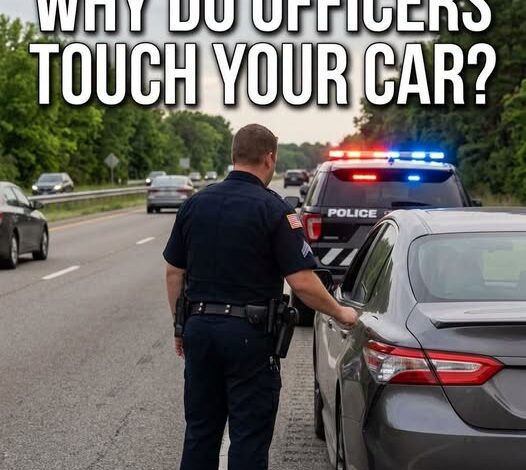
Some people have heard that officers routinely tap the rear of a vehicle during every stop.
While that practice has existed in some departments historically, it is not universal today. Procedures vary widely between agencies, and many officers no longer do so because dashboard cameras, body cameras, and other technology now document encounters in ways that older practices once attempted to accomplish.
Although the specific techniques may differ, the underlying goal remains remarkably consistent.
Reduce uncertainty.
Increase safety.
Complete the interaction peacefully.
Drivers also play an important role in making that happen.
Once you notice emergency lights behind you, slow down safely and look for an appropriate place to pull over. If possible, choose a location with enough room for both vehicles and away from fast-moving traffic. Activate your turn signal to indicate you recognize the officer and intend to stop.
After stopping, remain inside your vehicle unless instructed otherwise.
Turn off the engine if appropriate.
Keep your hands visible, ideally on the steering wheel, especially if the officer has not yet reached your window.
If you need to retrieve your driver’s license, registration, or proof of insurance, it’s often helpful to wait until asked before reaching into compartments or bags. If your documents are located somewhere that requires significant movement, simply tell the officer where they are before retrieving them.
Clear communication goes a long way.
Simple statements like, “My registration is in the glove compartment,” or, “My wallet is in my back pocket,” help avoid misunderstandings and allow everyone to know what movements to expect.
Most traffic stops conclude without incident.
Many end with a warning.
Others result in a citation.
Occasionally, an officer provides assistance unrelated to enforcement, helping with a flat tire, a mechanical problem, or a driver who needs directions or medical help.
While no one enjoys being stopped, understanding the process can remove much of the mystery surrounding it.
What may feel like an intimidating series of actions is usually the product of established procedures designed to reduce risk during encounters that begin with very little information.
At its core, a traffic stop is not meant to be a confrontation.
It is a structured interaction with a clear objective: resolve the reason for the stop as safely and efficiently as possible.
When both people understand their roles—one following established procedures, the other responding calmly and communicating clearly—the encounter is far more likely to remain routine.
In the end, the flashing lights, the careful positioning of vehicles, the measured approach, and the visible hands are not signs that anyone expects the worst.
They are precautions intended to help ensure something much more ordinary happens.
A brief conversation.
A safe conclusion.
And two people who continue on with the rest of their day.