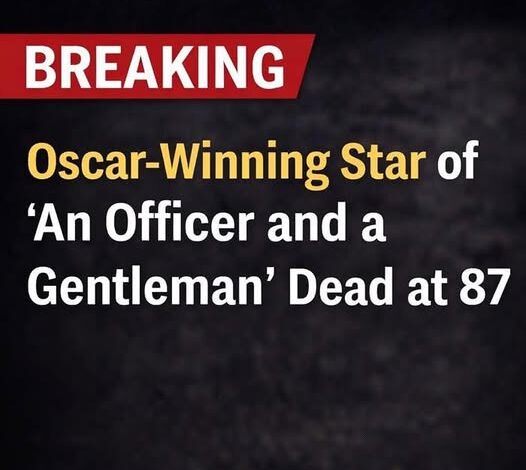
Louis Gossett Jr.’s death at eighty-seven feels less like the loss of a single actor and more like the closing of an era shaped by persistence, dignity, and hard-won breakthroughs. Long before he became an Oscar winner, a television icon, or one of the most respected performers of his generation, he was simply a boy growing up in Brooklyn who discovered that stepping onto a stage could change the way the world saw him — and eventually, the way America saw itself.
Born in 1936, Gossett entered the world during a period when opportunities for Black artists in mainstream American entertainment were painfully narrow. Hollywood often reduced Black performers to stereotypes, background roles, or caricatures designed to reassure white audiences rather than challenge them. Even talented actors found themselves fighting constantly against invisibility or humiliation. Yet from an early age, Gossett carried something impossible to ignore:
presence.
Teachers and classmates recognized it before the broader public ever did. As a teenager, he stepped into acting almost accidentally after being encouraged to audition for a school production while recovering from a sports injury. What might have remained a temporary distraction instead became the beginning of a lifelong calling. On stage, he discovered not only confidence but power — the ability to command attention through truth, emotion, and intelligence in a society that often tried denying Black men all three.
That gift carried him quickly toward Broadway.
Still barely out of high school, Gossett appeared in productions during a transformative moment in American theater, when Black artists increasingly fought to tell stories rooted in real experience rather than sanitized fantasy. One of the most important milestones came with A Raisin in the Sun, Lorraine Hansberry’s groundbreaking play about a Black family confronting dreams, racism, poverty, and dignity in postwar America.
The production itself became historic.
It forced mainstream audiences to confront Black interior lives with emotional complexity rarely allowed on major stages before. Gossett’s involvement connected him immediately to a generation of artists determined not merely to entertain America, but to confront it.
That distinction defined much of his career afterward.
Because Louis Gossett Jr. rarely approached acting as decorative performance. He understood storytelling as memory work — a way to preserve histories, expose injustice, and humanize experiences society often preferred ignoring. Whether on stage, television, or film, he brought emotional seriousness to characters who could have easily been flattened into archetypes by lesser performers.
Then came Roots.
When the landmark television miniseries aired in 1977, it transformed American culture almost overnight. Millions of viewers sat down expecting entertainment and instead found themselves confronting generations of slavery, brutality, family separation, and racial trauma presented with unprecedented emotional force for mainstream television.
Gossett’s performance stood among the series’ emotional anchors.
What made Roots revolutionary was not simply its historical subject matter, but the humanity it insisted upon. Characters were no longer abstract symbols buried inside textbooks. They were frightened, loving, furious, resilient human beings carrying impossible histories inside their bodies. Gossett understood exactly how much responsibility that required. He played his roles with gravity because he knew the stories themselves carried weight beyond television ratings.
For many Black viewers, Roots validated histories long minimized or softened publicly.
For many white viewers, it shattered comfortable distance from America’s racial past.
Gossett became one of the artists helping force that reckoning into living rooms across the country.
And yet, despite critical acclaim and extraordinary talent, Hollywood still struggled to fully recognize him.
That changed permanently in 1982 with An Officer and a Gentleman.
His portrayal of Marine drill instructor Emil Foley remains one of the most unforgettable performances in modern American cinema — not simply because it was commanding, but because it balanced ferocity with emotional depth in ways audiences rarely expected. Foley was intimidating, disciplined, demanding, and psychologically relentless. Yet beneath the harsh exterior lived disappointment, sacrifice, loneliness, and profound understanding of weakness.
Gossett infused the role with authority so complete that viewers immediately believed every scene he entered belonged to him.
When he won the Academy Award for Best Supporting Actor, the moment carried significance far beyond personal triumph. He became the first Black man to win in that category, breaking through barriers that had excluded generations of extraordinary performers before him.
But Gossett himself understood the complexity of being “first.”
In later interviews, he often spoke honestly about the burden attached to pioneering success. Being first rarely means arriving inside equality. It means entering systems still resistant to your presence while carrying pressure not to fail publicly because entire communities become symbolically attached to your performance.
He understood that one Oscar did not magically erase structural racism inside Hollywood.
Doors opened slowly.
Roles remained limited.
Stereotypes persisted.
Yet his victory cracked something undeniable open.
Young Black actors watching him accept that award could now physically see a possibility many industries had long implied did not exist for them.
Representation matters not because symbolism alone changes reality, but because seeing someone survive barriers reshapes imagination itself.
And Gossett never treated his visibility casually.
Offscreen, he spoke openly for decades about racism within entertainment and American society more broadly. He described humiliations he endured even after becoming famous:
being stopped repeatedly by police,
facing discrimination in hotels,
navigating industries where Black performers often worked harder for less recognition.
His honesty mattered because he refused the comforting myth that success automatically protects marginalized people from prejudice.
At the same time, Gossett also faced enormous personal battles beyond racism.
Throughout his later years, he spoke candidly about health struggles, including prostate cancer and chronic illnesses that forced him to confront mortality repeatedly. Yet even those conversations reflected the same dignity defining his career. He approached illness without self-pity, discussing vulnerability openly while encouraging others — especially Black men — to prioritize health screenings and medical care despite cultural stigma surrounding weakness or fear.
That openness deepened public respect for him further.
Because Louis Gossett Jr. never seemed interested in pretending strength meant invulnerability.
Instead, he embodied another kind of strength:
endurance.
The endurance required to survive industries not designed for your success.
The endurance required to remain emotionally open after decades confronting injustice.
The endurance required to keep creating meaningful work while carrying the symbolic weight of representation constantly.
By the time younger generations discovered him through later television appearances and films, Gossett had already become something larger than celebrity.
He was institutional memory.
A living bridge connecting modern Hollywood to earlier eras where Black performers fought simply to exist onscreen with dignity intact.
His passing now leaves a noticeable absence because figures like Gossett cannot be replaced easily. Talent alone is never enough to create a legacy that enduring. It requires historical timing, moral seriousness, resilience, and the willingness to challenge audiences rather than merely entertain them.
Hollywood often celebrates rebellion retroactively once it becomes safe.
Gossett lived through periods when speaking openly carried actual professional risk.
And still, he persisted.
That persistence echoes through the careers of countless actors who followed him. Every Black performer now stepping into leading roles, prestige dramas, award campaigns, and historically restricted spaces walks through doors Louis Gossett Jr. helped force open with discipline and brilliance decades earlier.
Some of those doors opened quietly.
Others he kicked down himself.
But all of them required cost.
Now, with his death, audiences are left not only with memories of iconic performances, but with the deeper recognition that artists like Gossett altered American culture permanently. Through characters, interviews, activism, and sheer endurance, he insisted Black stories deserved seriousness, complexity, and visibility equal to anyone else’s.
And perhaps that is why his legacy feels so large now.
Because Louis Gossett Jr. did more than succeed individually.
He expanded what America was willing to see —
and who future generations could imagine themselves becoming once they stepped into the light he fought so hard to reach.