For years, Halloween was Salena Webb’s favorite time of the year.
The moment October arrived, her creativity seemed to come alive.
While many people decorated with a few pumpkins or strings of orange lights, Salena transformed her entire front yard into something unforgettable. Neighbors looked forward to it. Children talked about it for weeks. Families drove through the neighborhood just to see what she had created.
What began as a simple hobby had gradually become a beloved local tradition.
Every year, Salena spent countless hours planning her display.
She sketched ideas on notepads.
Browsed stores for new decorations.
Repaired old props.
Experimented with lighting and placement until everything felt perfect.
To her, Halloween wasn’t about frightening people.
It was about creating wonder.
Her front yard became a stage where imagination took center stage.
Skeletons appeared to climb out of the ground.
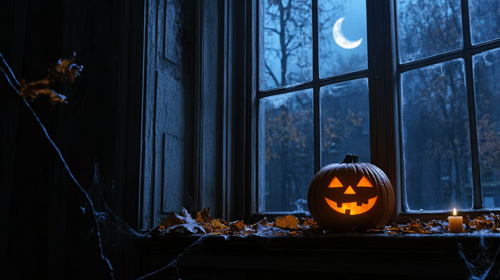
Fog drifted across pathways after sunset.
Old-fashioned tombstones lined the lawn beneath flickering lights.
There were faux coffins, spooky signs, cobwebs stretched between trees, and carefully arranged scenes that balanced humor and mystery.
The display wasn’t meant to be dark or disturbing.
It was playful.
Creative.
Fun.
Children laughed as they pointed at skeletons posed in silly situations. Parents stopped to take photographs. Neighbors lingered on evening walks, admiring the effort she put into every detail.
Salena loved watching those reactions.
For her, the decorations weren’t just decorations.
They were a way to bring people together.
A way to create memories.
A way to share joy.
What she never imagined was that one day those same decorations would become the center of a deeply personal conversation.
And a lesson she would never forget.
One afternoon, as she was making adjustments to her display, a neighbor approached her.
He looked nervous.
Almost hesitant.
Salena immediately sensed that something serious was on his mind.
After exchanging greetings, he explained why he had come.
His father had recently been diagnosed with cancer.
The diagnosis had changed everything for their family.
Medical appointments filled their schedules.
Uncertainty hung over every conversation.
Fear had quietly settled into their daily lives.
The man explained that his father often sat near the front window, looking outside throughout the day.
And lately, the Halloween display had become difficult for him to see.
The tombstones.
The coffins.
The skeletons.
Images that were intended as harmless holiday decorations now served as constant reminders of mortality during one of the most frightening periods of his life.
The neighbor wasn’t angry.
He wasn’t demanding anything.
He wasn’t asking Salena to cancel Halloween.
He simply wondered if there was any way she might consider making some adjustments.
Even small ones.
Just enough to make things easier for his father.
For a moment, Salena didn’t know what to say.
The request caught her completely off guard.
She looked across her yard at the display she had spent weeks creating.
The display she loved.
The display that had become a tradition.
Part of her felt disappointed.
The thought of dismantling sections of it hurt.
She had invested so much time and effort.
So much excitement.
But as she listened to her neighbor speak, another feeling slowly replaced the disappointment.
Perspective.
She imagined what his father must be experiencing.
The fear.
The uncertainty.
The emotional exhaustion.
Suddenly, the decorations looked different.
Not because they had changed.
Because her understanding had.
That evening, Salena sat quietly and thought about the conversation.
She could have said no.
The decorations were on her property.
She wasn’t breaking any rules.
Most people loved the display.
Yet the more she reflected, the more one simple truth became clear.
Halloween would come again next year.
And the year after that.
And the year after that.
But opportunities to ease someone’s pain don’t always return.
The next morning, she made her decision.
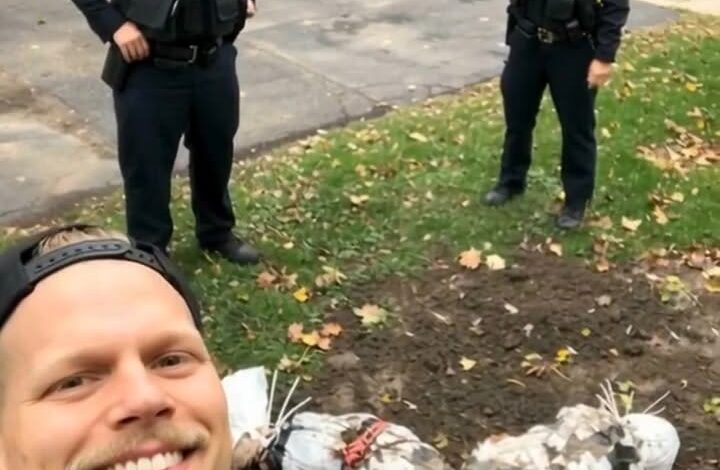
Without hesitation, she began taking down the graveyard section of the display.
The tombstones disappeared first.
Then the coffins.
Then the skeletons that had been posed among them.
Piece by piece, the display changed.
It wasn’t easy.
Every decoration represented hours of work.
But surprisingly, she didn’t feel resentment.
She felt peace.
Because she knew exactly why she was doing it.
This wasn’t about giving something up.
It was about giving someone comfort.
A few days later, Salena decided to share the story online.
Not because she wanted recognition.
Not because she expected praise.
She simply wanted to explain why the display looked different this year.
Sitting in front of her camera, she calmly described the conversation with her neighbor and the decision she had made afterward.
“There will always be another Halloween,” she explained.
“But helping someone when they need kindness matters more.”
She posted the video and went about her day.
She expected a few friends and neighbors might watch it.
Instead, millions of people did.
The video spread rapidly across social media.
Views climbed into the hundreds of thousands.
Then millions.
Comments flooded in from around the country.
People were moved by the story.
Not because it involved Halloween decorations.
Because it involved empathy.
Many viewers shared stories of their own.
Stories about neighbors who helped during difficult times.
Stories about small acts of kindness that made enormous differences.
Others admitted the video challenged them to think differently about how their choices affect those around them.
Again and again, people returned to the same message:
Compassion costs less than conflict.
The response overwhelmed Salena.
But she wasn’t finished finding ways to help.
Instead of abandoning Halloween entirely, she got creative.
The skeletons remained.
Only now they weren’t standing in graveyards.
Some played badminton.
Others appeared to be gardening.
A few were arranged in humorous scenes that made children laugh rather than shiver.
The display retained its festive spirit.
Just in a different form.
The transformation became another lesson.
Kindness doesn’t require giving up what you love.
Sometimes it simply asks you to adapt.
To be flexible.
To consider someone else’s perspective.
The most meaningful moment came several days later.
Salena visited her neighbor’s family personally.
She brought balloons.
A handwritten note.
And words of encouragement.
The gesture was simple.
Yet when she handed them over, emotions filled the room.
The family thanked her repeatedly.
Not just for changing the decorations.
For understanding.
For listening.
For caring.
What could have become an argument became a friendship.
What could have created division created connection.
As the weeks passed, the story continued to spread.
People debated why it resonated so deeply.
Perhaps because examples of empathy often feel rare.
Perhaps because modern life sometimes encourages people to defend their own interests before considering others.
Or perhaps because everyone understands, on some level, what it feels like to be struggling silently.
And everyone hopes someone will notice.
Salena’s story wasn’t really about Halloween.
It wasn’t about skeletons.
Or decorations.
Or social media.
It was about recognizing another person’s pain and deciding it mattered.
That choice changed everything.
It eased the burden of a family facing an unimaginable challenge.
It strengthened relationships within a neighborhood.
It inspired millions of strangers.
And it reminded people of something surprisingly simple.
Kindness doesn’t always require grand sacrifices.
Sometimes it begins with listening.
Sometimes it begins with understanding.
Sometimes it begins with being willing to change a plan for the sake of someone else’s peace of mind.
Years from now, many people probably won’t remember exactly what decorations stood in Salena Webb’s yard.
But they’ll remember what she chose.
Empathy over pride.
Compassion over convenience.
People over things.
And that lesson will last far longer than any Halloween display ever could.
Because while decorations fade, kindness leaves a mark that remains long after the season has passed.